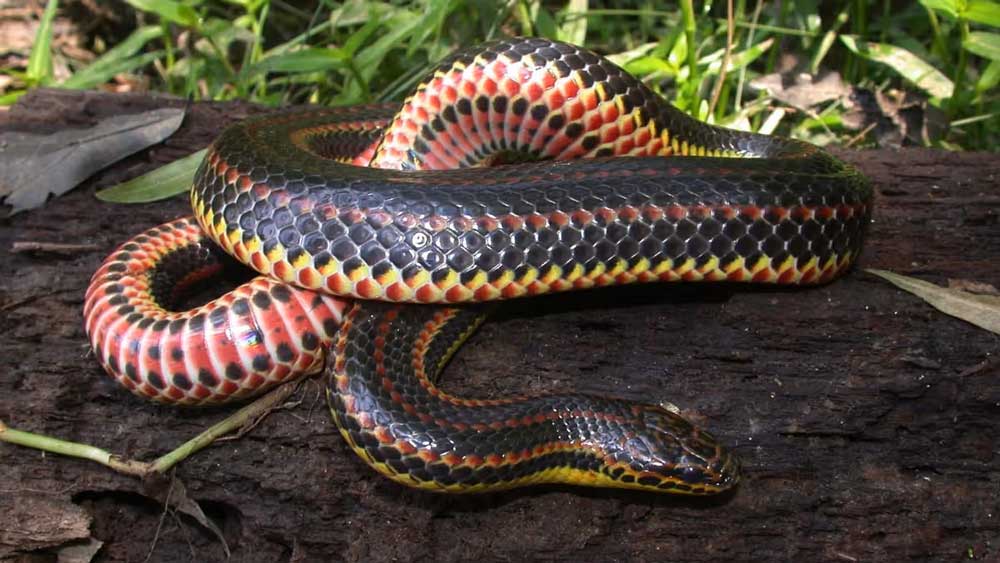
The state is asking people who see rainbow snakes in the wild to report their sightings at the NC Wildlife Rainbow Snake reporting page.
If you’re in the state of North Carolina, or are going to be herping in the state, the North Carolina Wildlife Resources Commission wants the public to know that it is seeking sightings of the non-venomous rainbow snake (Farancia erytrogramma), a species whose population the state says is declining.
Wildlife Resources Commission biologists are asking the public to report their sightings of this elusive species so they can assess where the populations are strong and where they are not so they can formulate plans for future monitoring and conservation efforts.
The commission says that the snake is found only in the Coastal Plain and Sandhill regions of the state, in and around moving waterways. They are becoming increasingly rare due to the decline of their primary prey item, the American eel (Anguilla rostrata). The eel is declining due to pollution, parasites and disease, dams and other barriers, as well as habitat loss and degradation as well as fishing for export to Asia as pets.
Rainbow Snake Seen In Florida’s Ocala National Forest For First Time Since 1969
Rainbow Snake Information
The rainbow snake, also known as the eel moccasin, is a non-venomous colubrid snake that is primarily aquatic and feeds on eels, frogs, tadpoles and other amphibians. In addition to being a strong swimmer, the reptile is a proficient burrower as well. It grows to about 36-48 inches (91–122 cm) in length, with larger specimens reaching up to 66 inches (168 cm). They are said to inhabit tidal mud flats, creeks, lakes and marshes.
A subspecies, the south Florida rainbow snake (Farancia erytrogramma seminola), was declared extinct in 2011. It inhabited the Fisheating Creek in Glades County, which is more than 150 miles south of the nearest known population in Lake County, Florida. The last documented sighting of that subspecies occurred in 1952.
If you see a rainbow snake when out herping, please visit the NC Wildlife Rainbow Snake reporting page here.