
Borneo lies deep in the heart of the Indo-Malay Archipelago. It is the world’s third-largest island, and its massive expanse of ancient rainforest pre
Borneo lies deep in the heart of the Indo-Malay Archipelago. It is the world’s third-largest island, and its massive expanse of ancient rainforest predates many of the species it protects. It is divided among three nations: Malaysia, Indonesia, and the small sultanate of Brunei. The island’s landscape is home to an astounding array of biodiversity, hidden within its distinct ecoregions. From the giant dipterocarp trees to the stunted growth of the highland forests, unique life abounds. The island ranks as one of the top three on Earth for the total volume of endemic species. While Borneo is famous for its iconic mammals like orangutans and pygmy elephants, it is also a herpetological utopia. More than a third of all reptile species and nearly every amphibian on the island are found nowhere else on Earth.
Borneo has fast become a global hotbed for herpers and the government is moving quickly to capitalize on the influx. As of 2023, the Sabah Parks governing body more than tripled the international entry fees. Furthermore, all herpers entering the main parks are now strictly required to hire a licensed guide, ending the era of solo exploration in both the highland and lowland forests. This was unwelcome news while planning our itinerary. To make matters worse, our guide warned me that it was the dry season and snakes are notoriously difficult to find at this time of the year. Despite the hurdles, I finalized our plans and purchased our airline tickets. We were all in, and there was no turning back now.
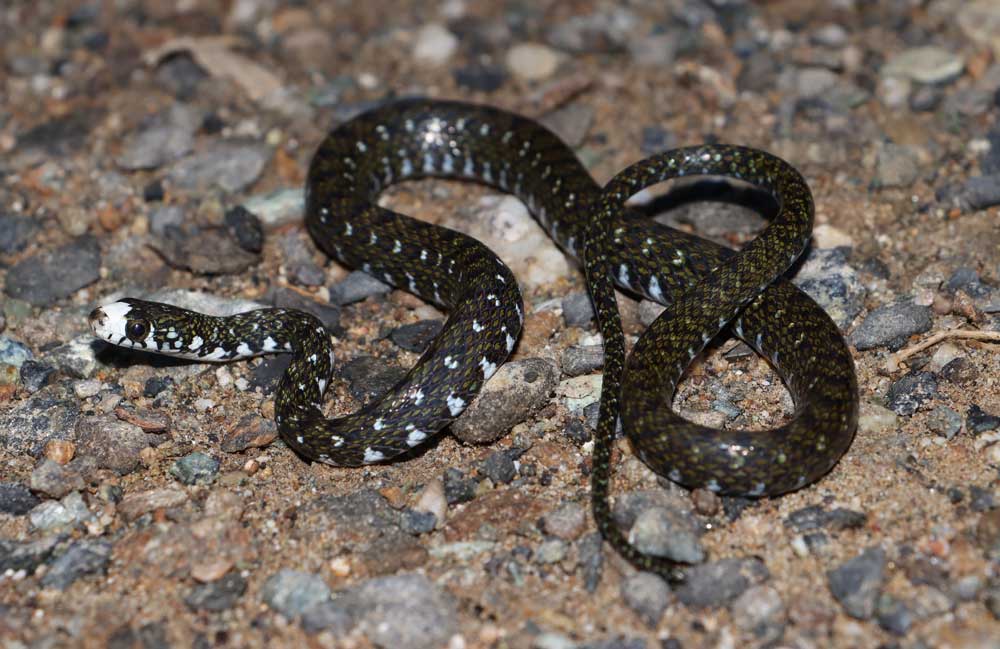
White fronted keelback (Hebius flavifrons). Photo by Dave Dinasio
We boarded our first of three flights and set off on the grueling 23-hour journey to our destination. Our first stop was San Francisco and then it was on to the Changi Airport in Singapore. The following morning, we hopped on an AirAsia flight that would take us to the state capital of Sabah in Borneo.
The sky was clear and as our plane made its final approach into the Kota Kinabalu airport, I had a perfect view of the mountains that sprung up behind a seemingly endless rainforest. A few minutes later we were on the ground. We passed through customs and that familiar sound of the agent stamping my passport meant that we were finally free to explore. Borneo! We rented a car and began the 2.5-hour drive to the town of Ranau, which is situated between the lower foothills and montane highland forest.
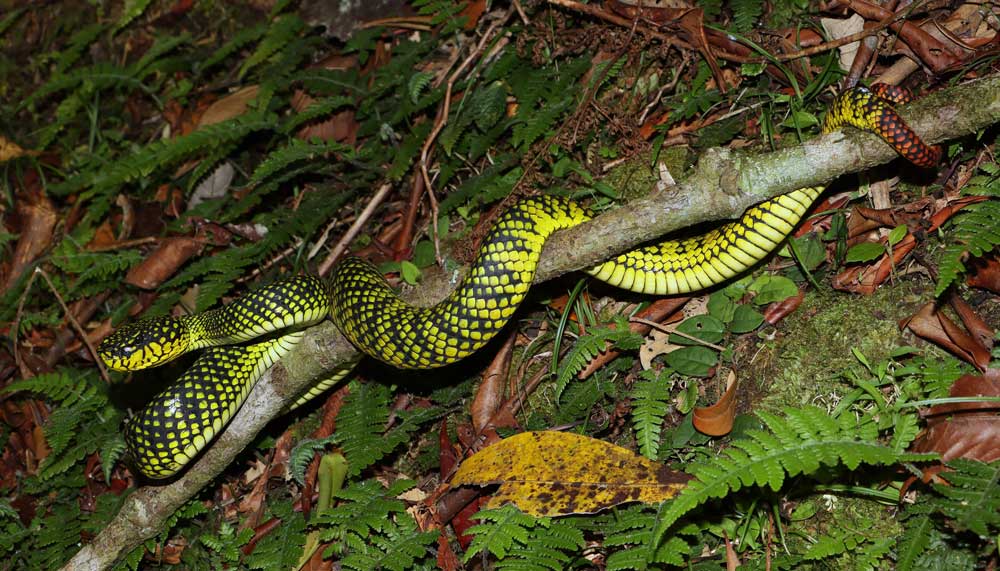
Malcolm’s pit viper (Trimeresurus malcolmi). Photo by Dave Dinasio
Dominating the horizon ahead of us was the Crocker Mountain Range, which stretches across the West Coast of Sabah with its most famous landmark, Mt. Kinabalu clearly visible in the distance. Unfortunately, I could not enjoy the scenery; I was behind the wheel, undergoing a trial-by-fire lesson in driving on the left side of the road. Despite the initial terror of managing steep hairpin turns through narrow mountainous roads, I got us to our Airbnb safely. We were now only hours away from our first night in the field.
Day 1 Herping the Montane Forest of Kinabalu Park
We arrived at Kinabalu Park at 7:40 p.m. After securing our park permits, we met our guide Maron, geared up, and began our ascent along the winding forest road. Starting at an elevation of 5,100 feet, our plan was to hike another 1,000 feet up into the montane cloud forest, scouring the ground and tree canopy for any sign of the park’s high-altitude herp species. Strangely, the “standard” rules for reptile activity are flipped in the park; these montane species have adapted to thrive in much cooler, high humidity environments. Even so, with the temperature hovering at 54°F, my brain kept telling me that it was far too cold for snakes to be on the move. I would soon find out how wrong I was.
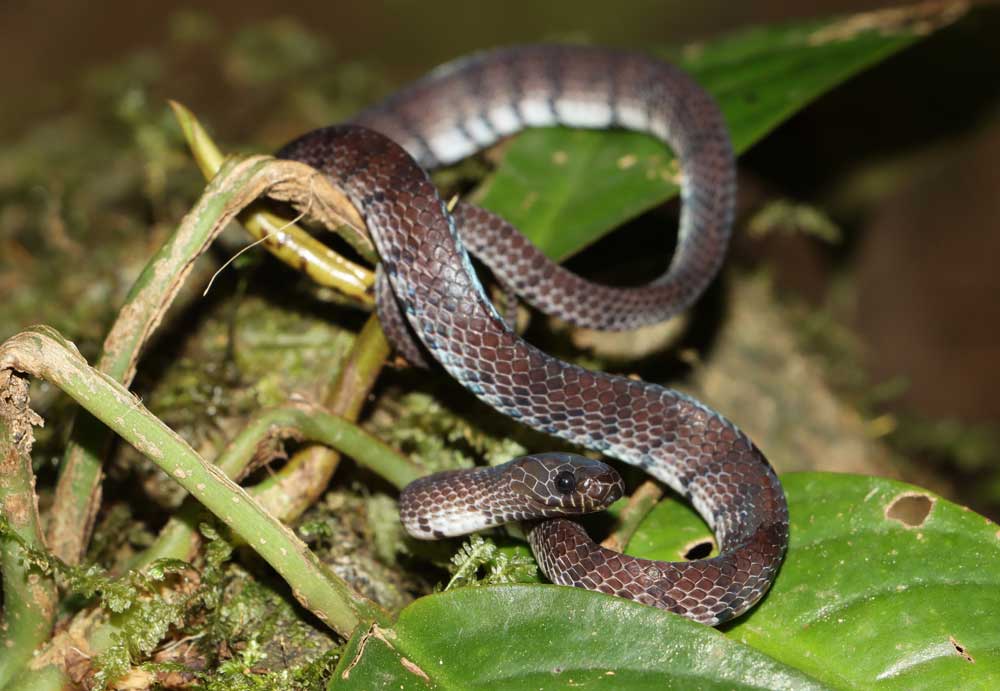
Smooth slug snake (Asthenodipsas laevis). Photo by Dave Dinasio
Our four-person team split up into pairs; Neil and I worked the right side of the forest road, while Danny and Evan covered the left. Maron walked about 20 yards ahead of us. I had just done a radio check to ensure the equipment was working properly when Maron’s voice cut through the static: “Malcolm’s!” I looked up to see his light aimed 20 feet into the tree canopy. Coiled motionless on a thin branch was a stunning adult, female Malcolm’s pit viper (Trimeresurus malcolmi), our main target and the crown jewel of Asian venomous snakes!
I couldn’t believe my eyes. It wasn’t supposed to be this easy. Everything I’d heard and read led me to believe that encountering this rare, endemic species, especially in these less-than-perfect conditions, was highly unlikely if not impossible. The once quiet forest quickly erupted into a frenzy of deafening cheers. Danny excitingly exclaimed, “We can go home now, this just made my year!” It felt like we were herping backwards. There was no build-up, no finding any of the common species before finding our target. This was it, we did it, we achieved our goal 20 minutes into our first night herping and the feeling was incredible!
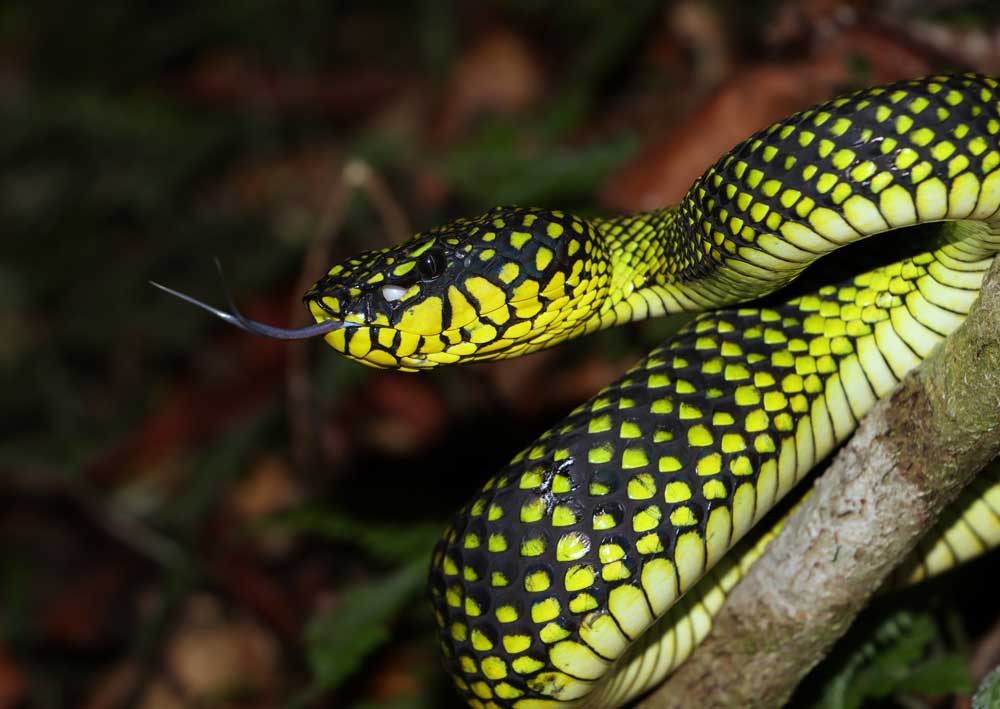
Malcolm’s pit viper (Trimeresurus malcolmi). Photo by Dave Dinasio
Once the adrenaline rush wore off, the problem became clear: we had a world-class snake, resting at an unreachable height. It was too high for quality photos and too rare to risk losing to the canopy. We took a moment to collect our thoughts and before I could even ponder our next move, I saw Maron walking out of the forest with a 15-foot bamboo pole. I smiled, knowing exactly what he had in mind.
Luck was on our side. There was a short section of guardrail that ran along the road, below the branch where the pit viper was resting. Danny stood atop the rail, bamboo pole in his grip; I held Danny’s left leg, Maron his right. The end of the stick barely reached the snake. There were only two scenarios that could play out: the snake was either going to disappear up and out of reach or it was going to slither onto the bamboo.
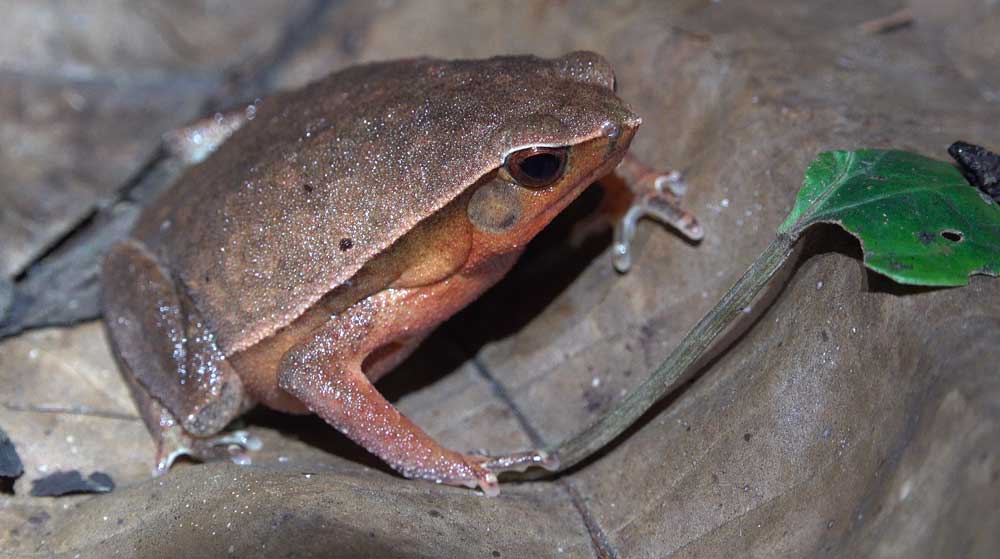
Kinabalu sticky frog (Kalophrynus baluensis). Photo by Dave Dinasio
It seemed nothing could go wrong. After a few attempts, the snake moved onto the pole, and we were able to safely bring it to the ground. We were all in a collective state of euphoria, as the reality of what we just accomplished began to sink in. We eagerly photographed the snake before releasing it into the same tree where it was found. It eventually made its way back to the exact branch it was initially perched on, as if it had never been disturbed.
Danny would later find a second Malcolm’s pit viper—another female—and this one was considerably larger than the first. I’m not sure how he managed to see it through the dense vegetation, but something caught his eye in the low branches, and his instincts told him to investigate further. He pushed aside the tangle of leaves with his snake hook, exposing the hidden serpent! Its head was massive and distinct from the neck, a clear indicator of the snake’s impressive venom capacity.
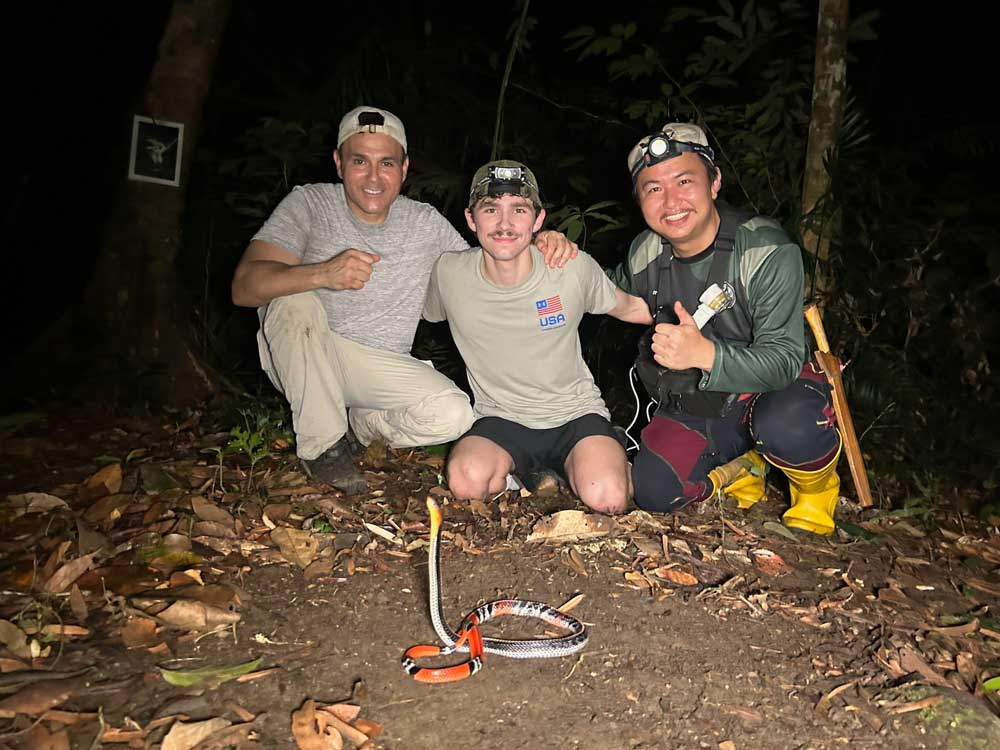
The author with Danny Dinaso and guide Maron with a Kinabalu krait (Bungarus flaviceps baluensis). Photo by Dave Dinasio
Maron had gone ahead of us, returning a short while later, holding in his hand our first colubrid snake of the trip, a magnificent Inger’s slug snake (Asthenodipsas ingerii). Its body had a pinkish hue with jagged stripes that ran down from its neck to its tail. Since this species is typically only seen during or after a heavy downpour, finding one felt like yet another unusual stroke of good fortune.
Maron and I decided to split from the group and drive to a slightly higher elevation. As we rounded a curve, our headlights caught a fleeting glimpse of movement along the side of the road. We stopped the car and searched the area to see if we could find the unidentified critter. After scanning the ground for a few seconds, I saw something move, the mystery was solved. Sitting in the leaf litter was a Kobayashi’s horned frog (Pelobatrachus kobayashii), one of the oddest amphibians I’ve ever seen. The endemic frog had large, bulging eyes adorned with prominent horns. It was incredibly well camouflaged; if we hadn’t startled it, causing it to jump, we likely never would have spotted it.
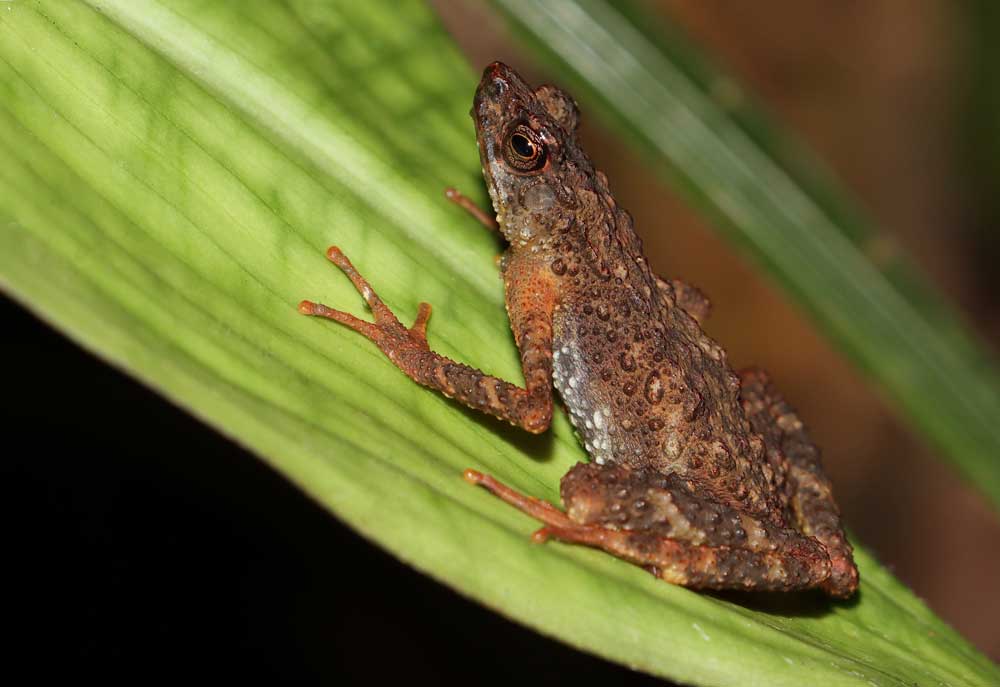
Kinabalu slender toad (Ansonia hanitschi). Photo by Dave Dinasio
Several more hours would pass, and the late-night fatigue was starting to set in. I was walking just to Neil’s right when he suddenly put his arm out, shouting, “Snake!” I froze as he reached down to retrieve our third snake species of the night: a Schmidt’s reed snake (Calamaria schmidti). It was a great spot by Neil. His sharp eyes likely prevented one of us from stepping on it. Although it was small with no obvious markings, it was anything but plain. The moment our light hit the snake, its scales refracted the light, causing its entire body to radiate a brilliant kaleidoscope of iridescent colors.
That would be our last find of the night. We said our good-byes to Maron and headed back to our place in Ranau. A well-deserved night’s rest awaited us!
Day 2 Back to the Montane Forest of Kinabalu Park
We returned to Kinabalu Park to begin our second night of herping. Our expectations were to find some of the more common species that inhabit the park. Maron had spotted at least a half dozen Sabah pit vipers the previous week and we were somewhat surprised that we had not seen one the first night. We agreed that we should once again split up to give us the best chance of success. I jumped in Maron’s truck, and we drove up to the highest point on the road. We parked and began hiking back down where we planned to meet the others at the mid-way point.
An hour had passed before a radio call from Danny broke the silence, alerting me that Evan had found a snake on the road. Maron identified it as a Griswold’s reed snake (Calamaria griswoldi). It was larger and more colorful than the Schmidt’s reed snake—and surprisingly defensive. The body was a vibrant, bright yellow, patterned with bold, dark markings. Maron explained that while the species isn’t necessarily rare, it is uncommon and not often seen.
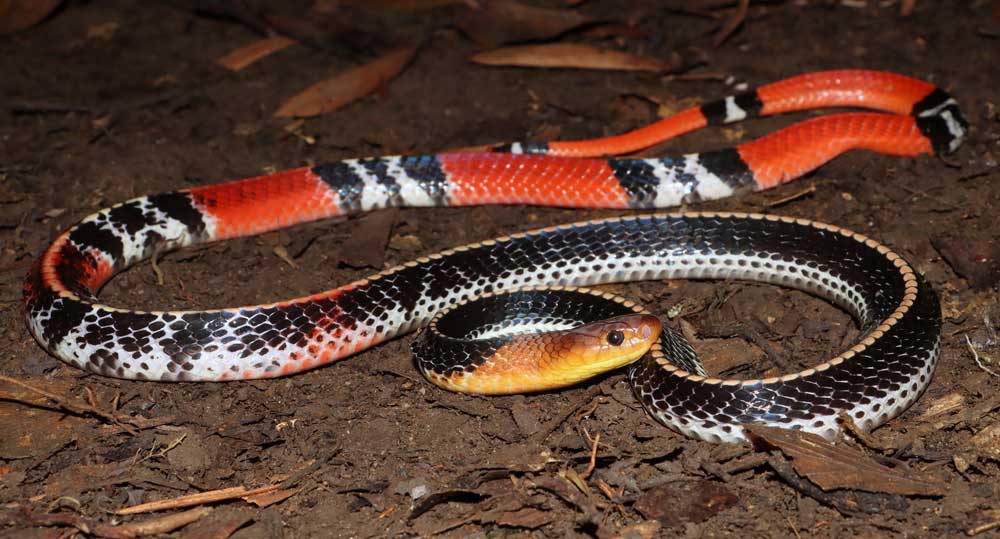
Kinabalu krait (Bungarus flaviceps baluensis). Photo by Dave Dinasio
We continued to scan the tree canopy with our lights until we saw the silhouette of a snake. Believing it to be a Sabah pit viper, we were surprised to find that it was another Malcolm’s pit viper, a smaller juvenile. This was the first time in Maron’s 15-year career as a guide that any group encountered three Malcolm’s pit vipers in a single 24-hour period. Many herpers travel from afar to search for this snake, and many return disappointed. We may not have spotted a Sabah pit viper, but no one was going to complain about finding a third Malcolm’s pit viper, arguably the most highly sought-after snake on the Asian continent!
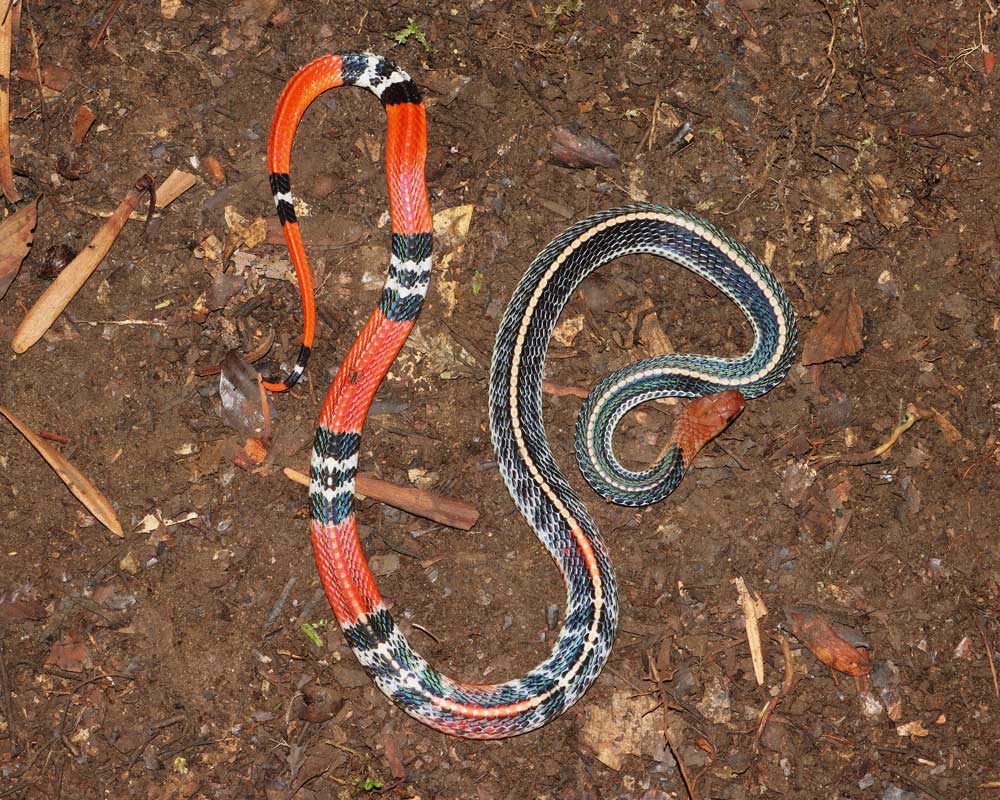
Kinabalu krait (Bungarus flaviceps baluensis). Photo by Dave Dinasio
Aside from finding a few small frogs, including a Kinabalu slender toad, the night ended uneventfully. Still, it was a major success in that we added another endemic snake to our species total. The following morning, Maron informed us that something unexpected had come up and he wouldn’t be able to meet with us that evening. Just like that, day three was a wash; we would have to wait until day four to pick up where we left off.
Day 4 Herping the Lower Foothills
I would describe herping in the highlands as quality over quantity. Finding one or two species a night is considered exceptional. It’s difficult to turn up species but when you do, it’s usually something rare and desirable. The lowlands, however, are a completely different story. Down here, it’s all about diversity and sheer numbers.
The lowland forest is positioned on the southeastern boundary of the park at a much lower elevation, dropping down to roughly 1,500 feet above sea level. For this reason, the ecology shifts dramatically. The habitat is dominated by enormous dipterocarp trees, thick jungle canopy, and giant bamboo. Afternoon herping in the lowlands can be summed up in one word–futile! Only the most heat tolerant reptiles can withstand the unbearable mix of heat and humidity that make sitting in a sauna feel like a walk-in freezer. Even then, they must utilize every bit of shade to keep from overheating. Between noon and 4:00 p.m. it’s like the entire forest is on lockdown. This felt more like the jungle we had anticipated before our arrival, in stark contrast to the chilly montane forest that we had recently left behind.
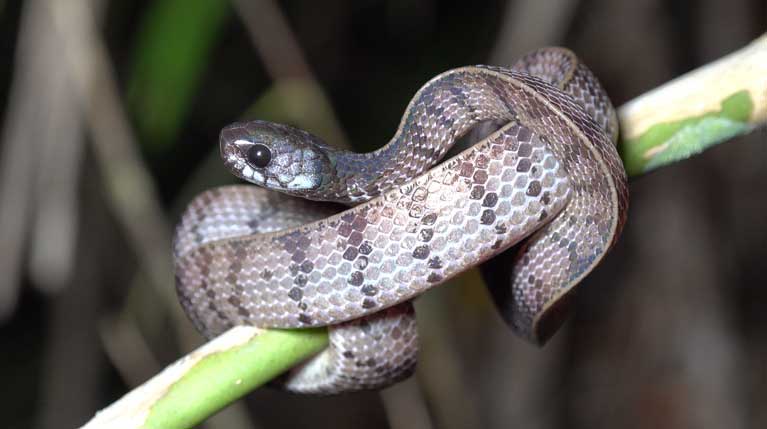
Inger’s slug snake (Asthenodipsis ingeri). Photo by Dave Dinasio
It was just after 5:30 p.m. and the midday heat had finally subsided. With a few hours to kill before our tour, we decided to do some road cruising. Up ahead, a small creek cut across the road, so we stopped to have a look around. We were wading in the shallow water when Danny noticed a small snake swimming a few feet ahead. He raced over, scooped it up and brought it back to the road. A quick look at the field guide confirmed it: an endemic white-fronted keelback (Hebius flavifrons). What a beauty! With its white tipped snout and olive-green body, decorated with several rows of small white spots, you honestly could not have painted a snake to look any prettier.
We knew nothing about Moon, our new guide with the cool name, but his years of experience and friendly demeanor immediately put us at ease. We piled into the back of his pickup truck and drove at a snail’s pace down a cratered and partially flooded dirt road that led to the forest. The jungle was unforgiving. It crawled with stinging ants and bloodthirsty leeches. The terrain was a combination of slippery rocks, mud, and roots, demanding absolute focus with every step. This was not the easiest place to herp.
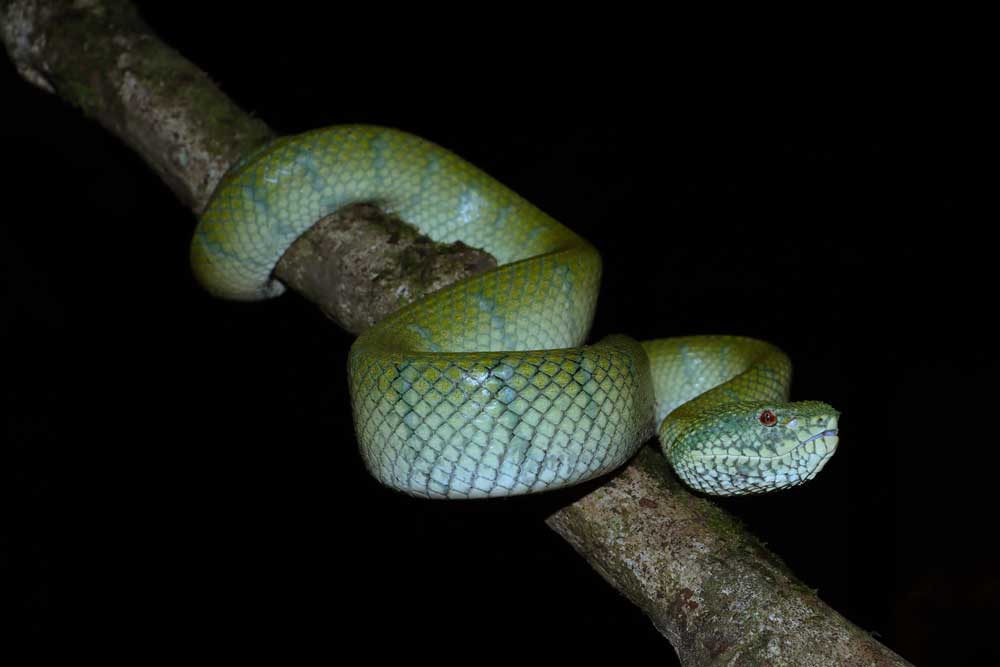
Bornean keeled pit viper (Tropidolaemus subannulatus). Photo by Dave Dinasio
Our success in the highlands had given us a false sense of confidence. Three hours and several miles into the hike and we still hadn’t turned up a single snake. Frustration was high and energy was low, but we pushed forward knowing things could change in an instant. That’s exactly what happened!
Within minutes of each other, we spotted both a male and female Bornean keeled pit viper (Tropidolaemus subannulatus). While they are far more common than T. malcolmi, they are equally spectacular, particularly the females. The species is a textbook example of sexual dimorphism—males are significantly smaller and a uniform green with small bicolored spots along the body, whereas females exhibit a variety of different color phases; the one we found was a brilliant mix of green, yellow, and blue! Photographing the snakes allowed us to rest up and regain our vigor—and, more importantly, our confidence. Our fourth night concluded after finding an elegant bronzeback snake (Dendrelaphis formosus). Not a bad way to bounce back from an otherwise rough start to our night.
Day 5 Night of the Krait
Field herping in the lowland rainforest is like dropping into a survival video game, where you have to outsmart the terrain and outlast the elements. All the while, the jungle attacks from all sides, trying to stop you from reaching the next level and claiming the ultimate prize: a rare endemic species! Neil became our team’s first casualty. Following a nasty fall the previous night, he sat this evening out, opting for some light herping around our lodge instead. It was a decision he would later regret.
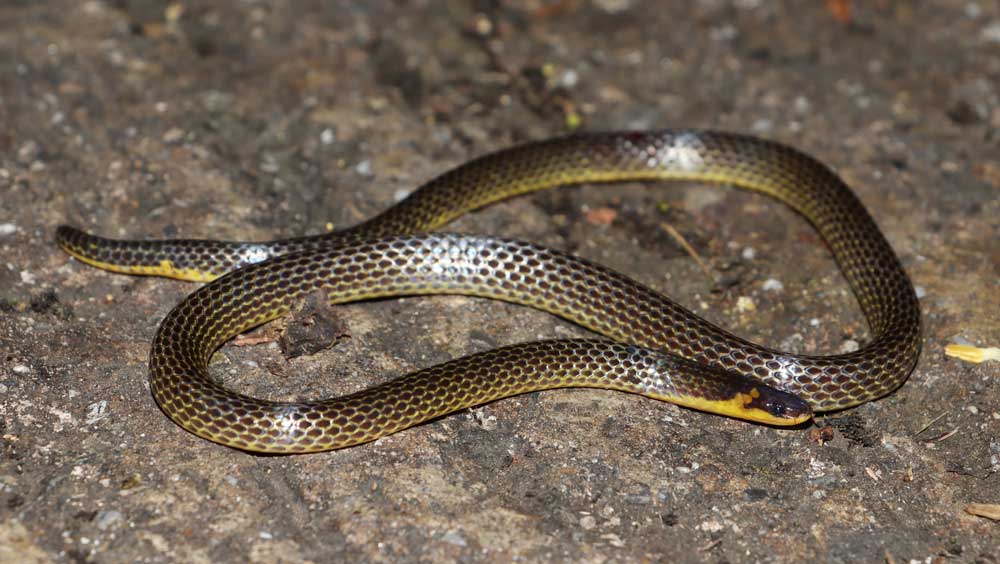
Griswold’s reed snake (Calamaria griswoldi). Photo by Dave Dinasio
The first significant find of the night happened as I was hiking along a fast-flowing river. Something slipped into the water and my first thought was that it had to be a turtle. I leaped across a few boulders into a flooded area adjacent to the rapids to investigate. My eyes went wide as saucers as I peered into the water and saw a comically large Borneo giant river toad (Phrynoidis juxtaspera). The enormous amphibian made no attempt to escape as I plucked it from the water. I watched Evan’s jaw drop as I held up the toad, which approached a staggering 18 inches from snout to outstretched legs. Looking at the huge paratoid glands, which secrete a noxious poison, it became obvious why the toad was so fearless; it likely had few, if any, natural predators.
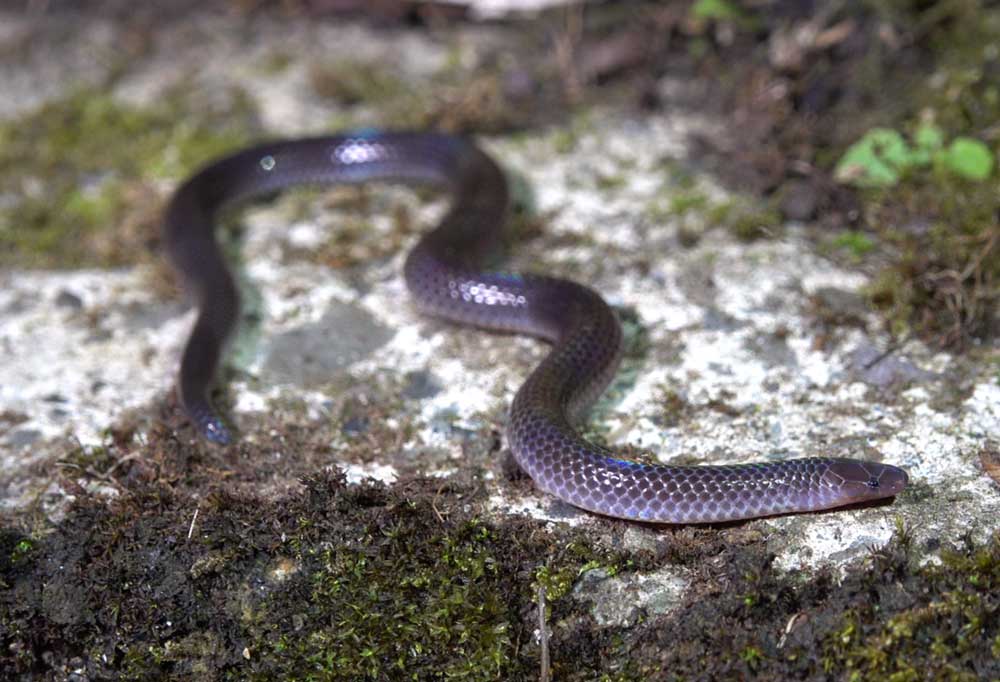
blunt-headed slug snake (Aplopeltura boa). Photo by Dave Dinasio
Not to be outdone, Moon soon stole the spotlight from our giant toad when he found a Malayan long-nosed horned frog (Pelobatrachus nasutus). It looked similar but more colorful than the Kobayashi’s horned frog that we found in highlands with even more pronounced features. The “horns” over its eyes and the projection on its snout were sharply pointed, perfectly completing its disguise as a piece of leaf litter on the forest floor. The amphibians would soon be forgotten as our next find was as thrilling as our Malcolm’s pit viper sighting. I was off trail, only a few yards behind Moon; Danny and Evan were barely within shouting distance, when a 4-foot Kinabalu krait (Bungarus flaviceps baluensis), slithered directly in front of us. Moon was blocking my view, preventing me from seeing the snake. He screamed “krait” just as the snake made a mad dash for cover. I watched as Moon fell to the ground in an effort to grab it before it disappeared into the leaf litter. A few seconds passed and I had no idea if he had the snake until he turned and I could see the unmistakable color and pattern of another prized Bornean snake!
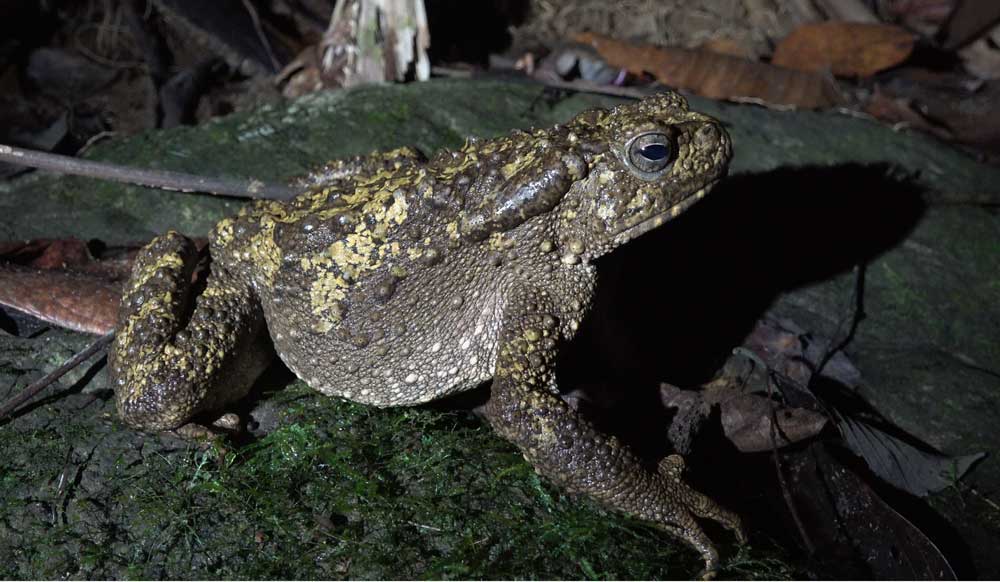
Giant river toad (Phrynoidis juxtasper). Photo by Dave Dinasio
Danny and Evan could barely hear the commotion, but they heard enough to realize that something epic was going down. Within seconds, I could see them both, sprinting like deer through the brush toward us. I won’t soon forget the pure joy on their faces when they first laid eyes on the snake. I’m certain our ecstatic screams awoke every diurnal animal within ear shot! The night would produce one last snake, a smooth slug snake (Asthenodipsas laevis), which we understandably underappreciated given the circumstances. But it didn’t matter. Against innumerable odds, we found a second trophy snake, this time in the lowlands, mirroring the surreal vibe that had kicked off day one in the highlands!
Day 6 Our Final Night in Borneo
I initially contemplated getting some much-needed rest before our morning departure from Borneo but the thought soon evaporated; I couldn’t help but think of Neil missing out on finding the krait the night before. Ultimately, the entire team committed to one last trek through the lowlands, and we were all glad we did. A striped bronzeback (Dendrelaphis caudolineatus) started our final night off with a bang. Although not endemic to the island, it was a lifer for all of us and ranks as the largest of Asia’s 50 plus bronzeback species. Then, one final herp revealed itself to wrap up our Borneo adventure: a blunt-headed slug snake (Aplopeltura boa). It is one of the most common snakes on the island, and that’s when it hit me: we had found one of Borneo’s rarest snakes 20 minutes into our first night and found the most common snake twenty minutes before leaving on our last!
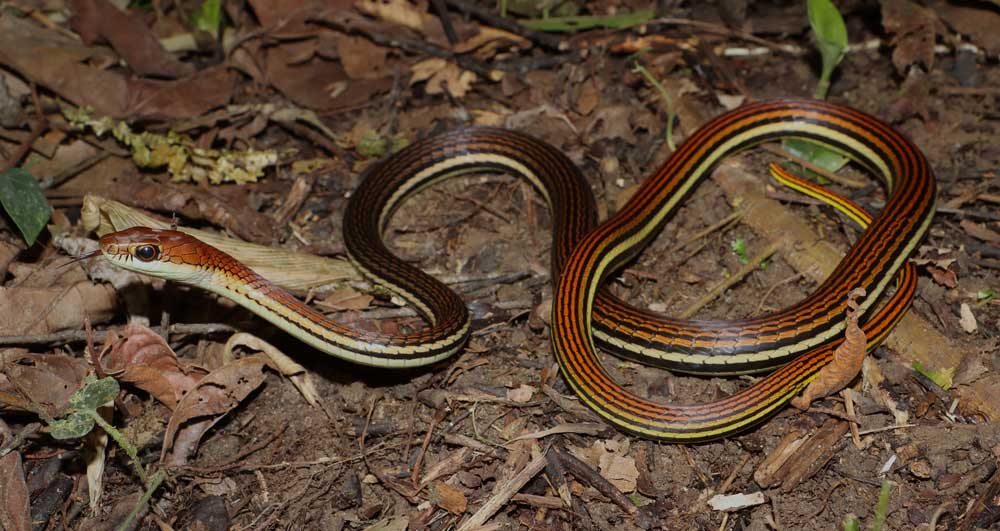
Striped bronze back (Dendrelaphis caudolineatus). Photo by Dave Dinasio
As I walked out of the jungle that night—ripping leeches off my body, sore, bloodied and riddled with insect stings while nursing the exhaustion of six grueling days—I realized how unjustified all of my pre-trip worries had been. The tripled park fees, the mandatory guides, the warnings about the dry season—None of it mattered. Borneo was everything we hoped it would be, even if it meant bleeding a little for it. The long journey home was going to feel a whole lot shorter with an SD card full of the crown jewels of Asian herpetology!