
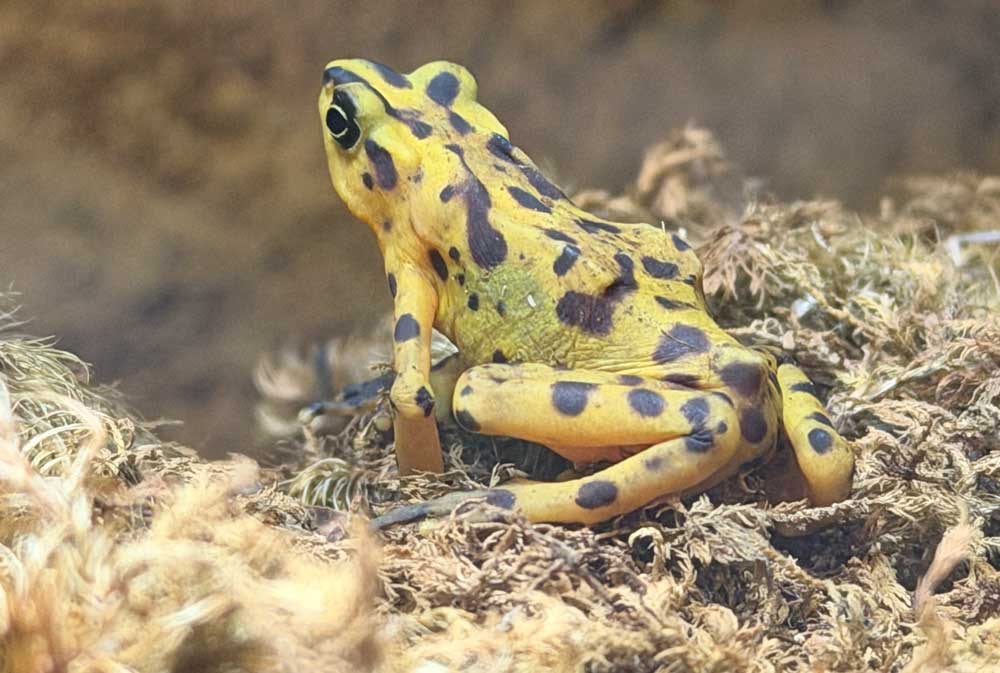
While the Panamanian golden frog is called a frog, it is a true toad and is in the family Bufonidae. It is the national symbol of Panama and is considered one of the most beautiful amphibians in the country.
ZooTampa announced it has successfully hatched 29 critically endangered Panamanian golden frogs (Atelopus zeteki), a species that has been declared extinct in the wild in 2009 due to habitat loss and the effects of the chytrid fungus. The toads hatched in January and are part of the Association of Zoos and Aquariums’ Species Survival Plan, which works to ensure assurance colonies for many endangered and critically endangered species.
“The hatchlings at ZooTampa are part of the Association of Zoos and Aquariums’ Species Survival Plan, a program designed to maintain healthy assurance populations of endangered species. These efforts are crucial for preventing the complete extinction of the Panamanian golden frog while conservationists work toward reintroducing them into their native habitats,” the zoo said in a statement to the media.
Froglet Video Horizontal 2-720
The zoo joined the Association of Zoos and Aquariums-managed breeding network a few years prior to 2019, the year it began exhibiting the species.
The Convention on International Trade in Endangered Species of Wild Fauna and Flora (CITES) listed A. zeteki as a protected species (Appendix I) in July 1975, and the United States listed it as an endangered species in June 1976.
While the Panamanian golden frog is called a frog, it is a true toad and is in the family Bufonidae. It is the national symbol of Panama and is considered one of the most beautiful toads in the country. It is often bright yellow in coloration with yellow-green and bright gold included in some specimens. It is often found with black spots on its back and legs. The females are the larger of the sexes, often reaching 45 to 63 mm (1.8 to 2.5 in) in length and 4 to 15 g (0.14 to 0.53 oz) in weight. Males range between 35 and 48 mm (1.4 and 1.9 in) in length and 3 and 12 grams (0.11 and 0.42 oz) in weight.