
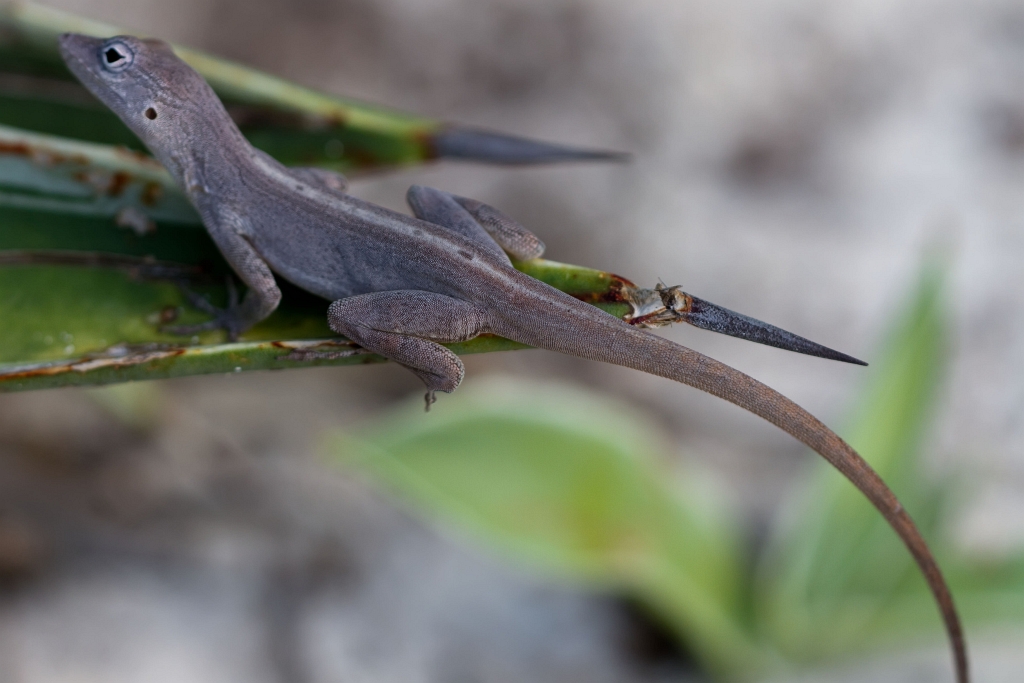
Silver Key anoles (Anolis scriptus) with shorter fourth hind toes were more likely to survive Hurricanes Irma and Maria in 2017 than anoles with longer toes.
Silver Key anoles (Anolis scriptus) with shorter fourth hind toes were more likely to survive Hurricanes Irma and Maria in 2017 than anoles with longer toes, according to research published in Current Biology. Researchers reached this conclusion after examining anole populations on two islands in the Turks and Caicos that were struck by the hurricanes.
According to the researchers, the findings suggest that the hurricanes exerted directional selection on the lizards’ clinging ability. The anoles that survived had shorter fourth hind toes, and genome analysis identified five candidate loci (specific locations in the lizard genome) that showed evidence of parallel selection on the two islands. Parallel selection occurs when the same environmental pressure independently favors similar traits in separate populations, potentially involving changes in some of the same genomic regions. On both islands, the hs6st1 gene showed a signature of selection and was associated with the length of the longest hind toe.
The hs6st1 gene encodes an enzyme involved in modifying heparan sulfate, a molecule found on cell surfaces that plays important roles in cell signaling. During limb development, this signaling is involved in regulating the growth and formation of developing digits. The researchers found that variation near hs6st1 was associated with variation in the length of the longest hind toe.
To investigate whether hs6st1 could actually influence toe development, the scientists conducted an experiment using brown anoles. They edited the gene in brown anole embryos, and the resulting lizards developed shorter hind toes. Although brown anoles are a different species from Silver Key anoles, the experiment provided functional evidence that disrupting hs6st1 can produce the predicted developmental phenotype—in this case, shorter hind toes.
The study shows how an extreme weather event can be associated with changes in an animal’s physical traits, functional performance, and underlying genetics, potentially resulting in adaptive responses in the wild. In this case, genetically distinct anole populations exposed to extreme winds showed similar changes in a complex trait—the length of their hind toes—at multiple levels of biology, from physical form to genetic variation.
The complete paper, “Genomic targets of hurricane-induced selection on clinging performance in an island lizard,” is available on the Current Biology website.