
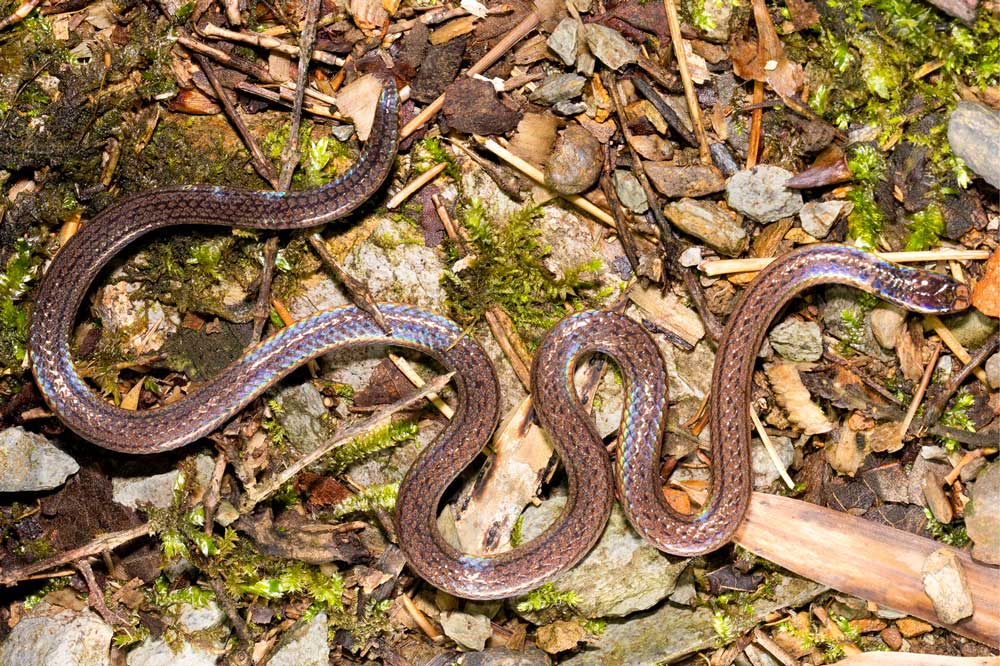
According to the researchers, the snake uses its tail as a form of mimicry to confuse predators that the tail is a head.
Researchers in China have discovered a new species of reed snake in the Calamaria genus. The snake, the Guangxi reed snake (Calamaria incredibilis) was found in Chongzuo and Guilin Cities in Guangxi, China. According to the researchers, the snake uses its tail as a form of mimicry to confuse predators that the tail is actually a head and there are two snakes in the area versus a single snake. The snake goes into a figure 8 position and then raises its blunt and rounded tail to mimic a second head.
The Guangxi reed snake differs from all its congeners based on the following morphological characteristics, including “nine enlarged maxillary teeth; rostral higher than wide; prefrontal shorter than frontal and contacting the first two supralabials; mental not in contact with anterior chin shields; dorsal scales in 13–13–13 rows, smooth throughout; a single preocular and postocular; four supralabials, with the 2nd and 3rd ones contacting the eye; five infralabials; six scales surrounding the paraparietal; 170–182 ventrals in males; 21–23 paired subcaudals in males; a relatively short tail (8.2–8.4% of total length in males), thick and nearly cylindrical, gradually tapering to an obtuse point; dorsal coloration brown, seven longitudinal series of interrupted dark brown stripes are visible along the body, extending from behind the collar to the tip of the tail; the margins of the dorsal scales are heavily suffused with black pigment, forming an almost reticulate pattern; the ventral surface yellowish white, with dark brown blotches along the outermost lateral margins; absence of light spots on the dorsal tail.”
Calamaria incredibilis is about 8 inches in length and is brown in coloration with seven dark stripes down its back. The head’s ventral surface is yellowish white with irregular dark brown blotches. The dorsal surface of the body is brown in coloration.
Mostly nocturnal in nature, the snake eats invertebrates such as earthworms and insect larvae. It lives in leaf litter, rock crevasses and in the soil on the forest floor. The researchers (Shuo Qi, Tan Van Nguyen, Jian Wang, Zhao-Chi Zeng, Jing-Song Shi, Yu-Hao Xu, Han-Ming Song, Zhong Huang, Yun-Ming Mo, Nikolay A. Poyarkov, Ying-Yong Wang) say it is mostly docile in nature except when it uses its tail as a “second” head to confuse predators.
The complete paper describing the new species “An unexpected discovery of hidden diversity: a new species of the genus Calamaria H. Boie in F. Boie, 1827 (Squamata, Calamariidae) from Guangxi, China” can be read on the Zoosystematics and Evolution journal web page.