Mikey Bustos is a singer, songwriter, actor, comedian and YouTuber (1.87 million subscribers) best known for his AntsCanada YouTube (6.86 million subscribers) channel (his videos have garnered close to 1 billion views) that discusses all things ants.
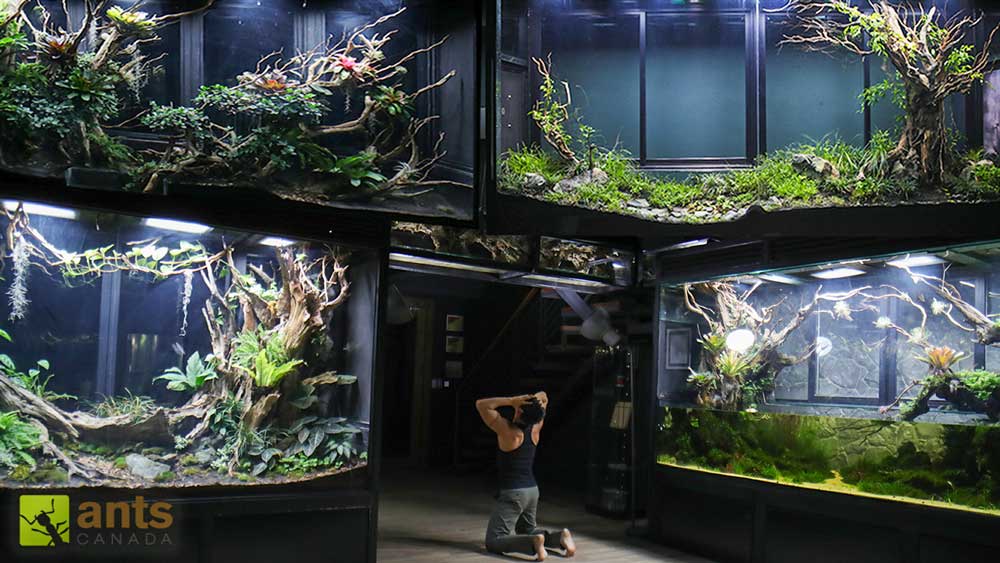
Mikey Bustos is a singer, songwriter, actor, comedian and YouTuber (1.87 million subscribers) best known for his AntsCanada YouTube (6.86 million subscribers) channel (his videos have garnered close to 1 billion views) that discusses all things ants. The social media star (more than 10 million followers across the various social accounts), who grew up in Canada reading REPTILES magazine, National Geographic Magazine, and other publications, has built what can arguably be described as one of the largest, if not the largest, and most elaborate home ecosystem vivariums in his home in Cavite, Philippines.
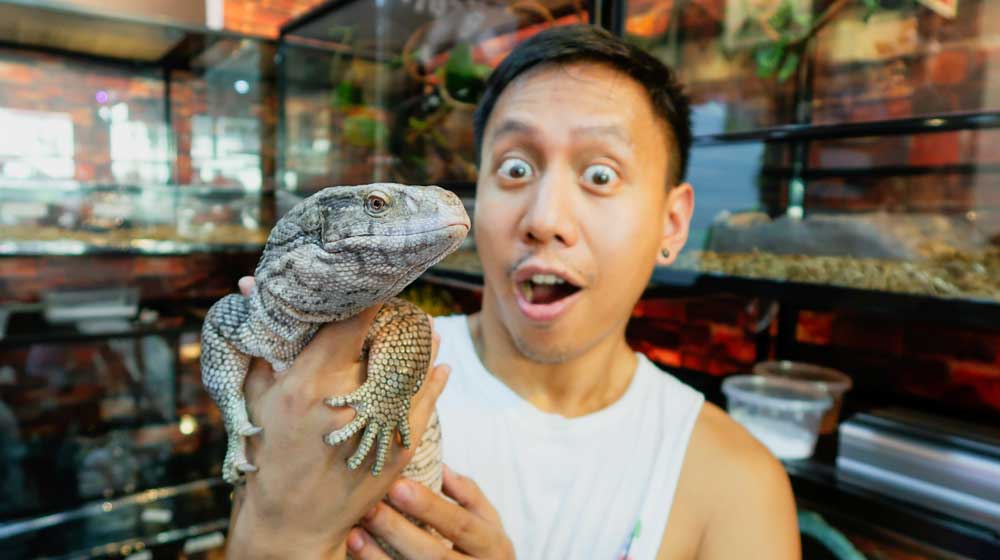
Mikey and his Savannah monitor. Photo courtesy Mikey Bustos
Each of the four biomes; Pantdora, the cloud rainforest floor; Orchadia, the tree top canopy; Hydromeda, the wetlands; and Verdantia, the grasslands, features a wide variety of flora and fauna, from reptiles and amphibians, to invertebrates, birds, fungi and plants.
Bustos became fascinated with insects and green anoles, as a young kid in Canada, and his love for creepy crawlies has grown from there. REPTILES magazine spoke with Bustos on the building of his vivarium system, which comprises four separate biomes, all connected.
REPTILES Magazine: You mentioned that you have been a reader of REPTILES since the 90s when you first started keeping reptiles. What reptiles did you start keeping and at what age?
Mikey Bustos: Yes, pre-internet, pet care manuals and REPTILES magazine were the go-to sources for reptile info and husbandry. My first reptiles were green and brown anoles, which my dad bought me for Christmas after begging for ages. I must have been around 12 years old. This quickly escalated to an iguana, other anole species, Asian grass lizards, veiled chameleons, uromastyx, bearded dragons, savannah monitors, and a house gecko, launching a full blown obsession for reptiles that has lasted into adulthood. The anoles were my gateway herp!
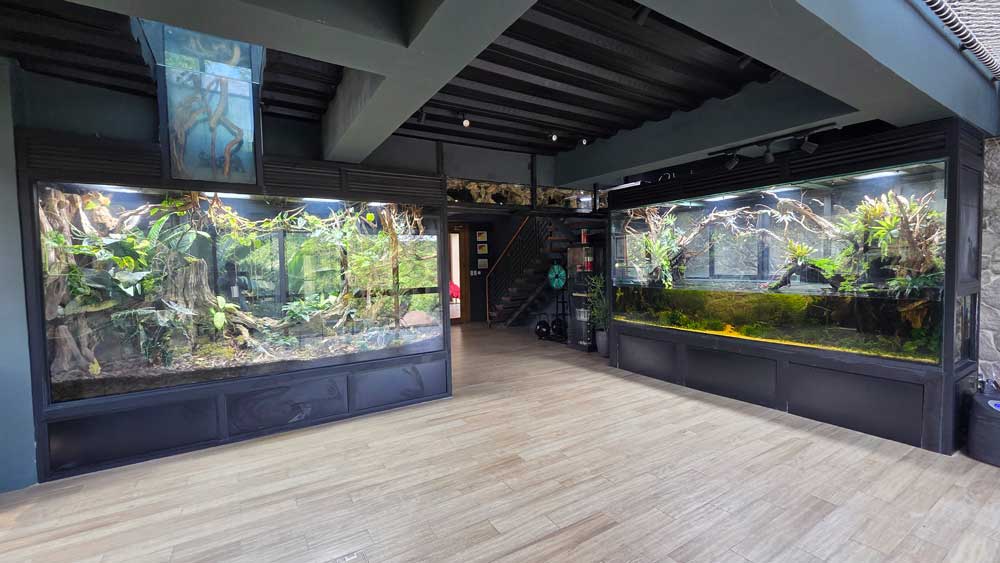
The enclosures are massive. Photo by Mikey Bustos
RM: Same as me! How has reptile keeping changed for you over the last few decades, and what came first? The ants or the reptiles?
MB: Reptile keeping has advanced so much since the 90s. Back in the day, I had to light and heat my reptiles with bulbs and spotlamps bought at my hardware store. Now the herp business has grown so big, there is a product for nearly every aspect of reptile care. It’s amazing to see!
I also watched as rare colour morphs of reptiles over time became more commonly available as breeders began producing the reptile rainbow!
For me, naturally the bugs came first, as they were easiest to access as a kid. I started keeping ants and other critters from my yard and the nearby park as early as 7 years old. I was the weird kid on the block always on my hands and knees in the dirt with jars to take stuff home, ants included. I would set up all my bugs in containers with labels and create a BUG ZOO museum-style in my parents’ basement, which I would then show all my friends in the neighbourhood. Guess some things never change!
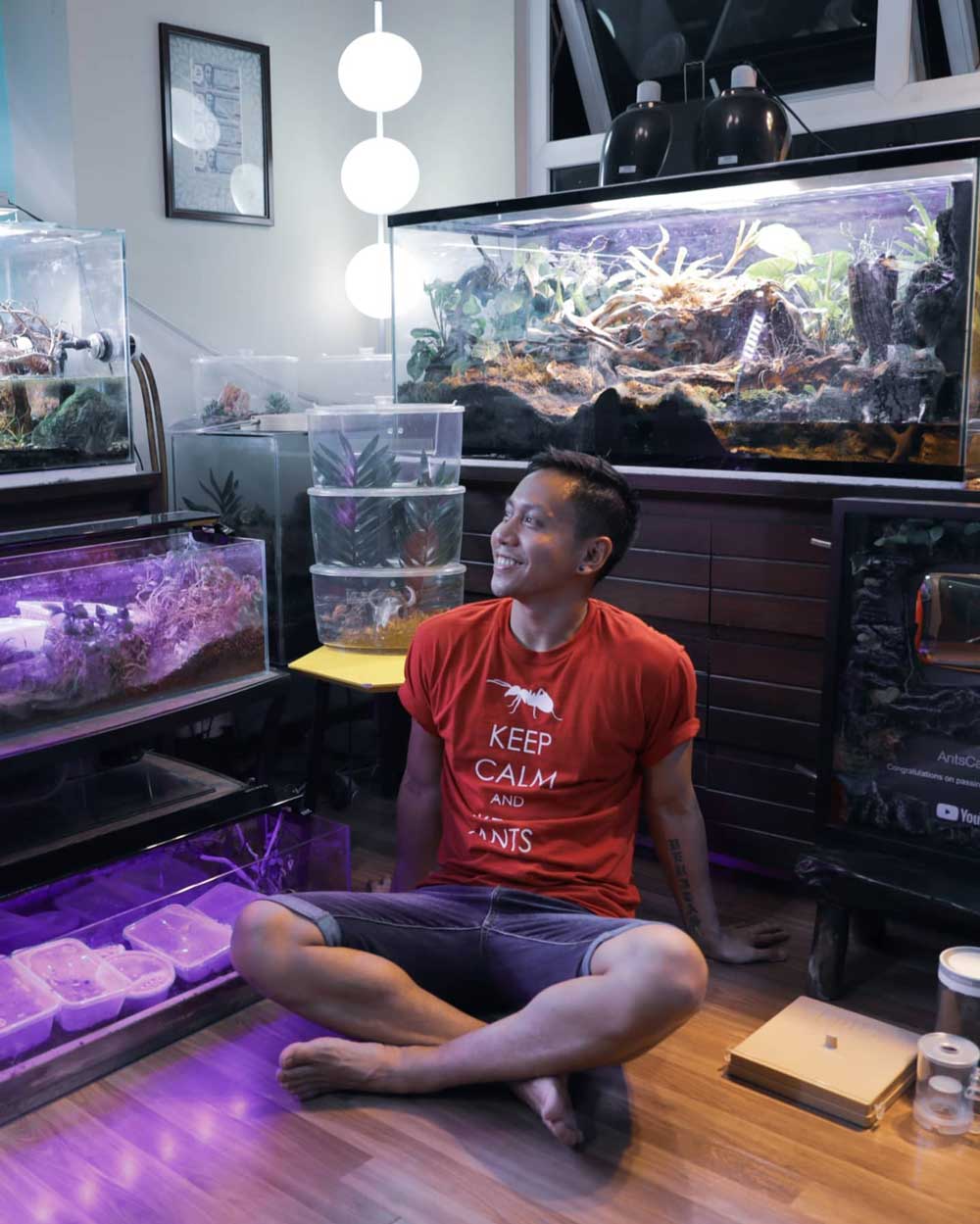
Mikey has been into reptiles for years. Photo courtesy Mikey Bustos
RM: When did the idea of creating your cloud rainforest vivarium materialize? Was it from expeditions into actual cloud rainforests?
MB: Yes, having visited cloud rainforests over the years, I had a good idea of how I would execute such a vivarium when the day ever came, but what made me finally decide to actually start a cloud rainforest vivarium was sheer curiosity. In 2023, after years of creating focused single-species ant farms of all kinds, the only idea left to try was to house ants in the most naturalistic way possible: housing them in an ecosystem vivarium, basically a bioactive setup on steroids. For the first time, it would allow me to study ant behaviours in their purest form and discover how they fit into ecosystems, something you can’t really appreciate in a traditional ant farm. With the larger amount of space and diversity in niches, I could also house more than one ant species together, which in traditional ant farming is not possible.
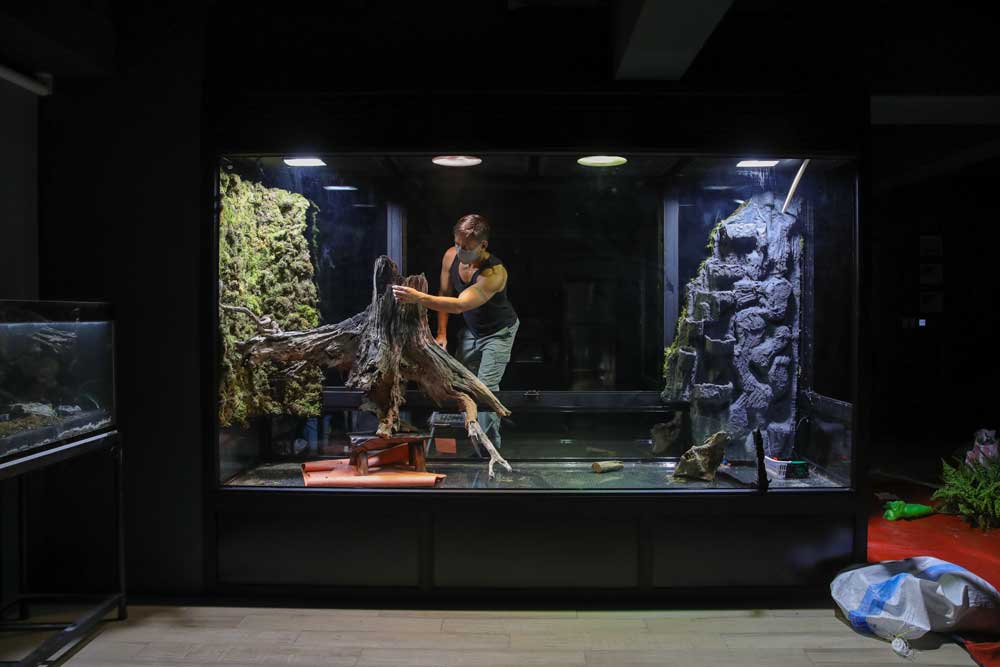
Mikey putting his designs to work. Photo courtesy Mikey Bustos
To my surprise, housing ants in vivaria allowed me to appreciate ants in a whole new light, as for once, I could see them operating within an ecological context, like seeing how they are just a small piece of one huge complex ecological puzzle. As seen in my YouTube videos (youtube.com/@AntsCanada), I’ve been able to observe some of the most insane ant relationships, including mealybug farming for honeydew and interspecies ant rivalries! I also discovered peculiar ant symbioses, including how some plants like Princess vines have extrafloral nectaries to attract ants to their foliage, which I can only assume is for protection from herbivory or for ant poop fertilizer.
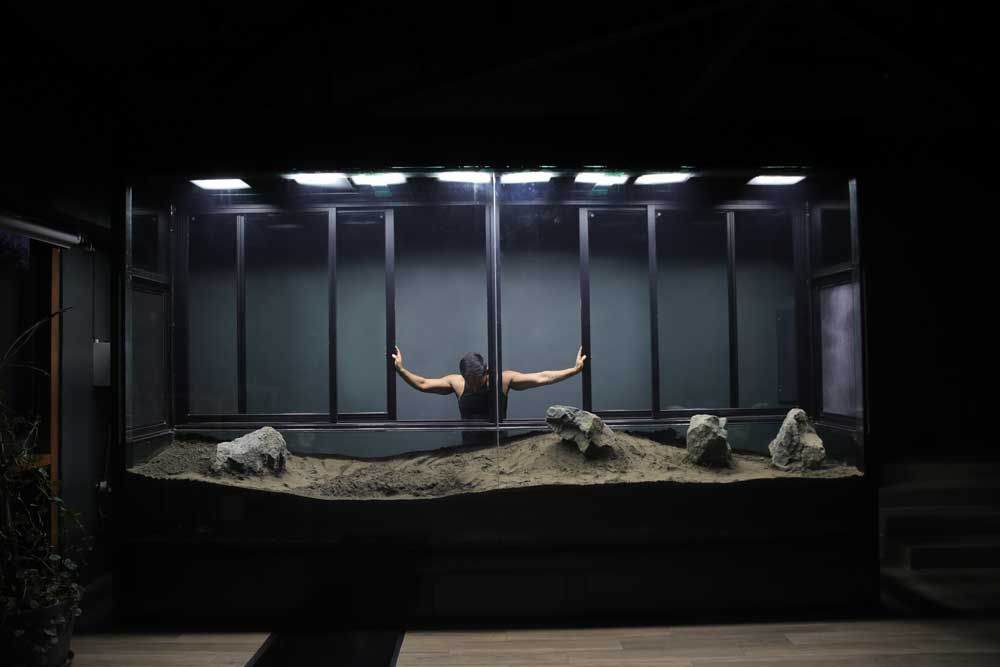
RM: Can you describe how you are controlling the environment in each of the three cloud forest vivariums? Can you discuss your use of UVB lighting, misting systems, heating (how does heating play out in a country like the Philippines? Is it warmer or cooler where you live?) and other mechanicals that help to recreate as much of a natural environment as you can?
MB: My Ant Room in which my vivariums are housed is SMART and climate controlled to the degree. I live in the Philippines so it’s hot year round 25 to 40 degrees Celsius (77 to 104 degrees Fahrenheit) and usually 70-100% humid. Actually, unlike when I kept reptiles in Canada where I needed to have equipment to keep the reptiles warm and humid, the challenge in the Philippines is to keep the reptiles from overheating. A room with closed windows and no air conditioning can become an oven fast and kill all pets, ants included. My air conditioning units turn on to cool down the Ant Room, especially during our scorching dry summers. The Ant Room is kept at a nice 22 to 25 degrees Celsius (72 to 77 degrees Fahrenheit) during the day which creates an ideal cloud rainforest temperature.
For humidity, the vivariums are equipped with fog machines which are also automated. It rains in all the tanks, also automated, as well as wind via fans, especially in my new Grasslands Vivarium (my 4th vivarium).
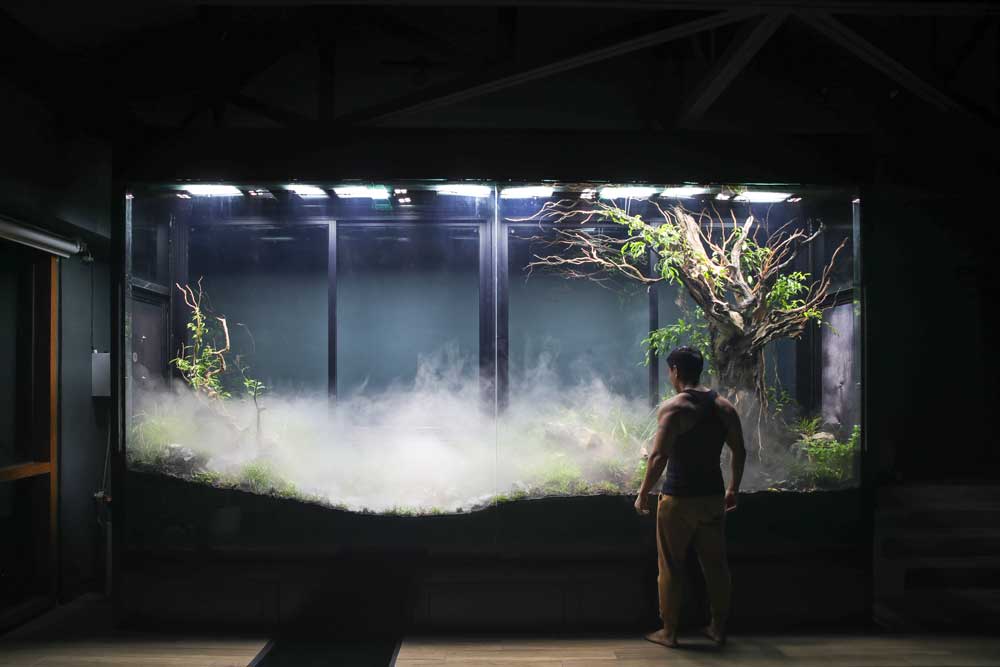
Fog in in the enclosures is a recurrent happening. Photo courtesy Mikey Bustos
In terms of UV lighting, I have several spots around the tanks where reptiles (and now birds) can get their dose of UV from UV bulbs. But for heat, reptiles will usually find a warm spot under any of the lighting, close to the top screen mesh, usually on driftwood. If there are ground dwelling reptiles, I will fixate lighting to shine through the side mesh. Reptiles in the Philippines don’t really need to bask as long as those in temperate countries. In fact, basking lamps can quickly kill a reptile here if you aren’t careful. There are also moments in the morning when natural sunlight comes streaming into the tanks which I find the reptiles like. It’s a myth that all UV gets filtered out by windows. Some wavelengths make it in (I’ve measured it!), especially if it’s strong Philippine sun!
RM: Over the course of how many years was the planning for your vivariums, and what was the duration from start to where you are today?
MB: I built Pantdora, my first giant ecosystem vivarium, in late 2023. It took several months of planning before that, mostly working out structural stuff
But in terms of working out the biological details of how an ecosystem tank would actually work, I feel that required the entirety of my life’s knowledge on animal husbandry and hobby experience.
I first started keeping vivariums when I was an early teen, a concept I learned from the great Philippe De Vosjoli (https://shorturl.at/IkKds), who authored some of the best reptile care handbooks available in the 90s. He had a chapter about vivaria in a book he wrote about keeping green anoles, and that concept of keeping multiple species of reptiles/amphibians in a single enclosure, a community tank, fascinated me!
But working out an ecosystem vivarium is a full step above community tank, as it is incorporating full life cycles of various animals and plants, etc, so an ecosystem vivarium required much more knowledge and experience, with which I didn’t feel I was ready until 2023.
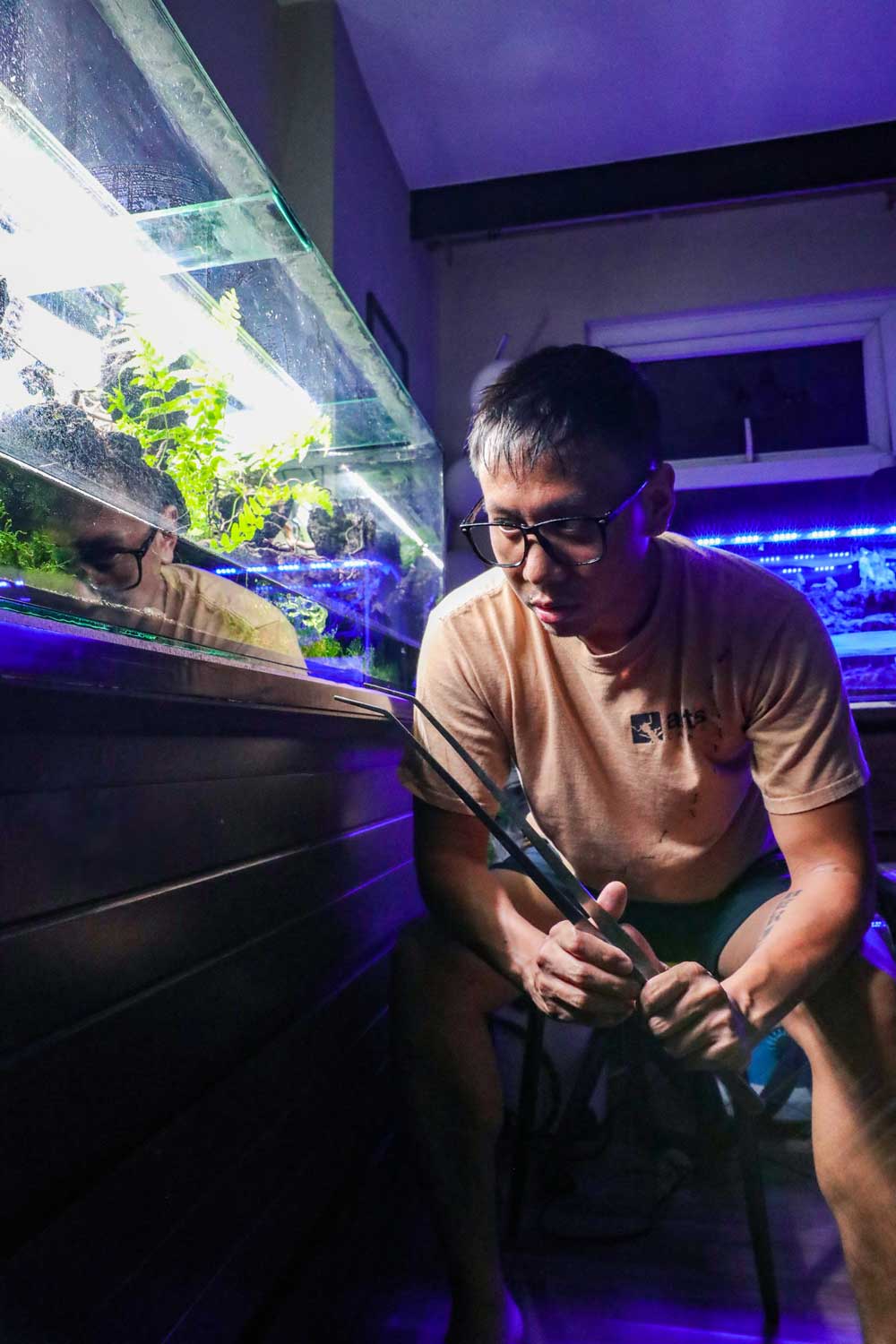
RM: What did the first iteration of your cloud rainforest vivarium look like?
MB: Pantdora v1.0 will always be my favourite. It featured a giant ironwood stump as its centerpiece, flanked by asparagus fern, philodendrons, mosses, and vines. It was majestic, dioramic, and made for some amazing creature viewing. The basics are still there today, i.e. stump, a rock wall, but the forest within took on a life of its own and changed gradually overtime, as nature does.
RM: What are the ongoing challenges in keeping these ecosystems in harmony?
MB: The biggest challenge is protecting the ecological balance. Adding creatures into the vivaria almost always has repercussions on the entire ecosystem within. Add too many predatory species and insect biodiversity goes down, add too many herbivores and plant biodiversity goes down, add the wrong plant and plant biodiversity goes down. Either way, it’s an amazing way to learn about the dynamics of ecosystems and the role different species play in the ecosystems they are part of.
Another challenge has been keeping invasive ants out! Black crazy ants have been a pain since day one! I have to come up with natural solutions to get rid of them, from carnivorous plants, to trapping, to adding rival ant species, to simply spot vaccuuming them up!
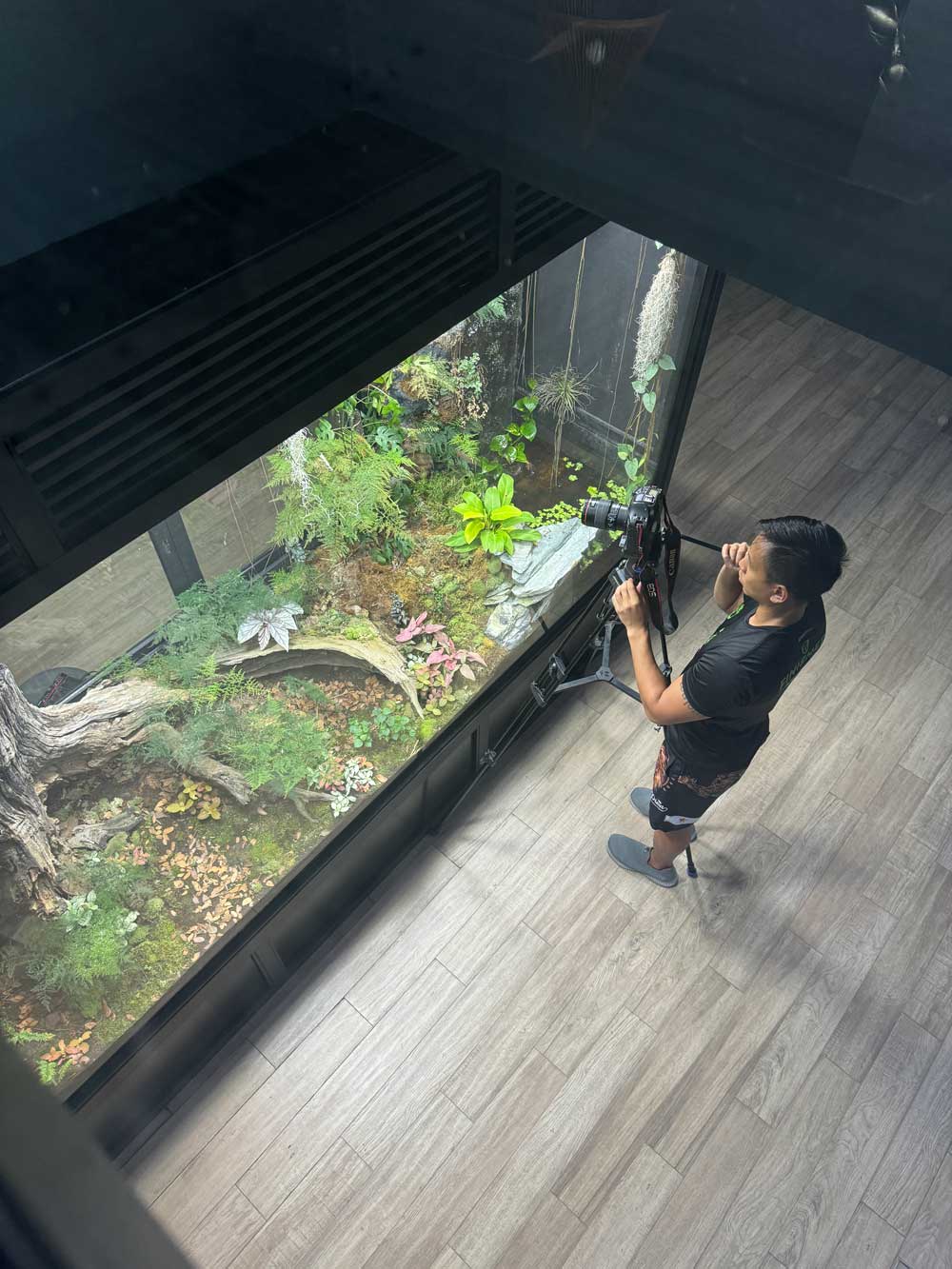
Mikey shooting some content. Photo courtesy Mikey Bustos
RM: How did you choose what flora and fauna went into your vivariums?
MB: For creatures, I would mainly go with what was around my area, but wanna hear something crazy?
Mother Nature decides most of the time! The majority of the species were actually seeded unknowingly into the vivaria via the decor, plants, and soil. The huge stump in Pantdora, for instance introduced a massive marauder ant colony, a dwarf ant species, and a whole termite colony! I once found a baby flying Draco lizard in one of my vivaria which could only have gotten in via the driftwood inside the setup!
Of course, my knowledge on the biology of various creatures also comes into full play, when deciding what creatures I do put in myself and when it’s time to pull creatures out.
I am also a big plant geek and so I often choose plant species I’m familiar working with that tolerate the lights I am able to provide.
For any species, plant or animal, that I don’t have experience with, I consult with experienced experts for advice.
RM: How big are each of your vivaria? You mention in your socials of connecting them. Were there any challenges in doing so?
MB: The vivaria range from 1,000 to over 2,000 gallons of space. Yes, the vivaria (except my latest one, for now) are connected via glass bridges. It was challenging to work out these connections as I had to work around the existing structures of my Ant Room, which was designed and built years before I ever decided to create the vivaria. Luckily, we had glass floor cutouts installed on the second floor, for better distrubution of natural light in the Ant Room, but this actually made multi-floor connection of the vivaria possible!
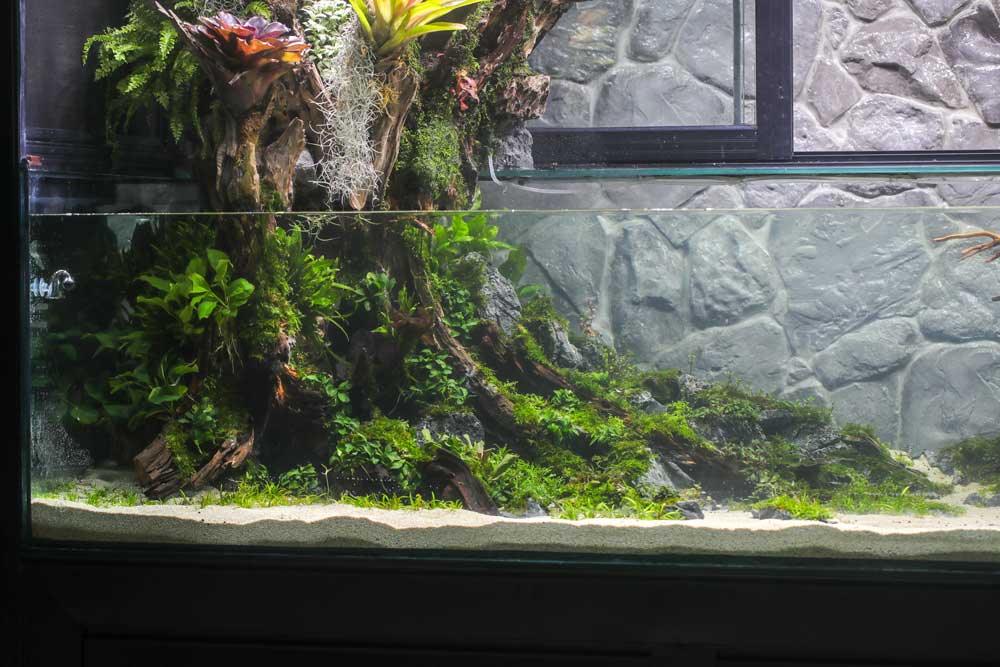
The wetland enclosure, designed to mimic a tidal wetland. Photo by Mikey Bustos
RM: Do the vivaria occupy one room in one floor of your home in the Philippines, or do they essentially reach for the ceilings as seen in your social media?
MB: My Ant Room is built on the second floor of my home, and the Ant Room itself has two floors. So the two floors you see in the Ant Room in my videos are actually the 2nd and 3rd floor of my home. It’s like a separate house built into my home. There is a section of the Ant Room where a net floor exists and its there where you can look way up to the roof of the Ant Room, as well as the glass floor panels.
The bottom floor vivaria almost reach the ceiling, but the top floor of the Ant Room has a large vaulted ceiling, so there’s space for a whole other set of vivaria up there, if ever I run out of floor space. Haha!
RM: Where did your fascination with ants, ecosystems, and micro-worlds begin?
MB: Definitely childhood. I just always loved animals for as long as I remember. As mentioned, I was the child always in the dirt playing with insects. I was always wandering into my family members’ backyards at family gatherings, collecting bugs in jars to bring back home. I was a frequent visitor at the public library, borrowing every animal, pet, and insect book and magazine I could get my hands on. I also grew up watching nature documentary shows narrated by the great Sir David Attenborough, National Geographic Magazine, books by Philippe De Vosjoli, and of course, REPTILES magazine were my literary loves!!!
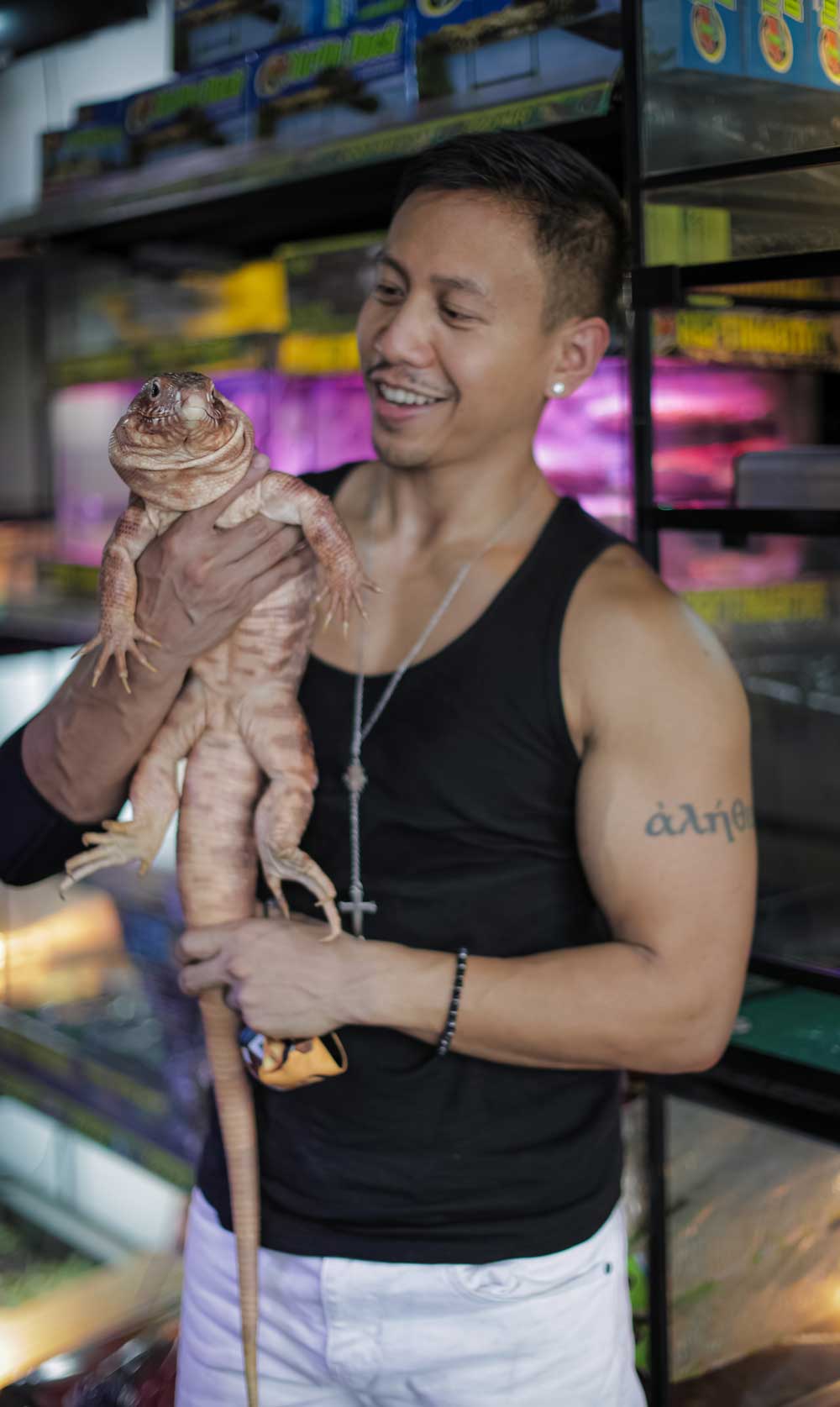
Mikey has been keeping reptiles since he was a kid living in Canada. Photo courtesy Mikey Bustos
RM: What reptiles and amphibians are you currently keeping? And have they all found a home in your cloudforest vivariums?
MB: The list is quite long, but the herps in my vivaria are my senior Sorong green tree python, some house geckos, golden tree frogs, and a pac man frog. I have a baby spectacled caiman who used to live in my first vivarium but has since moved out. I also adopt and rescue, so I have a colony of iguanas, a red-footed tortoise, a Suriname horned frog, and other herps.
RM: Do you imagine building other ecosystems—or was this a once-in-a-lifetime project?
MB: Of course! The Ant Room is large enough to house at least 10 more vivaria, and once all full, I have other ideas in mind! These vivaria are not a once in a lifetime project, but a lifetime project for sure, as it’s my personal joy and hobby that I love sharing with other nature-loving people.
I must say that I feel so grateful to be able to do what I love, and it’s all thanks to the solid community supporting the AntsCanada channel, the AC Family, so I’ve made it my duty to see just how far we can take our nerdy little hobby, by providing a hub for us nature-lovers to learn and discover Mother Nature’s best kept secrets together, via these biological slices of nature within glass, we know as vivaria. I feel creating these worlds is one of my greatest life purposes.
Let me also say how honoured I am to be interviewed by REPTILES magazine. As an avid reader of your earliest issues, I never imagined something like this would ever happen in a million years. Thank you for being a great source of information and inspiration for generations of herp-lovers worldwide. You guys sure inspired me, flipping through your pages as a kid, and this all feels like a full circle moment being here today! My reptile-loving heart is so full!