
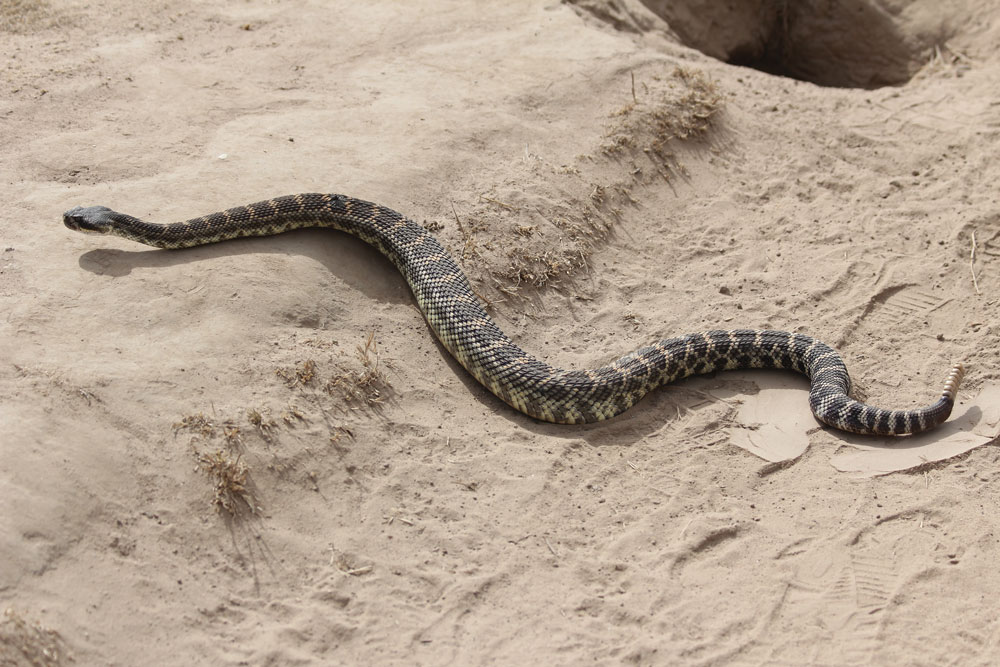
Southern California has the highest risk for rattlesnake bites due to denser populations that overlap snake habitat, year round recreational activity and a warmer climate.
Another Southern California resident has died from a rattlesnake bite, marking the second time this month that someone has died from a venomous snake bite in the state. Gabriela Bautista, 46, and a resident of Moorpark, was hiking in Wildwood Regional Park north of Los Angeles when she was bitten by a rattlesnake right before noon March 14, KTLA.com reports. She was airlifted to Los Robles Regional Medical Center where she later died March 19. According to the Ventura County Medical Examiner’s Office, Bautista died of rattlesnake venom toxicity. Bautista was married with children and was an avid hiker.
What is not known is what species of rattlesnake bit Bautista. In the region where Bautista was bitten, the Southern Pacific rattlesnake (Crotalus oreganus helleri) is known to frequent the area. A teenage girl was also bitten March 20 while riding her bicycle near the Wendy Hill trailhead in nearby Newbury Park. She survived. Wildwood Regional Park and the city of Newbury Park are adjacent to each other. This death makes two in the span of just a month. Julian Enrique Hernandez, 25, of Costa Mesa, CA was biking near the Quail Hill Community Center in Irvine, CA February 1 when he was bitten. Hernandez was transported to a hospital and placed in an intensive care unit, and despite more than a month of treatment, Hernandez died March 4.
California has some of the most rattlesnake bites in the country, with an average of more than 800 bites each year. This represents 10 percent of the total rattlesnake bites nationwide, according to the Division of Medical Toxicology at UC San Diego Health System. This could be due to the sheer population of the state, and the ideal year round weather conditions that don’t occur anywhere else in the country.
Rattlesnake Venom Potency
Snake venom potency can be influenced by the weather and the prey that venomous rattlesnakes snakes eat, according to a research paper put out by the University of Michigan Life Sciences Institute. The university researchers, along with those from the University of Nevada Reno and the University of Utah studied how blood serum samples of wild Desert woodrats (Neotoma lepida) have evolved to resist rattlesnake venom. These rodents can survive from 500 to 1000 times the amount of venom that kills a lab mouse, the researchers said.
Eastern Diamondback Rattlesnake Survives Getting Swallowed By Eastern Indigo Snake
“Even across different populations of the same snake species, eating the same prey, we see evolutionary differences in their venoms,” Matthew Holding, Ph.D., lead author of the study and an evolutionary biologist in the University of Michigan Life Sciences Institute. “With this study, we really wanted to dig into what drives these differences in the natural coevolutionary arms races between the snakes and their prey.”
Could Rattlesnake Venom Potency Be A Factor In These Deaths?
According to Biology Insights, there are 7,000 to 8,000 venomous snake bites in the United States each year, with 90 percent of those bites attributed to rattlesnakes. Of these, about five to six deaths occur per year. In California, there are about 800 snake bites each year, when factoring in unreported incidents, according to the Environmental Literacy Council. Of the bites, one to two deaths occur in the state from rattlesnake bites. These deaths often occur due to delayed treatment with antivenin, allergic reactions, and severe envenomation in vulnerable individuals.
Rattlesnake Bite Risk In California
Southern California has the highest risk for rattlesnake bites due to denser populations that overlap snake habitat, year round recreational activity and a warmer climate. The Southern Pacific rattlesnake (Crotalus helleri) is the species most responsible for the bites in Southern California, while the Northern Pacific rattlesnake (Crotalus oreganus oreganus) is most responsible for Northern California bites. The venom of these snakes are mostly hemotoxic. This causes pain and swelling, bruising and bleeding and tissue necrosis. Their venom can also be neurotoxic, based on the locality. Some populations are hemotoxic while others aer neurotoxic and some have mixed venom. Neurotoxic envenomations affect the nervous system and can cause muscle weakness as well as difficulty speaking or swallowing and in some cases, breathing problems.
What To Do If Bitten By A Rattlesnake
Stay calm and call 911 if possible. Movement spreads venom faster. Keep the bite at or slightly below hear level. Remove any jewelry, or tight clothing as swelling can happen very quickly. immobilize the limb and try not to use the area where the bite occurred. Get to a hospital as fast as possible.