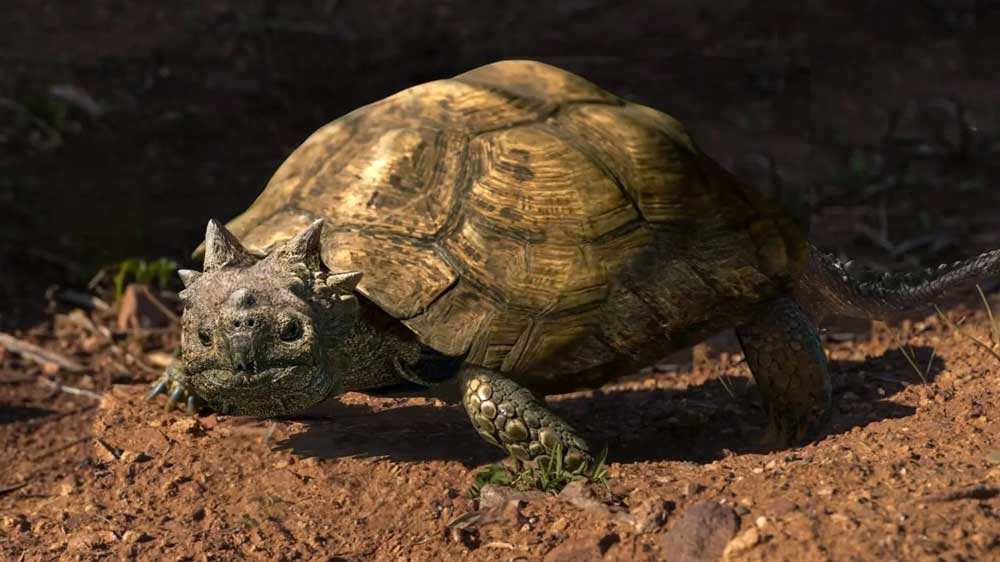
The extinct Meiolaniformes group of chelonians persisted from the Early Cretaceous period into the Holocene of Australia, Oceania and South America
Researchers have discovered a new species of horned turtle from the extinct Meiolaniformes group of chelonians. The species, Patagoniaemys aeschyli sp. nov., came from the Upper Cretaceous (Maastrichtian) Los Alamitos Formation in Argentina’s Rio Negro Province. The turtle is described from a partial basicranium, an incomplete carapace and fragmentary postcranial bones.
It differs from P. gasparinae due to the presence of longitudinal ridges in the nuchal bone, among other differences. The specimens were found at the base of the Cerro Cuadrado mountains at Nueva Poupée Farm (ex Los Alamitos Farm). The specimens were found with microvertebrates, including diverse fishes, anurans, snakes, sphenodonts, chelid turtles, birds, sauropods, theropods, and a variety of mammals, the researchers wrote in their paper.
Extinct Big-headed Turtle Species Named After Stephen King Character Maturin
The extinct Meiolaniformes group of chelonians persisted from the Early Cretaceous period into the Holocene of Australia, Oceania and South America. It contains the following taxa, Chubutemys, Otwayemys, Patagoniaemys, and Peligrochelys.
The complete paper describing the species, “A new meiolaniform turtle from the Maastrichtian of Northern Patagonia, Argentina” can be read on the ResearchGate website.