
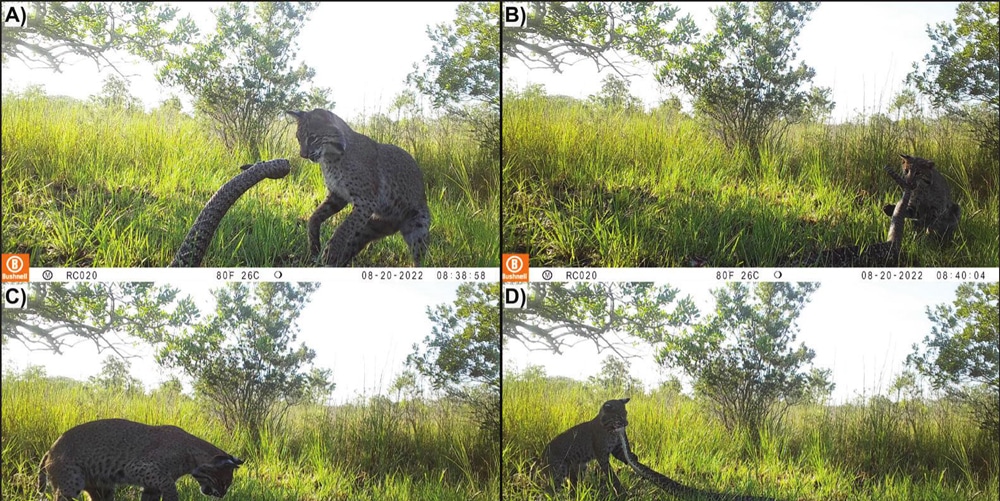
The photographs show the bobcat biting the rattlesnake's tail, then avoiding it, clawing the body and biting the head.
Researchers employed a field camera in Florida and captured, in a series of 38 photographs, a bobcat (Lynx rufus) attacking an adult Eastern diamondback rattlesnake (Crotalus adamanteus).
The remote camera recorded 38 photographs in a nearly two hour time span. The photographs show the bobcat biting the rattlesnake’s tail, then avoiding it, clawing the body and biting the head. Photographs that followed the initial attack showed the rattlesnake overturned with wounds to its head, midbody and tail.
The observation, the researchers said, provide “rare primary photographic evidence of a bobcat attacking an adult Eastern diamondback rattlesnake.” This documented interaction, the researchers say adds to the limited documentation of bobcats as predators of large reptiles.
Previous evidence of bobcats attacking the venomous snake are scant, with just one interaction that occurred in Georgia back in 2001. In this instance, the stomach contents of the bobcat revealed the remains of the Eastern diamondback rattlesnake. However, this observation does not confirm whether the cat attacked the snake or just scavenged a dead snake.
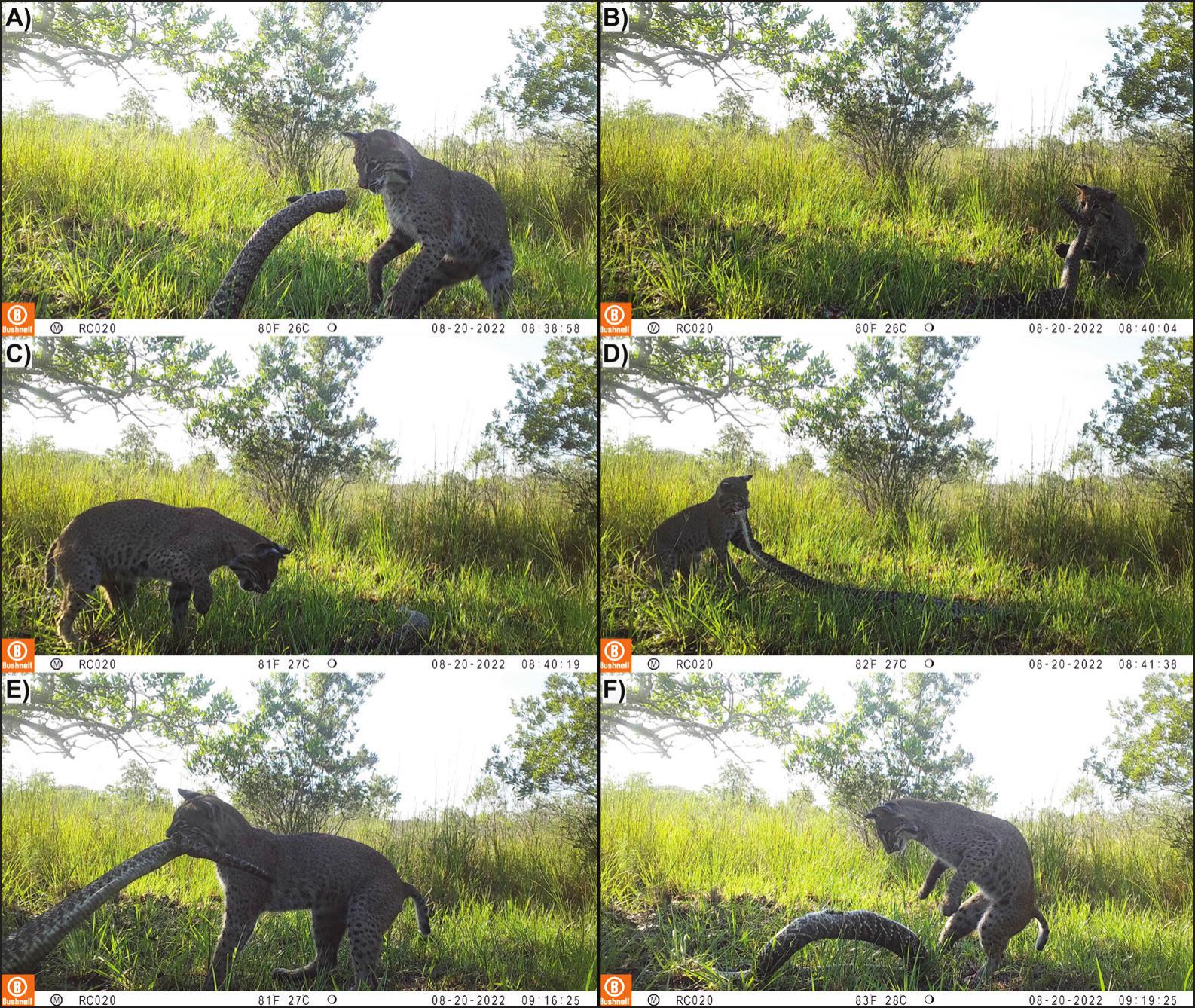
Camera-trap pictures of an attack event by a Lynx rufus (Bobcat) on a Crotalus adamanteus (Eastern Diamondback Rattlesnake). Panel (A) shows the Bobcat avoiding the snake’s tail. (B) shows it biting the contracting tail. (C) shows the Bobcat clawing at the snake’s body. (D) shows the Bobcat biting the snake’s head. (E) shows the Bobcat biting the snake’s tail. (F) shows a deep wound on the snake’s body. Photographs were taken on 20 August 2022 at the University of Florida Range Cattle Research and Education Center, Ona, FL. Photos by Mohamed Khalil Meliane, Peyton E. Niebanck, Nicole Rita, Samantha Nunn, E. Hance Ellington
The researchers set up a Bushnell Core camera at the University of Florida Range Cattle Research and Education Center, in Hardee County, FL to capture field interactions of any kind. The device was positioned at a height of 50cm and programmed to take burst shots of three pictures on trigger with a delay recovery interval of 0.6 seconds.
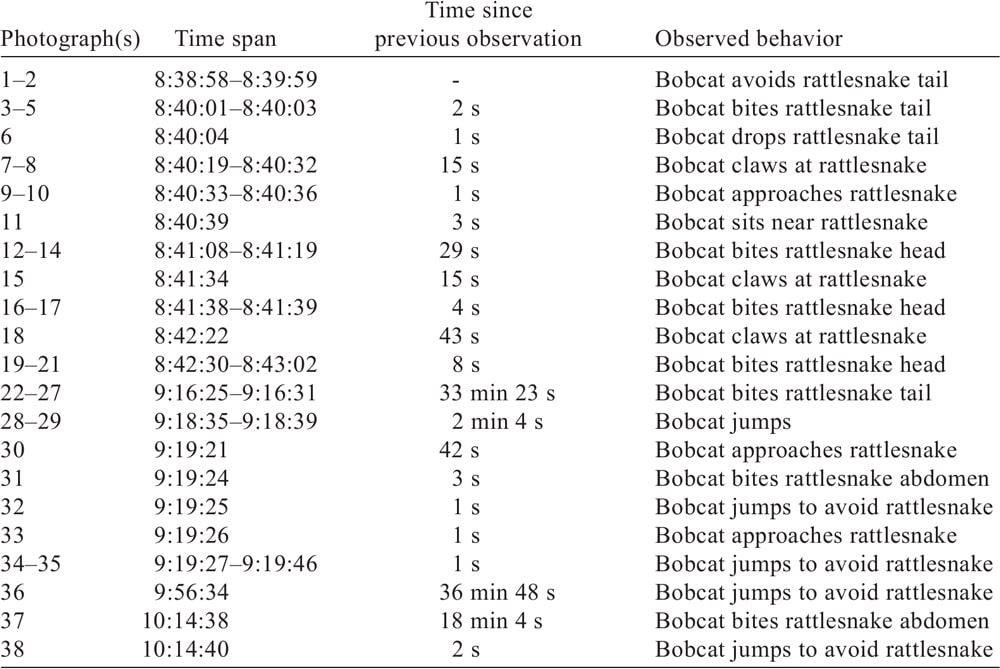
The researchers created a timeline of the activities of the two animals. The bobcat first avoided the rattlesnake’s tail. The next image shows the bobcat holding the rattlesnake’s tail in its mouth, for five seconds, then clawed the rattlesnake for 20 seconds. It then rested near the snake for 29 seconds then bit the snake’s head for 114 seconds. Following this, it bit the tail for six seconds. More photos showed the snake on its back but still attempting to attack the bobcat. Those attacks were unsuccessful.
Other camera trap photos of bobcats reveal them eating the eggs of the Burmese python (Python bivittatus) in the Everglades. This occurred in 2022. These are the first documented evidence of a nest predator of Burmese python eggs. Another documented event occurred in 2021 when researchers determined the bobcat has the capability to kill adult pythons based on the carcass of a dead adult female that showed claw scratches on the carcass and signs at a nearby cache site that the researchers say are consistent with a bobcat attack.
The researcher note that this evidence points to the capacity of the bobcat to predate not only large vipers, but also invasive snakes such as the Burmese python.
The complete paper describing the attack, “Photographic Evidence of a Bobcat (Lynx rufus) Attack on an Eastern Diamondback Rattlesnake (Crotalus adamanteus)” can be read on the open access BioOne Digital Library.