
One of the most notable findings was the fact the snakes can stabilize and elevate their heads while rolling in the direction they are traveling.
Dwarf reedsnakes of the Pseudorabdion genus in Southeast Asia can roll across the ground at speeds approximately four times faster than their normal slithering movement, according to researchers who studied the unusual escape behavior.
The snakes use a coordinated series of body movements to propel themselves forward while keeping their heads relatively stable. The study helps to determine how these small reptiles achieve rapid movement without the specialized structures associated with rolling.
Researchers filmed the snakes from multiple angles to examine how their bodies moved during rolling. The recordings revealed that the snakes reached peak forward speeds of 5.6–12.1 feet per second (1.72 to 3.69 meters per second), much faster than their maximum speeds when crawling normally. Despite their speed, the snakes maintained directional control while traveling along a narrow track measuring just eight inches wide.
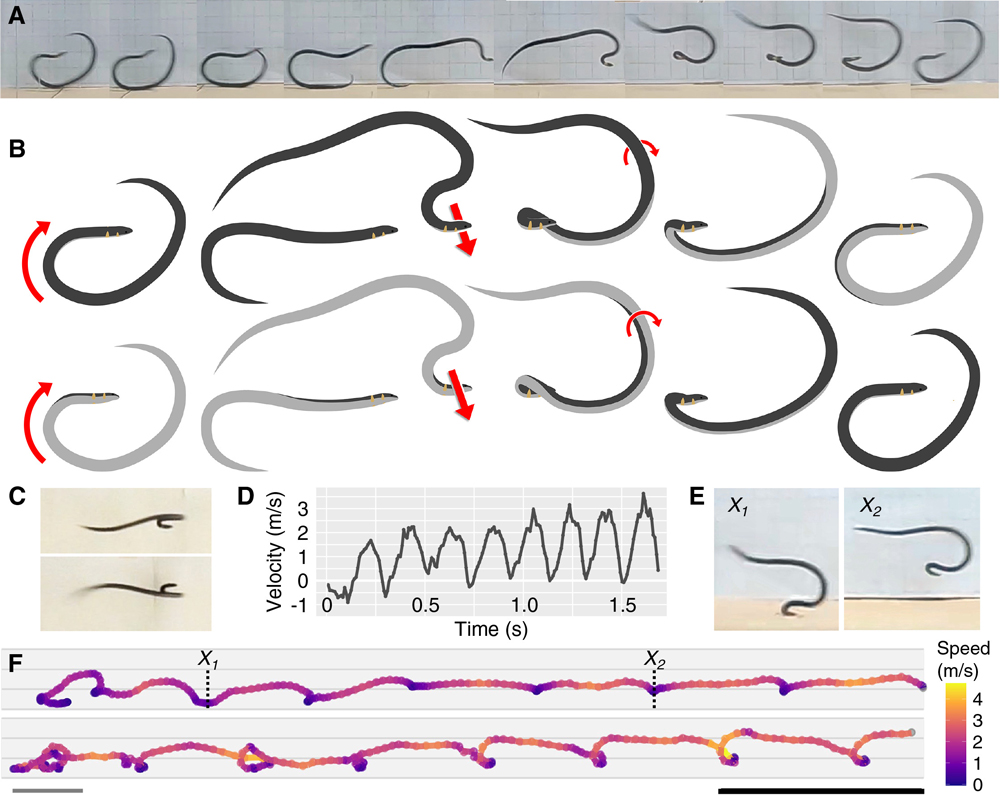
Figure 1. Snapshots showing the sequence of locomotor behavior. (B) Cartoon illustrating the kinematic mechanism of rolling locomotion. Top: the snake initially contacts the ground on the left side of its body, exposing the dorsal side (dark gray) in right lateral view. It then performs a left stroke accompanied by a half-rotation body twist, reversing laterality. Bottom: the snake rolls with right-side ground contact, exposing the ventral side (light gray). A subsequent right stroke with a half-rotation twist restores left-side ground contact. Ventral coloration is shown lighter than in real animals for clarity. (C) Overhead-view snapshots of two consecutive strokes showing left–right alternation. Top: the body arch swings downward past the left side of the head (left stroke). Bottom: it then swings downward past the right side (right stroke). (D) Forward velocity of the head over time. (E) Snapshots corresponding to head positions x1 and x2 in (F), showing differences in vertical head position during stroking motion between early and later locomotor phases. (F) Lateral view of movement trajectories of the snout (top) and tail tip (bottom). The black and gray bars represent 0.5 m and the snake’s total length, respectively.
Rolling presents a challenge for animals because their bodies lack the fixed axle that allows a wheel to rotate while maintaining a stable orientation, the researchers said. When an animal rolls, its head and sensory organs can rotate along with the rest of its body, potentially affecting balance and directional control.
Dwarf reedsnakes overcome this challenge via their movements, which are coordinated. Rather than rotating their entire bodies as a single unit, they alternate between rolling onto one side and sweeping a curved section of the body downward beside the head. Researchers refer to this downward movement as a “stroke,” the researchers said.
With each cycle, the side contacting the ground changes, and the direction of the stroke alternates. Repeating this pattern generates forward movement while allowing the snakes to maintain control of their trajectory.
One of the most notable findings was the fact the snakes can stabilize and elevate their heads while rolling in the direction they are traveling. This is occurring while the rear portion of the body rotates substantially.
This might help the animals maintain directional control during rapid escapes, the researchers said. The researchers’ observations suggest that different sections of the body perform distinct functions, with the rotating portions providing propulsion while the head remains comparatively stable.
Rolling has been documented in dwarf reedsnakes in field observations, but the precise movements involved were not fully understood, the researchers noted. The new findings help explain how these small snakes perform the behavior at high speeds while maintaining control.
The findings provide a closer look at an unusual escape strategy and illustrate how behavioral adaptations can enable reptiles to move in ways that their body structure alone might not suggest.
The complete paper, “Locomotor kinematics and head stabilization in rolling snakes” can be read on the Current Biology website.