
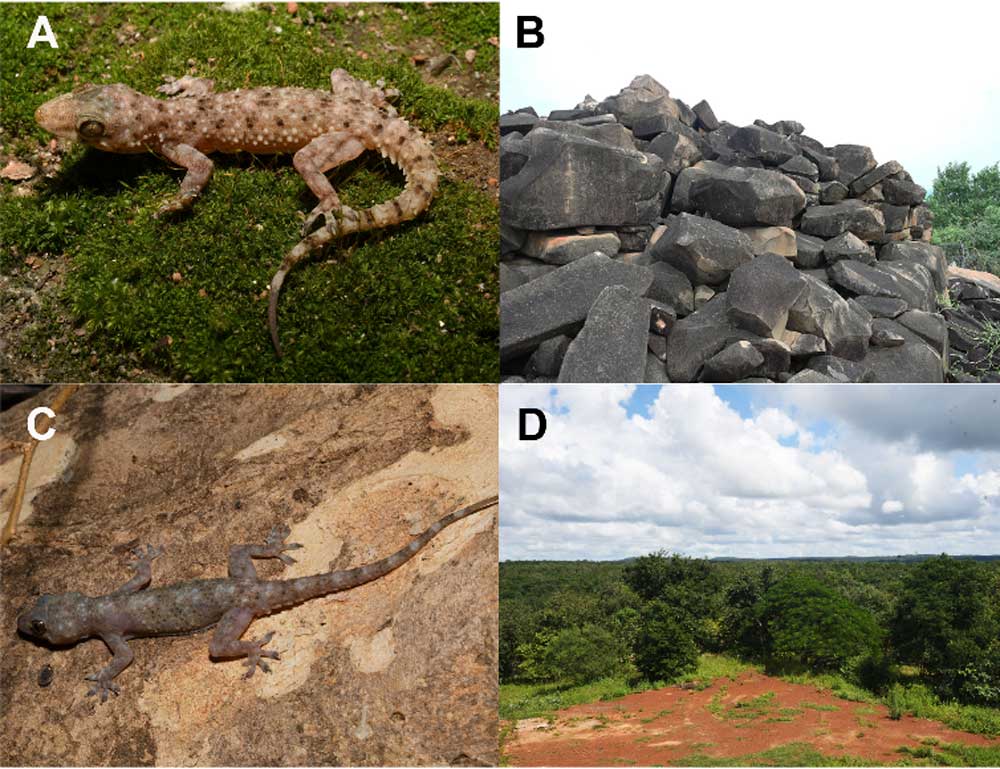
They were discovered in the Central Plateau, Deccan Peninsula and are assigned to the Hemidactylus brookii group, Murrayi clade.
Researchers have discovered and described two new gecko species of the family Hemidactylus from the Nalgonda and Warangal districts of Telangana State, India. They were discovered in the Central Plateau, Deccan Peninsula and are assigned to the Hemidactylus brookii group, Murrayi clade.
Hemidactylus cairnicola
Hemidactylus cairnicola is a medium-sized gecko reaching 49 mm in snout-to-vent length. It has a relatively stout, slightly depressed body and a large head distinct from the neck. Its dorsal scalation consists of granular scales intermixed with enlarged, strongly keeled, conical tubercles arranged in 13–15 longitudinal rows from the occiput to the base of the tail. The belly has approximately 31–32 scale rows across its width and 137–145 longitudinal ventral scales. Males have seven or eight femoral pores on each side.
The species is currently known only from its type locality in Nalgonda District, Telangana, where it inhabits rocky outcrops within rocky scrub forest and adjacent agricultural landscapes. It is frequently encountered on black rock cairns and exposed rock surfaces, where its light-brown to gray coloration varies with the background and provides effective camouflage. The head has several dark spots and paired preocular and postocular streaks, while irregular dark markings extend across the body and tail. The underside is lighter and unpatterned.
Primarily nocturnal, H. cairnicola retreats into rock crevices during inactive periods and emerges at night to forage for insects. Individuals have also been observed resting or basking on exposed rocks during winter and rainy days. It occurs near villages and traditional Lambada settlements and can be found near several other reptiles, including geckos, skinks, agamid lizards and the Indian sand boa, Eryx johnii.
Hemidactylus koyaorum
Hemidactylus koyaorum is endemic to the Deccan Peninsula biogeographic zone and is currently known only from its type locality in Warangal District, Telangana. It belongs to the Hemidactylus brookii group and the murrayi clade, where it is most closely allied to H. treutleri. Mitochondrial ND2 sequences reveal substantial genetic differentiation from H. treutleri, with an uncorrected divergence of 7.0–13.5%. The two new species are themselves separated by 9.5–10.0% sequence divergence.
The researchers are Bharath Bhupathi¹, Sumidh Ray², B. Laxmi Narayana³, Amirtha Balan⁴, Deepa Jaiswal⁵ and Pratyush P. Mohapatra. They are from the Freshwater Biology Regional Centre, Zoological Survey of India, Hyderabad 500048, Telangana, India; ² P.G. Department of Zoology, Fakir Mohan University, Balasore, Odisha, India; ³ Zoological Survey of India, FPS Building, Indian Museum Campus, Kolkata 700016, West Bengal, India; ⁴ Nehru Zoological Park, Bahadurpura, Hyderabad 500064, Telangana, India; ⁵ Wildlife Institute of India, Chandrabani, Dehradun 248001, Uttarakhand, India.
The complete paper, 1BC39296DED5Two new cryptic species of Hemidactylus (Reptilia: Gekkonidae)allied to H. treutleri from Telangana, India, can be read on the European Journal of Taxonomy website.