
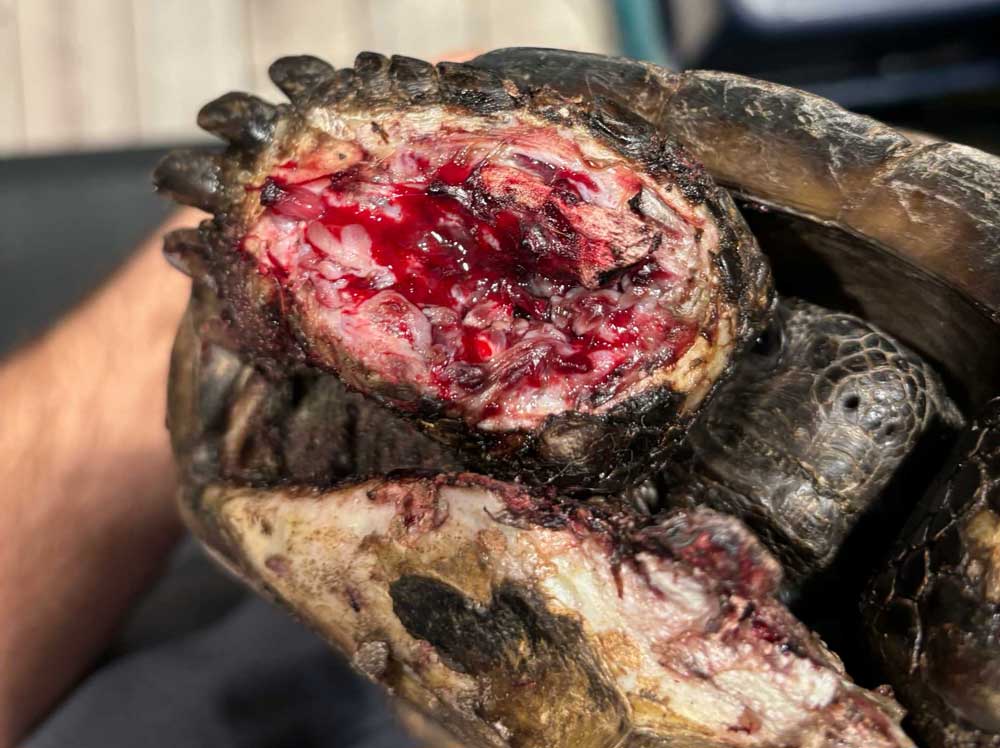
For any challenge reptiles face, their scaly skin finds ways to provide their owners advantages in adaptation. With scales so integral to their lives, when there are issues with the skin it can cause significant issues.
One of the most defining features of reptiles are their scales. These scales are not static structures. They vary based on the taxa. Some reptiles, such as varanids and crocodilians, have bone embedded in their scales. Others like those seen in rattlesnakes, are keeled. The hides of Uromastyx and Chuckwallas are elastic to allow for their inflation behaviors. In some geckos and all snakes, scales have taken the role of the eyelid to form the spectacle. For any challenge reptiles face, their scaly skin finds ways to provide their owners advantages in adaptation. With scales so integral to their lives, when there are issues with the skin it can cause significant issues. This article will plan to go over broad issues that affect reptile skin. This article is not meant to be a guide in how to diagnose/treat skin issues in your reptile. If you have concerns, it is best to go to your reptile veterinarian to get your animal evaluated.
Infectious Dermatologic Diseases
Bacterial
Bacterial skin infections are commonly seen in reptiles. There can be two forms of these kinds of infections—bacterial dermatitis and abscesses. Bacterial dermatitis can present in multiple ways. It can present as ulceration (eating away at the skin) with or without bleeding, loss of scalation, crusting, and pain on palpation. An example of a bacterial dermatitis is Devrisea agamarum, which is a significant pathogen for Uromastyx and other agamid lizards. This is especially important as bearded dragons are asymptomatic carriers, thus can be 100% normal but pass it to susceptible species. Other generalized infectious of the skin affecting different parts of the body are often colloquially called “x rot” like tail rot. While the causative organisms and underlying causes can vary, these conditions often present with some degree of necrosis of the affected area. Bacterial dermatitis can also be a manifestation of systemic disease, seen with conditions like Septic Cutaneous Ulcerative Dermatitis aka SCUD.
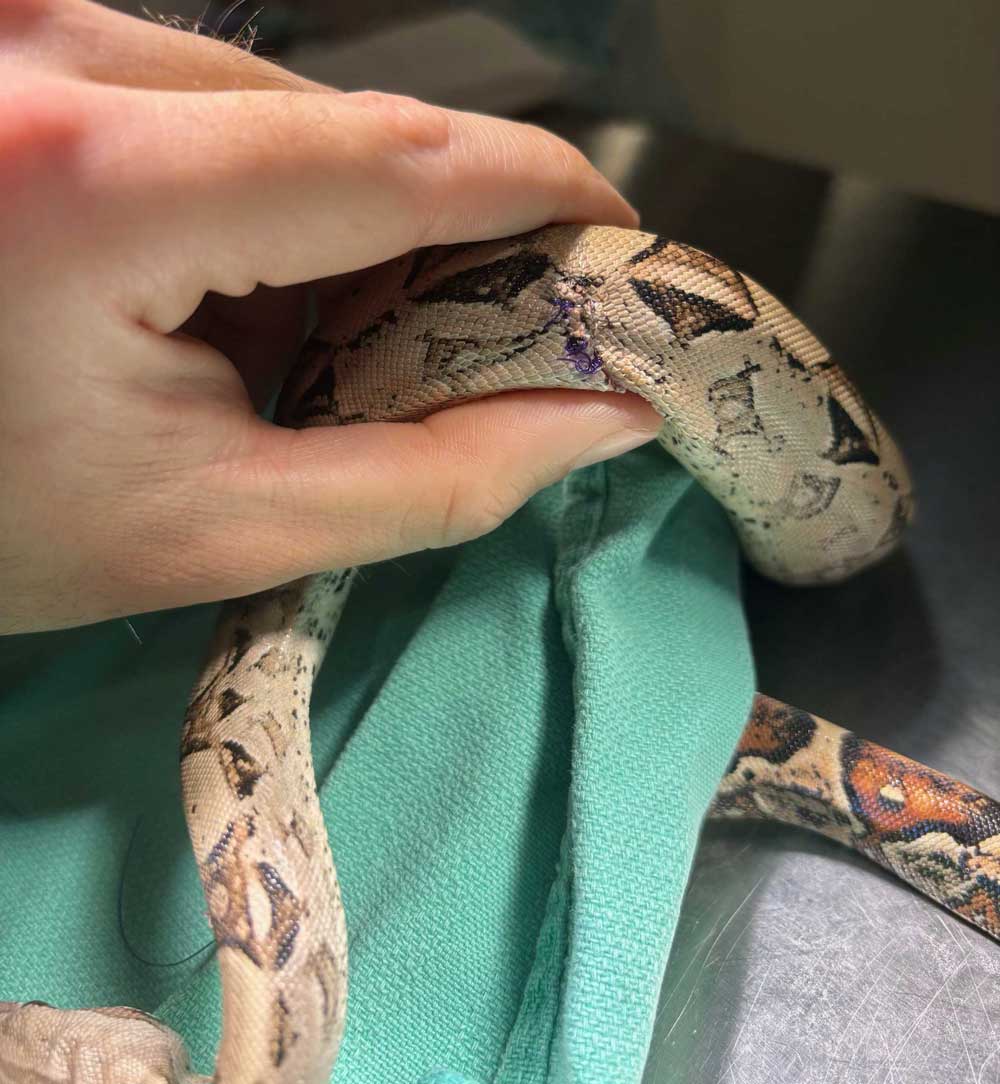
Boa constrictor with skin disease
Abscesses form from chronic wounds/infections and are how reptiles respond to these lesions. Because reptiles lack peroxidase enzymes (the ones that make our pus liquidy), reptile abscesses are often thick. These require surgical removal because the thick walls that stop the spread of infection also stop antibiotics from targeting the infection.
Viral
Viral diseases are implicated in many diseases in reptiles. Skin lesions in viral infections can often come as part of a systemic infection as well. Poxviruses can affect several kinds of reptiles and behave similarly to mammalian poxviruses. A notable example of a viral infection in a reptile is the fibropapilloma virus (https://shorturl.at/HTBrU) seen in sea turtles, which is caused by a herpesvirus creating large nodules on the face and flippers. Other viruses such as ranaviruses and papillomaviruses also affect the skin.
Fungal
Several fungal organisms have been implicated with dermatitis in reptiles. Oftentimes, these fungal organisms also cause systemic illness as well. These infections are all often very contagious to other reptiles. Examples include yellow fungus in bearded dragons/other lizards, snake fungal disease (https://shorturl.at/IegiU), and Emydomyces affecting box turtles and pond turtles.
Parasitic
Parasites can be on the outside of the body aka ectoparasites or internal aka endoparasites. Mites are a prevalent issue affecting captive reptiles, with snake mites (https://shorturl.at/64cuT) being a prominent example. Additionally, some endoparasites like tapeworms and nematodes can cause nodules/granulomas in reptiles, especially when the reptile is an intermediate host, or not the primary host for the parasite. Parasites will do this so that when the reptile is consumed by the primary host they can infect the GI tract and complete their life cycle.
Non-Infectious Dermatologic Diseases
Dysecdysis
Dysecdysis (https://shorturl.at/yLoJy), or abnormal shedding, happens due to something affecting the shedding cycle, or ecdysis. Oftentimes, there is a delay in shedding, which causes stuck shed. This typically is due to inadequate husbandry conditions such as low humidity levels. In mild cases warm water soaks and careful assistance can help remove stuck shed; however, if sufficient layers build up, underlying areas can become necrotic and may require amputation. This often occurs on the toes and tails of lizards. Dysecdysis also includes accelerated shedding, which can be due to irritation to the skin such as mites and suture or metabolic issues.
Trauma
Trauma can occur within the enclosure and outside of the enclosure. Ensuring enclosure decorations are sturdy/will not move and watching your reptile diligently when it is out of the enclosure are important. Be careful with certain types of reptiles as one such as giant day geckos can slough off portions of scales with excessive handling. Rare forms of trauma I’ve witnessed include body wall hernias in leopard geckos. These occur for a variety of reasons and result in a tear in the body wall causing internal organs to be pushed out underneath the skin.
Burns
Thermal burns occur in reptiles when they are not provided ideal basking spots. They can occur with the usage of heat rocks- which are dangerous and not recommended- usage of a heat mat without a thermostat, or too small of a basking spots (think a large monitor lizard trying to warm its entire body with one basking bulb). Ways this can be avoid are using thermostats to regulate temperature and creating basking spots large enough to warm the reptile’s entire body.
Bites
These can occur between cage mates or between your reptile and its food. If housing reptiles together, it is important to stay on top of them to ensure there is minimal fighting. This can be done by providing multiple basking spots, hides, and food/water bowls. This can also happen when prey items defend themselves. This is why it is recommended to remove any uneaten crickets from an enclosure and not to feed live rodents.
Edema
Edema, or fluid accumulation under the skin, can also occur and cause compressible swellings underneath the skin. This can occur in reptiles with congestive heart failure (CHF), liver disease, and renal disease.
Cancer
Not every mass in a reptile is an abscess. Unfortunately reptiles are not immune to cancer, and really any kind of cancer can cause masses. I’ve see melanomas in turtles, squamous cell carcinomas, mast cell tumors, and sarcomas in bearded dragons, and lipomas in snakes.
Nutritional
Nutritional diseases can affect the skin as well. Vitamin A is important for maintaining moist mucous membranes such as the inside of eyelids, the inside of the mouth, and within the hemipenes of lizards. Without sufficient vitamin A, these areas start to accumulate keratinous debris. This can cause keratin build up in the eyes of leopard geckos, aural/ear abscesses in aquatic turtles, hemipenal plugs, and stomatitis (or inflammation of the mouth) in lizards. Supplementing appropriate vitamin A levels and treating any presenting issues is key.
Gout, particularly articular gout, can also cause a swelling at a joint. This causes a lot of pain and when aspirated may show a large amount of chalky white debris. Gout treatment includes pain medications, allopurinol to reduce further accumulation of uric acid into the joints, and husbandry modifications in the realm of diet, hydration/humidity, and temperature.
Preventing Dermatologic Illnesses in Reptiles
The best way to minimize skin diseases in reptiles is providing optimal thermal/humidity gradients. Substrate used should be cycled/replaced regularly, as substrate too wet can lead to infections and too dry can lead to issues such as stuck shed. Additionally, ensuring proper cleaning/maintenance of the enclosure is paramount. If there is a water feature and the reptile is aquatic, providing a powerful filter and frequent water changes will help reduce irritation to the skin from excessive waste in the water. Most importantly, if you see something concerning, bringing your animal to an exotic veterinarian immediately will help treat issues before they progress.
Eric Los Kamp, DVM, is an exotic animal and wildlife veterinarian at Winter Park Veterinary Hospital in Winter Park, Florida who has aspirations to board certify in reptile/amphibian medicine. In addition to being a member of the Association of Reptile and Amphibian Veterinarians (ARAV), he is an avid Ackie monitor keeper.