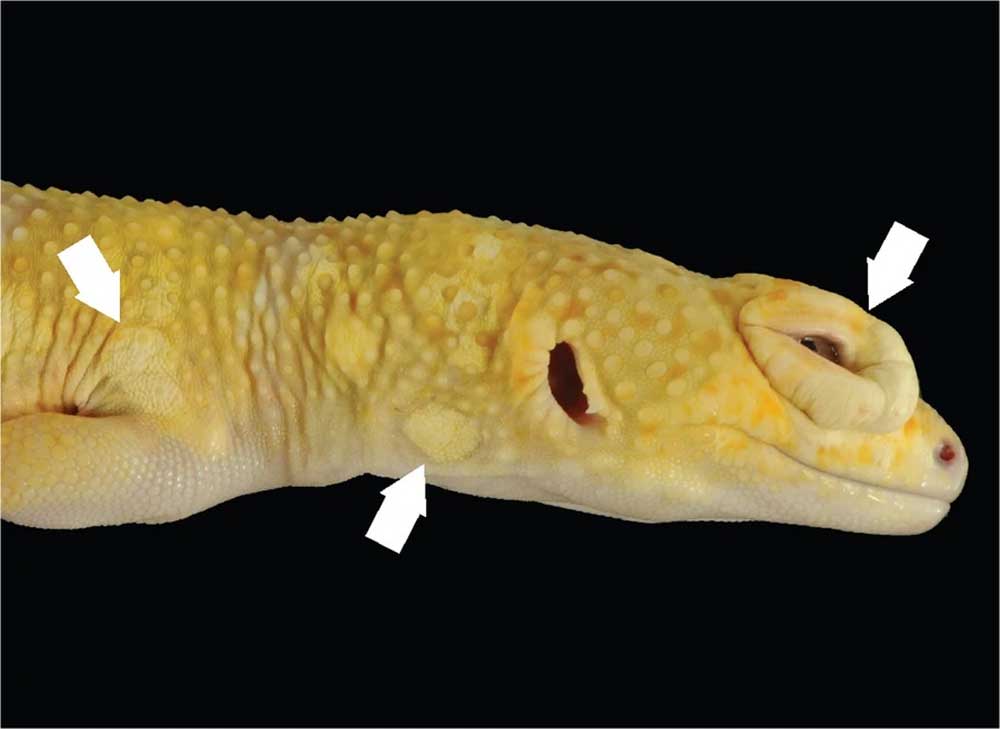
The lemon frost leopard gecko is notorious for having iridophoromas tumors under their skin. These tumors then spread to the liver.
Researchers are looking at the lemon frost morph of the leopard gecko (Eublepharis macularius) and how its high propensity for having iridophoromas cancers (more than 80 percent) provides an opportunity to study pigment cell cancers and tumors in non-mammalian vertebrates.
The researchers conducted whole genome sequencing on matched tumor and non tumor samples of the lemon frost morph and found that they share what is called a missense mutation in the TATA-box binding protein (TBP). This is akin to your DNA being a huge cookbook and each gene being a recipe, and before a cell can copy that recipe it needs to know where it begins. The TATA box is the “Start Here” sign that is located near the beginning of many genes and the TATA-box binding protein sticks to that sign after it finds it.
The researchers also found a recurrent gene fusion between the IARS1 and RNF213 genes. These genes ensure proteins are built correctly and regulate how blood vessels are developed and how they react to stress or injury. These were essentially fused together in the lemon frost morph. The researchers also found three genes that mutated have a role in the cancer in these morphs: MAP3K13, TENM4, and OR2AT4. These mutations essentially changed the genes, causing “dysregulation in actin filament organization, which the researchers say is a hallmark of metastatic potential. This potentially causes tumorigenesis including transcriptional misregulation, chromatin remodeling defects, and cytoskeletal disruption.
These cancers are found in 80 percent of the lemon frost leopard geckos the researchers studied. The iridophoromas are a pigment cell neoplasm in reptiles. This causes the iridophores, or cancers to grown uncontrolled in the dermis. They are formed as dense white nodules, and while initially confined to the dermis and can be surgically removed, they can appear in other areas over time and these legions easily metastasize and spread, with the most frequent site being the liver.
The researchers wrote in their paper that their study offers the “first characterization of genomic changes associated with iridophoroma in a reptilian species and establishes the lemon frost gecko as a promising model for cancer research.”
The complete paper, “Dissecting cancer in a non-mammalian model: genomic insights from lemon frost geckos,”can be read on the Springer Nature Link Journal.
Some Background on the Lemon Frost Leopard Gecko
Reptile breeder Steve Sykes purchased a pair of the lemon frost leopard gecko morph from a breeder in 2015 and after a year breeding the male with other geckos, Sykes noticed some of the offspring were growing small white bumps on their bodies, which Sykes knew to be tumors. Sykes wanted to know if there was a way to breed the lemon frost morph free of the tumors, and if the coloration was linked to the cancers, so his geckos got into the hands of Leonid Kruglyak, an evolutionary geneticist with the University of California, Los Angeles.