
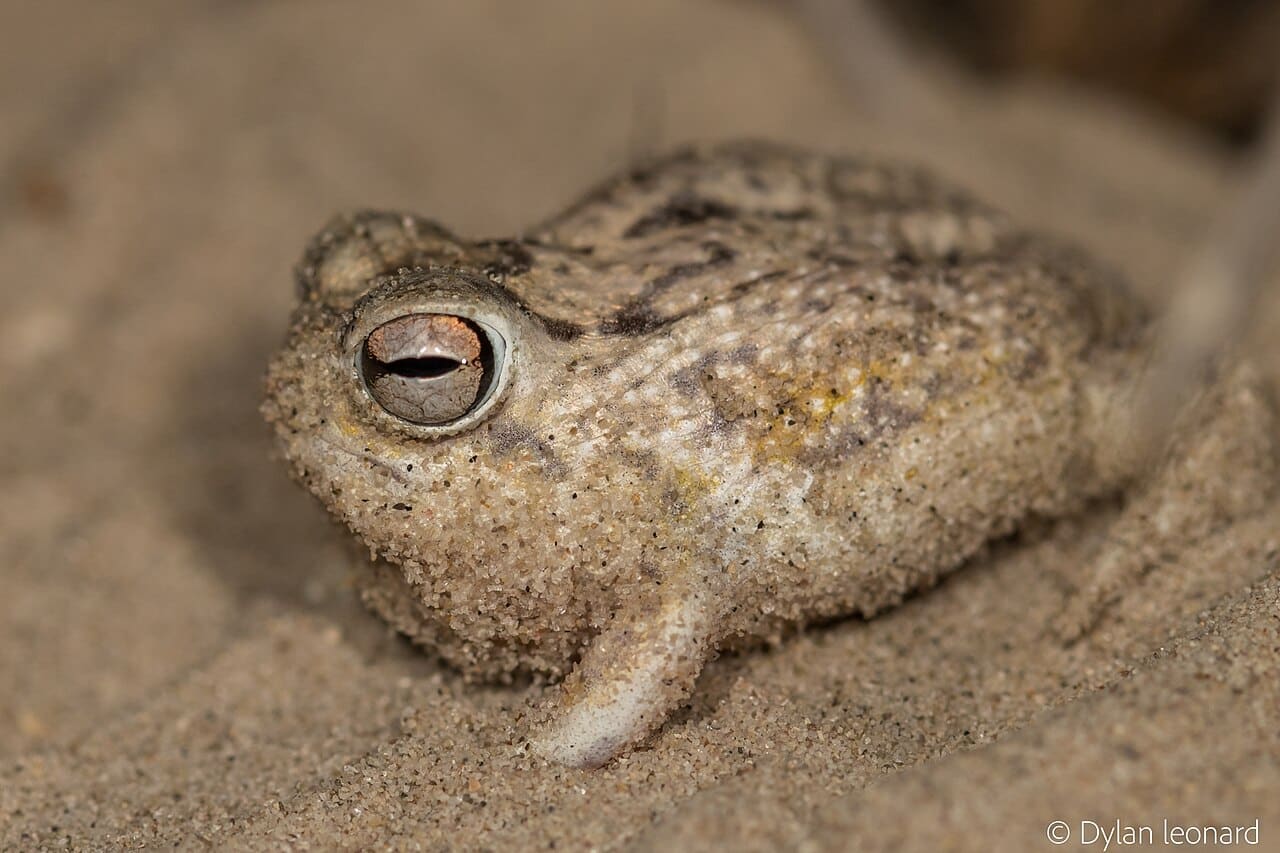
Breviceps macrops is the only frog in the genus named the desert rain frog.
The desert rain frog (Breviceps macrops), once the darling of social media for its fubugly face and cute squeak has been moved to Vulnerable from Near Threatened on the IUCN Red List.
The IUCN says in its July 9 press release that diamond mining and energy infrastructure development on Namibia and South Africa’s west coast has contributed to the decline of the frog. The IUCN also points to expanded industrial development and a green hydrogen project as factors that will negatively impact 1/3 of the desert rain frog’s range in South Africa and 2/3 of the amphibian’s range in Namibia in the next 20 years.
The IUCN also noted that suspected demand for this species grew due to a viral video in 2013. Other factors that the IUCN says can be negatively affecting this species are heat stress and acidification. The population of Breviceps macrops is expected to decline by 20 percent if conservation measures aren’t implemented to protect the species, the IUCN said in its press release.
The desert rain frog is also known as the web-footed rain frog and Boulenger’s short-headed frog. They come out after rains to eat mostly ants, termites, beetles, moths, woodlice, amphipods, juvenile millipedes, and caterpillars. They also reproduce in the rainy season. These frogs don’t make good pets as they are exclusively wild caught and do not acclimate to life in captivity. There are unconfirmed reports of this species being successfully bred in Europe and Asia. There aren’t any documented breeding programs of this species.
It is of the family Brevicipitidae, of which there are 21 species in the Breviceps genus. They are found in arid to semi-arid climates in both eastern and southern Africa. Breviceps macrops is the only frog in the genus named the desert rain frog.