
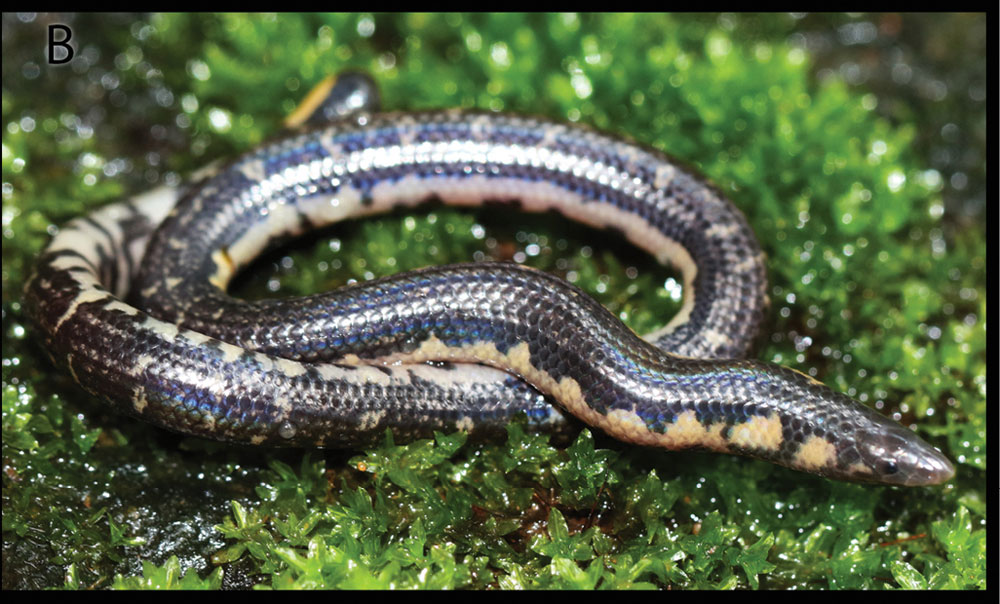
The snake was found in the Siruvani Hills in the Central and Western Ghats mountains of India. It is in the family Uropeltidae.
Researchers have described a new species of shield tail snake from the Western Ghats mountains of India. The snake was found in the Siruvani Hills in the Central and Western Ghats mountains of India. It is in the family Uropeltidae, which are known as the shield tail snakes. They are named as such because they feature a thick, flattened tail that is heavily keratinized, or strengthened by keratin, to create a tough structural tail that helps with burrowing and defense.
The snake differs from its congeners due to biogeographic and molecular phylogenetic distinctiveness. It features a lustrous, dark brownish black coloration with a creamy white bottom with irregular patches and brownish black blotches. Juveniles of the species measure between 120-140mm in length, while adults are estimated to measure 304mm, or one foot in length.
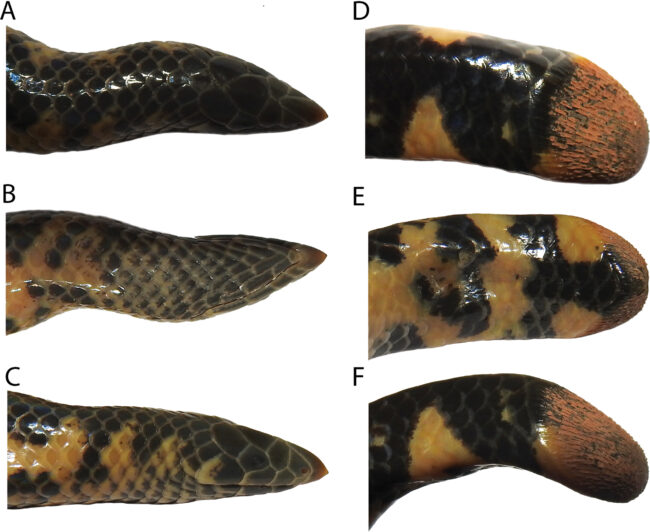
Head (left) and tail (right) of the holotype (BNHS 3387) of Rhinophis siruvaniensis sp. nov., shown in dorsal (A, D), ventral (B, E) and lateral (C, F) views. Images are not to scale. Photographs by VPC.
It is currently known to exist in the Siruvani Hills area with further surveys recommended in the Attappadi and wetter regions of Anaikatti Hills. Its habitat includes wet evergreen forests that feature villages and spice plantations. The specimens studied were found in a coffee plantation. Other individuals were found under fallen logs and rocks.
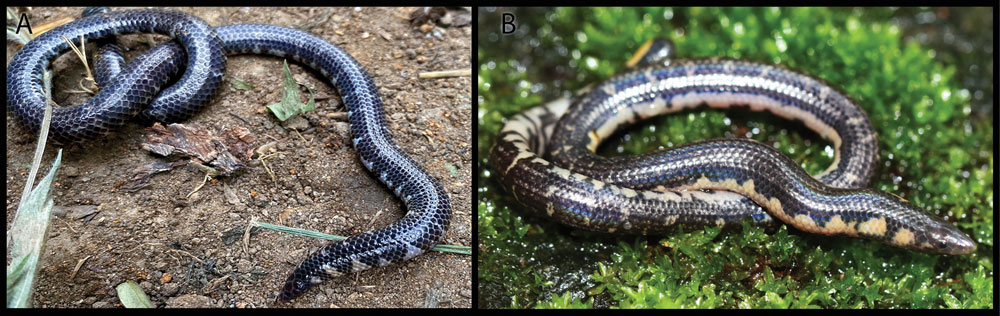
Rhinophis siruvaniensis sp. nov. in life. Paratype VPRS0622157 showing adult colouration (A) (Photograph by Nitin Xavier) and referred specimen VPRS0720116 showing juvenile colouration (B) (Photograph by UPK).
The complete paper describing the species, “A new species of Rhinophis Hemprich, 1820 (Squamata, Uropeltidae) from Siruvani Hills, Western Ghats, India” can be read on the Evolutionary Systematics website. The researchers who described the new species are Vivek Philip Cyriac, P. K. Umesh, N. S. Achyuthan, Vidisha Kulkarni, and S. R. Ganesh of the Centre for Ecological Sciences, Indian Institute of Science, Bengaluru, India, § Wayanad Wild, CGH Earth Experience, Wayanad, India, and Kalinga Foundation, Shivamogga, India.