
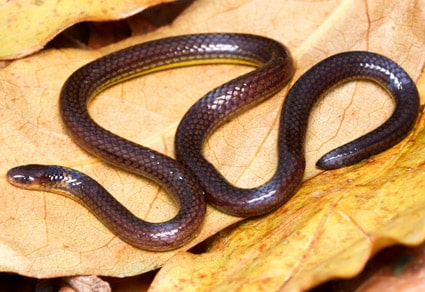
The burrowing snake species was found in montane evergreen forests in the state and adds to the number of herpetological findings in the area
Researchers have described a new species of snake from the genus Calamaria. The Calamaria genus is comprised of 66 recognized species of dwarf, burrowing snakes. The new species, Calamaria mizoramensis sp. nov (proposed “Mizoram Reed Snake”) was discovered in Mizoram State, India. Mizoram sits at an elevation of 670 to 1,295 meters.
The burrowing snake species was found in montane evergreen forests in the state and adds to the number of herpetological findings in the area that comprises an Indo-Burma biodiversity hotspot. The researchers say the herpetofauna in Mizoram state currently comprises 169 species, including 117 reptiles and 52 amphibians.
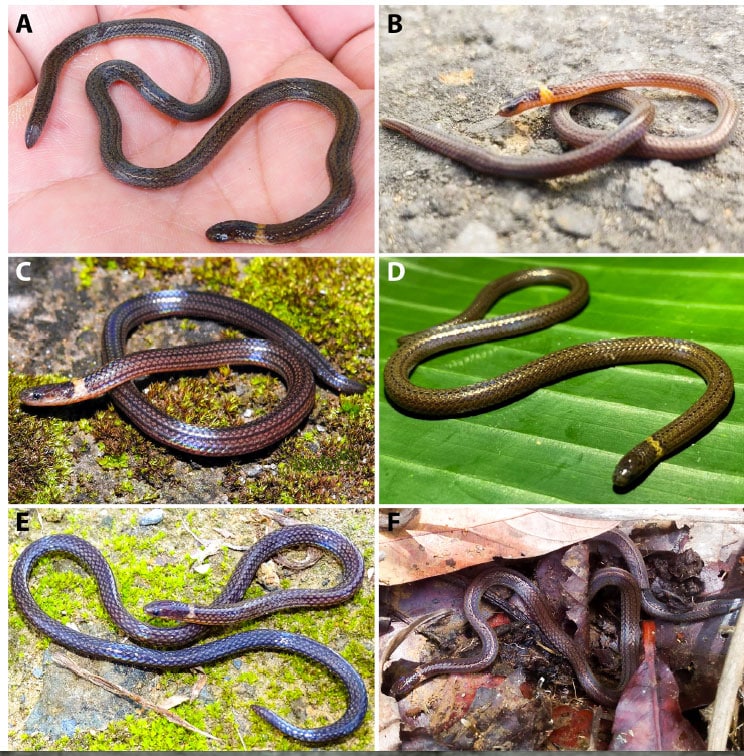
FIGURE 5. Photographs in life and in situ of Calamaria mizoramensis sp. nov. from Mizoram, India. (A) Sawleng, Saitual (MZMU 865); (B) North Hlimen, Kolasib (MZMU 915); (C) Chanmari West, Aizawl (MZMU 867); (D) Sihphir, Aizawl (MZMU 2411); (E) Kawrthah, Mamit (MZMU 866); (F) Tlangpui, Mamit (uncollected). Photographs by H.T. Lalremsanga (A, E), J.C. Alfred Van Sanglura (B), Vanlal Hrima (C), Lalzarzoa (D), and Lal Muansanga
Calamaria mizoramensis Description
Calamaria mizoramensis is genetically diverse from its congeners from a distance of 15.3 percent, the researchers say. It is different from its congeners by its “8-11 enlarged maxillary teeth; rostral higher than wide; prefrontal shorter than frontal and contacting the first two supralabials; mental not in contact with anterior chin shields; dorsal scales in 13-13-13 rows, smooth throughout; a single preocular and postocular; four supralabials, with the 2nd and 3 rd ones contacting the eye; five infralabials; six scales surrounding the paraparietal; 147-175 ventrals; 13-27 paired subcaudals; a relatively short tail (10.3-13.1% in males, 4.7-6.5% of total length), thick and nearly cylindrical, terminating in an obtuse tip; dark brown to blackish-brown, with three to six longitudinal rows of slightly paler or dark-edged scales forming indistinct stripes of variable clarity along the body and a faint pale nuchal ring; a yellow ventral surface with dark outer corners on the ventral scales; and a broad, distinct median black stripe on the ventral surface of the tail,” the researchers wrote in their paper and as described in the abstract detailing the new species.
The researchers conducted DNA analysis to confirm Calamaria mizoramensis as a new species. The snake is blackish-brown in coloration on its dorsal side and yellow on its ventral side with a darker stripe from the second subcadault to the tip of the tail. It features six longitudinally stripes running along its body. The male holotype had a total length of 251mm while the female had a total length of 259 mm. The researchers say the coloration of the snake provides great camouflage in the leaf litter habitats where the snake can often be found.
The snake is in the family Colubridae. An abstract of the paper describing the new species, “A new species of the genus Calamaria H. Boie in F. Boie, 1827 (Squamata: Calamariidae) from Mizoram State, India” can be read on the ResearchGate website.