The photograph provides some insight into the nesting habitat of this species as well as the timing of larval development, which is important for the study of this species as well as the conservation of the species as well.
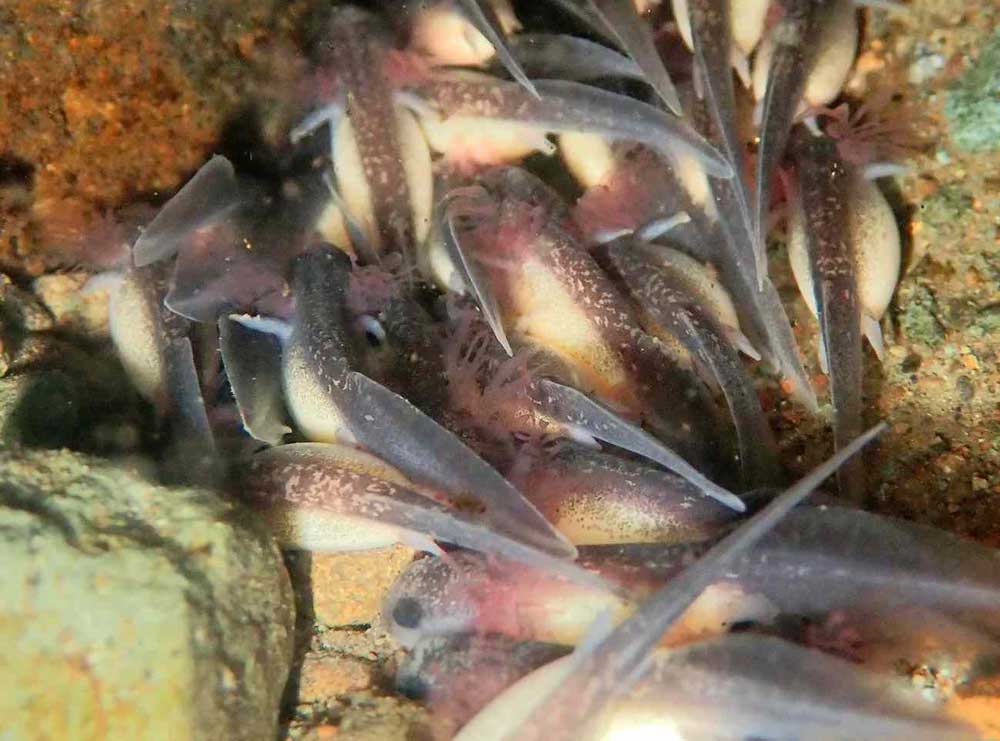
A fish biologist snorkeling in the upper Olema Creek in Point Reyes, California discovered a cluster of California giant salamander (Dicamptodon ensatus) larvae while searching for juvenile coho salmon. Biologist Michael Reichmuth has been surveying the creek for 20 years and has always documented other species he sees, but his photographs of the salamander larvae taken in September 2025 are the first that he had seen and also documented the first time that a cluster of the recently hatched California giant salamander larvae had been seen by scientists in the wild at this life stage.
Patrick Kleeman, a U.S. Geological Survey biologist and amphibian expert confirmed that the larvae are indeed California giant salamander larvae. “The location in a small stream known to harbor a population of California giant salamanders makes it the most likely species,” he said in a National Park Service story detailing the find of these amphibians.
The photograph provides some insight into the nesting habitat of this species as well as the timing of larval development, which is important for the study of this species as well as the conservation of the species as well.
The species is listed as a species of special concern in California. And they are classified as a near threatened species by the International Union for Conservation of Nature, due in part their minuscule range in coastal, Central California and sensitivity to changes in the environment.
California Giant Salamander Information
The California giant salamander grows to about 7 to 12 inches in length, including the tail, and is largely brown, sometimes marbled or reticulated pattern in coloration as adults. They are one of the few salamander species that can vocalize. They are one of the most difficult amphibians to study because they are not easily seen and are not captured in traps set out for them with any regularity. The love in damp coastal forests in montane and riparian habitats. They are found in coastal forests that include Douglas Fir and California coast redwood forests. On land, they are found under leaf litter and in tunnels while in the water they are known to inhabit cool rocky streams and sometimes in lakes and ponds.
The terrestrial California giant salamander feeds on snails, slugs, beetles, caddisfly larvae, moths and flies. They also feed on white-footed mice, shews and possible reptiles and other amphibians. There are reports of cannibalism in the species, of smaller specimens. The aquatic adults feed on aquatic invertebrates, fish, snakes and other amphibians.