
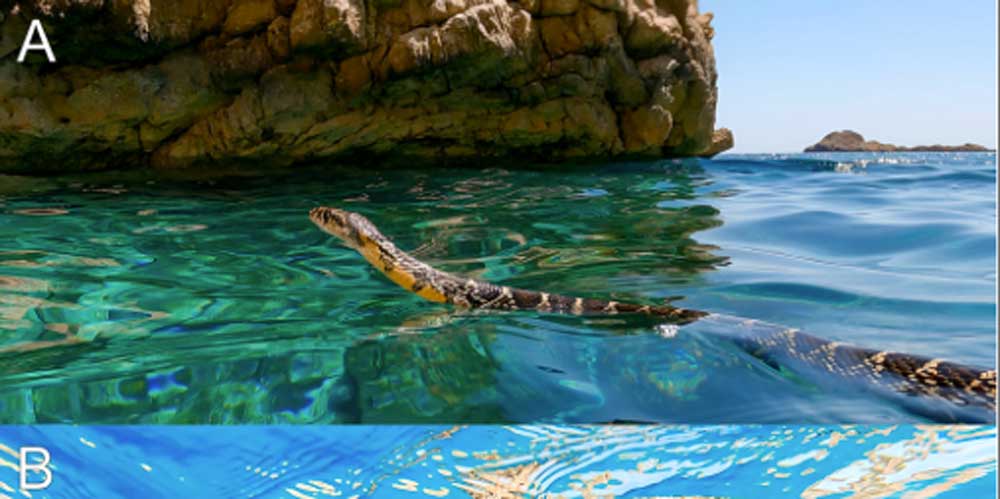
According to researchers, the wall lizard represents more than half the diet of the snake, and due to this, the lizard has been reclassified as Endangered by the IUCN.
The Ibiza wall lizard (Podarcis pityusensis), one of the most colorful lizard species in the world, has been negatively impacted on its island homes of Ibiza and Formentera in the Mediterranean Sea. This is due to the horseshoe whip snake (Hemorrhois hippocrepis), an introduced species (likely via imported olive trees) that is preying on the wall lizard.
According to researchers, the Ibiza wall lizard represents more than half the diet of the snake, and due to this, the lizard has been reclassified as Endangered by the IUCN. Culling of more than 12,000 of these invasive snakes since 2016 hasn’t stopped the spread of the species across the main island of Ibiza, and in fact, the population of the snake has accelerated, leading to a more rapid decline of the iconic lizard.
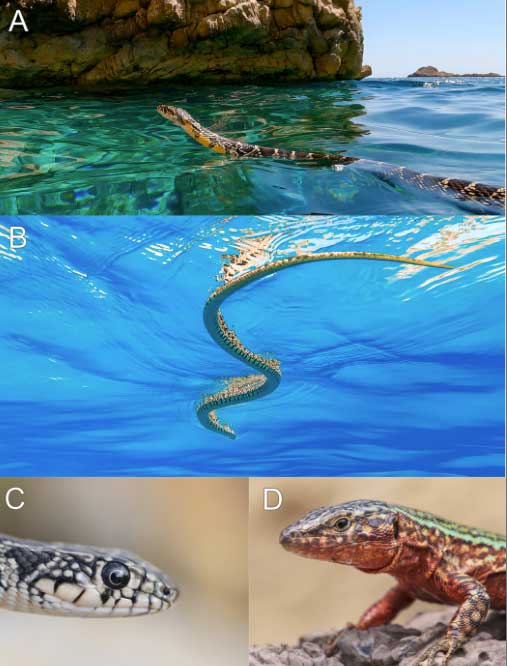
Horseshoe whip snake swimming in open water off the coast of Ibiza, displaying the same behavior observed during the colonization of Santa Eulària islet. (C) A close-up of the invasive snake. (D) An individual from the now-extirpated Ibiza wall lizard population on Santa Eulària islet. This image might be the last picture taken of an individual belonging to this evolutionary significant unit. Photo credits: A, B—Rubén Casas; C—Guillem Casbas; D—Roberto García-Roa.
Scientists initially had thought that small populations of the Ibiza wall lizard living on surrounding islets were considered safe from predation, but that is no longer the case. Researchers in April 2024 discovered, during a routine marine bird nesting and monitoring campaign, a horseshoe whip snake swimming from the main island toward the islet and reaching it. This interaction was captured on video, and a second interaction was also observed and photographed showing the invasive snake exhibiting open sea swimming behavior. A third snake was found on the islet. That snake was captured and euthanized. This isn’t the first instance of the snake on the islet. In September 2023, 12 snake traps were deployed on the islet with active monitoring. From the time of the installation of the traps to May 2025, 58 snakes were captured either via hand or via the traps. Santa Eulària islet is only 4.67 hectares. This puts the estimated density of the snake at 12.4 snakes per hectare.
The researchers in 2023 then conducted surveys to determine the abundance of the wall lizard. They observed only two lizards September 28, 2023 and one lizard October 4, 2023. Contrast this with a 2016 census where 72 lizards were found along an 869 meter transect on the same islet. This suggests the population was abundant 10 years ago. Eleven more visits were made between October 2023 and May 2025 and zero lizards were observed. The population on Santa Eulària is now considered completely extirpated.
The complete paper, Swimming snakes wipe out endemic lizards from Mediterranean islets” can be read on the Ecology Society of America website.