
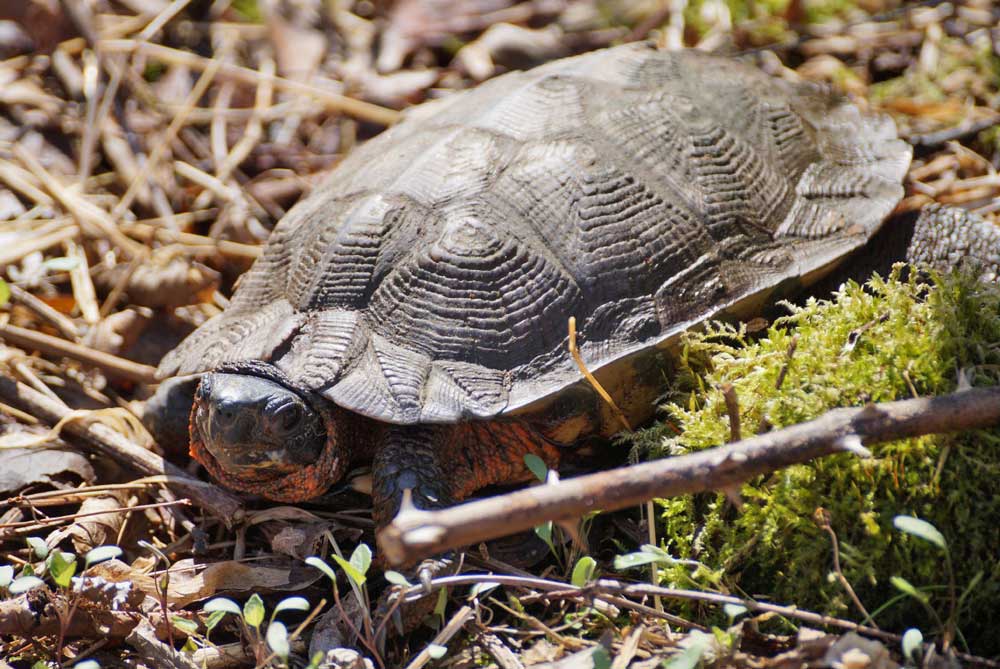
Researchers with the Great Hollow Nature Preserve and Ecological Research Center in Connecticut studied wood turtles (Glyptemys insculpta) in the Catskill Mountains of New York and concluded that the turtles may be able to persist at higher elevations as temperatures rise.
As the climate changes, many species will have to adapt to survive even relatively small shifts in temperature. Researchers with the Great Hollow Nature Preserve and Ecological Research Center in Connecticut studied wood turtles (Glyptemys insculpta) in the Catskill Mountains of New York and concluded that the turtles may be able to persist at higher elevations as temperatures rise. They surveyed 28 one-kilometer stream segments and found wood turtle populations at some of the highest elevations ever reported for the species. The turtles occupied habitat with many of the same features found in the lowland ecosystems where wood turtles typically thrive.
The researchers say the higher elevations is where they believe these turtles will move up to as the climate changes and montane stream systems will likely support geo-graphically distinct populations. These populations have been ignored by conservation planning. And as climate change is projected to destroy much of the existing wood turtle habitats, the high elevation areas are likely to play a critical role in wood turtle conservation.
The researchers further noted in their paper that habitat-suitability modeling conducted in the northeastern United States shows that the optimal wood turtle habitat will be restricted to the higher elevation areas, including the Catskills mountain range. The Catskills will also become a hotspot for wood turtle habitat, serving as a climate refuge.
Wood turtles already at the higher elevations will more likely persist than those in the lowlands unless the lowland populations can move to the higher elevations at the pace of climate change, the researchers noted. The higher elevation turtles will remain the most viable under climate change. These will represent future strongholds for the species. They said that more research is necessary to determine if the lowland wood turtle populations can move to higher elevations. And the study of the turtles at higher elevations will be important to the conservation of these reptiles.
The complete paper, “High-Elevation Habitat Associations of Wood Turtles (Glyptemys insculpta) in New York’s Catskill Mountains: Conservation Implications in a Changing Climate,” can be read on the BioOne Digital Library website.