
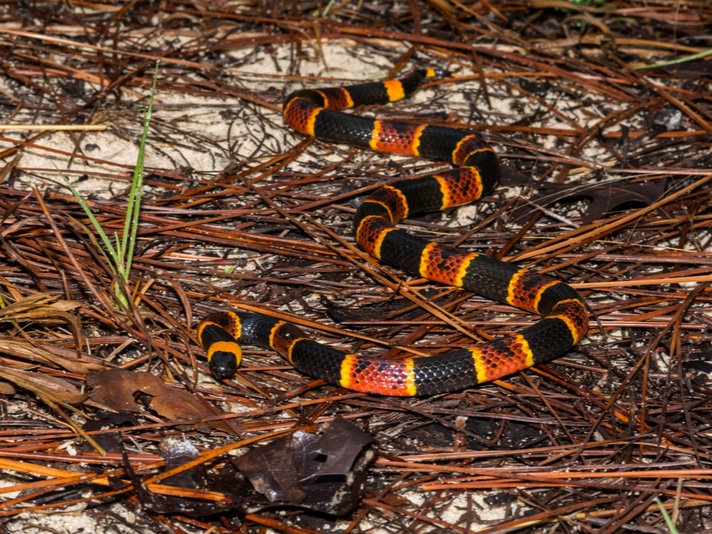
The venom of the Eastern coral snake is neurotoxic and affects the central nervous system. This leads to respiratory failure and paralysis.
Coral snakes possess a highly potent neurotoxic venom that stops nerve transmission, causing respiratory failure and paralysis if not treated immediately. Coral snakes though, tend to be shy and if people leave them alone and don’t pick them up or touch them, they most likely won’t get bitten. There are three coral snake species in the United States; the Eastern coral snake (Micrurus fulvius); the Texas coral snake (Micrurus tener); and the Sonoran coral snake (Micruroides euryxanthus).
The Eastern coral snake grows to about 2 to just under 3 ft in length. It is known for its red and black bands that are separated by a yellow band. This coloration gave rise to the old saying, red touch yellow, kill a fellow, red touch black, venom lack (or friend of Jack). This rhyme doesn’t always work, as there are abberant eastern coral snakes, and there are other coral snake species that don’t retain any of these colors. The Eastern coral snake is found from the southern portion of North Carolina to Florida and as far west as Louisiana.
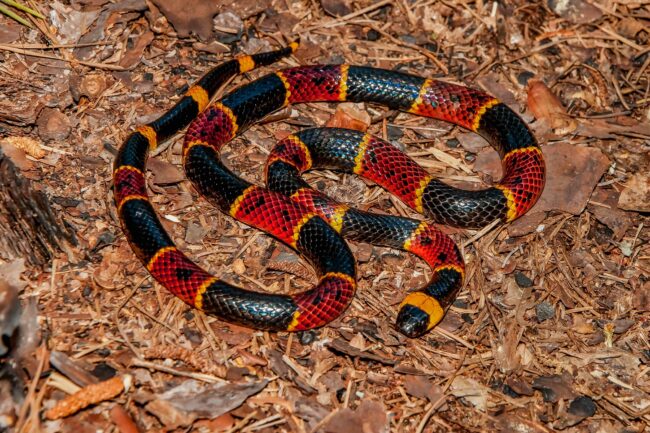
Eastern coral snake (Micrurus fulvius) Photo by Jay Ondreicka/Shutterstock
The venom of the Eastern coral snake is neurotoxic and affects the central nervous system. This leads to respiratory failure and paralysis. Coral snake bites are considered rare and their venom delivery system is not as robust as rattlesnake species. With approximately 5,000 venomous snake bites in the United States occurring every year, less than 100 cases involve coral snakes, according to the research paper “Epidemiology and characteristics of coral snake bites reported to the National Poison Data System (2006‒2022)”
Florida Herper Posts Photos To Facebook Of Eastern Coral Snake Without Red Bands
Of the 20 states that reported cases in the 17 year study, Florida and Texas accounted for 90.5 percent of all bites. April was the most reported month for coral snake bites. The study also noted that “Antivenom was administered in 21% (n = 286) of total cases and 37% (n = 511) of patients were admitted to a critical care unit. Dry bites occurred in 7% (n = 100) of total cases.” Males were bitten far more than females. Males accounted for 75 percent of all adult cases and 75.7 percent of all child cases.