It is estimated that more than 32,000 people die from being bit in Africa every year (estimated approximately 500,000 envenomations) by venomous snakes.
Just like pretty much anywhere else in the world, excepting perhaps Antarctica, Africa has plenty of dangerous creatures. Understandably, people tend to focus on the large predators that may see you as a snack, or the even larger creatures that can end you just for being nearby. However, snakes in Africa are much more likely to ruin your life (or end it) than a hungry lion, crocodile, or angry hippo.
Australia has a deserved reputation as home to the deadliest venomous snakes, but for a variety of reasons, Africa’s most venomous snakes are far, far more likely to kill humans. Snake bite statistics are notoriously unreliable—most aren’t reported, even when death results. Even when they are reported, species identification isn’t always reliable. However, it’s estimated that more than 32,000 people die from being bit in Africa every year (estimated approximately 500,000 envenomations). For all the potency of Australian snakes, there are less than a handful of such deaths yearly.
Black Mamba
(Dendroaspis polylepis)
Truly the king of Africa’s legendary deadly snakes, the black mamba bite is most often fatal to humans if untreated. Even with antivenin treatment, about 14 percent of bite victims succumb and serious disability and long-term health problems affect a large portion of survivors. Untreated bites cause nearly 100 percent mortality. Because of the unique properties of the black mamba venom, bite wounds are unremarkable, with almost no swelling and rather than pain, the victim may feel slight numbness or tingling. Untreated, a healthy adult human can die from a full envenomation in as little as 20 minutes.

Black mamba. Photo by reptiles4all/Shutterstock
The black mamba is the longest venomous snake in Africa, commonly reaching nearly 10 feet with some specimens exceeding 14 feet. Relatively slender, the black mamba is typically gray, beige, or olive colored, darkening with age. The black moniker comes from its mouth, in which it opens wide as a warning before it strikes. Extremely agile, the strike radius of the black mamba is as much as 5 feet, and many victims receive bites to the upper body where quick onset of symptoms and likelihood of fatality is increased. It typically strikes and envenoms multiple times if provoked. The agility and size of this snake give it the capability to move at speeds above 10 mph for short distances. Despite its reputation as aggressive and unpredictable, it prefers to avoid humans.
With its wide range and few natural predators, the black mamba is listed as non-threatened. An egg-laying species that hunts both on the ground and in trees, its preferred prey are small mammals and birds but have been known to take somewhat larger mammals. Although black mamba aren’t the most common source of snake bites in Africa, they are responsible for many of the deaths.
Mozambique Spitting Cobra
(Naja mossambica)
The Mozambique spitting cobra isn’t the deadliest snake in Africa, but it is certainly one of the most feared. Although fatalities are rare, severe disfiguration and blindness can occur when the venom is spit. The snake is incredibly accurate up to 10 feet with its venom and can spit without warning from its raised position (up to 2/3 its length) or prone, even in tight spaces. Its bite is quickly and severely destructive to local tissues, leaving most victims alive, but with permanent impairment. It is a temperamental and quick-to-defend-itself snake that prefers to spit first, bite if it must, then retreat.
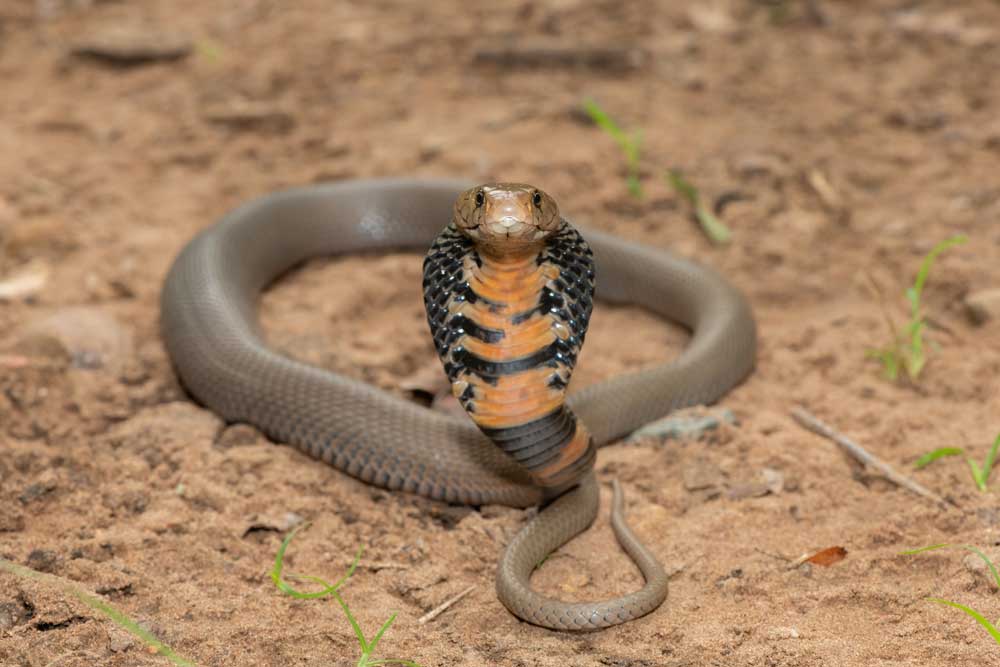
Mozambique spitting cobra. Photo by Craig Cordier/Shutterstock
A medium-sized snake with most adult specimens in the 3-foot range, one adult has been observed exceeding 5 feet. A tropical and subtropical species, the spitting cobra enjoys a large range and is listed as “least concern” by the IUCN. It is an egg-laying snake with up to two dozen offspring in a clutch. It has a highly varied diet ranging from insects, amphibians, eggs, small birds and mammals to other snakes, including the legendary black mamba.
Puff adder (Bitis ariens)
Maybe the black mamba is more deadly, the spitting cobra more fearsome, but the puff adder may be the snake that causes the most human fatalities in Africa (saw tooth vipers are challengers for this title and are responsible for the most bite-related fatalities in the world). The venom is powerful, about 100 mg can kill a healthy adult and a typical envenomation can deliver between 150 and 350 mg. It has large fangs that are capable of penetrating leather, and it is an ambush hunter that has a huge range. Finally, it has a preference of basking near walking trails and rarely retreats from humans, sometimes striking multiple times before escaping. Serious envenomations are estimated to be lethal more than 50 percent of the time and within approximately a day, but overall, with prompt and effective treatment, the fatality rate is estimated at about 15 percent.
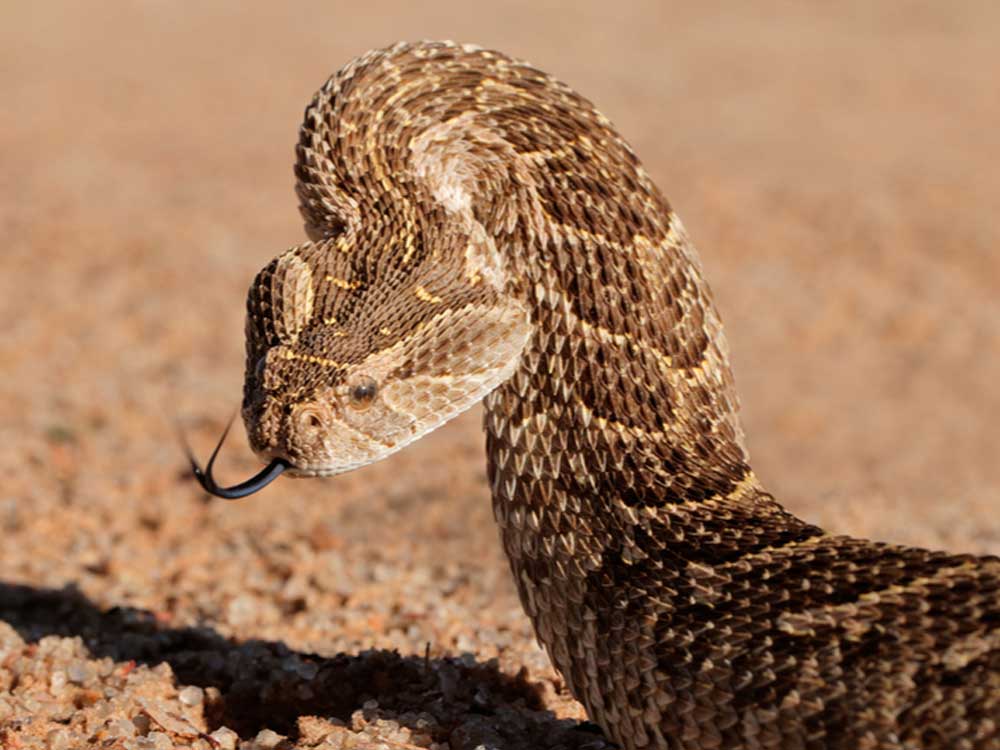
Puff adder. Photo by Eco Print/Shutterstock
Essentially everywhere in the southern half of Africa, except for the Sahara, the puff adder population is classified as least concern. Primarily feeding on rodents, other snakes and lizards. A viviparous species, the puff adder holds the snake brood record of more than 150 from a zoo-housed specimen. The most common litter size is 20 to 40 babies.
Gaboon viper
(Bitis gabonica)
Often referred to as the Gaboon adder, the Gaboon viper is incredibly deadly, but fortunately it accounts for very few human bites. The Gaboon viper is one of the heaviest venomous snakes in the world, the heaviest in Africa, and carries the largest set of fangs, exceeding two inches of any venomous snake. To go with those massive fangs, the Gaboon viper has the second largest venom capacity in the world. Unlike most vipers, it holds its prey until it succumbs, enabling it to deliver as much as 600 mg of venom in a single bite. As little as 35 mg can be fatal to a healthy adult human.
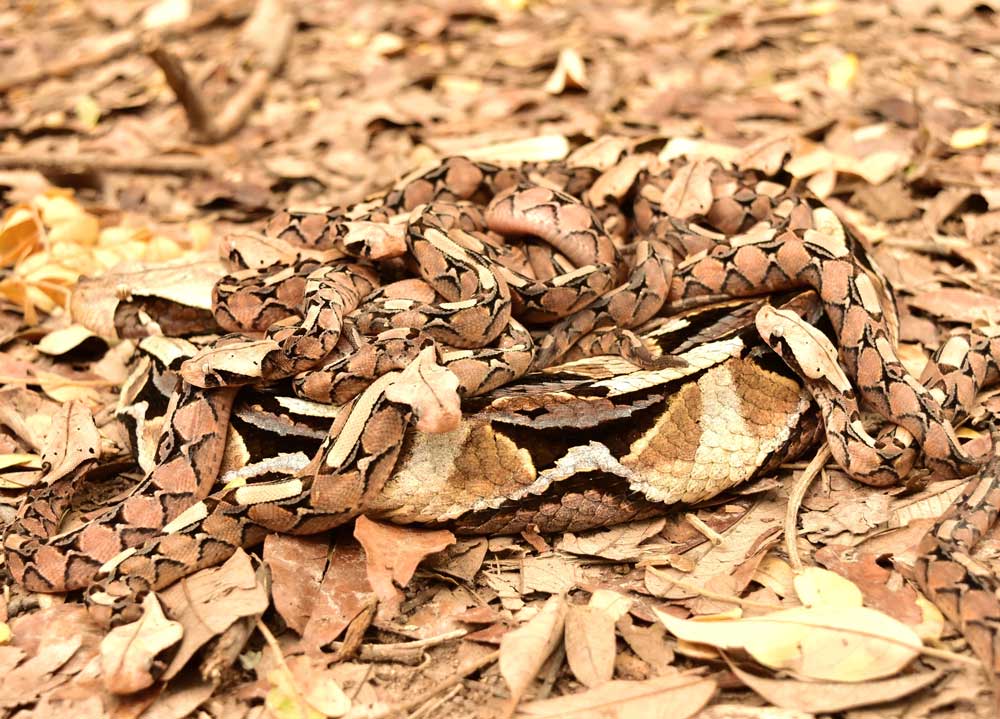
Gaboon viper. Photo by Paul Lloyd/Shutterstock
Even rapid treatment with antivenin can leave victims with a long, painful recovery and death can occur weeks after treatment. However, the Gaboon viper is one of the most docile venomous snakes. The sharply defined coloration of this viper is extremely effective as camouflage, even though it’s primarily a nocturnal hunter. Its massive head (needed to house those fangs and absurdly large venom glands) feature the most moveable eyes of any snake species.
They feed primarily on birds and small mammals, but full-grown rabbits and hare are common prey, with porcupines and even the royal antelope (average weight is 5 lb) reported. Although ambush is its main tactic, it is known to aggressively hunt in grasslands early in the evening.
Egyptian Cobra (Naja haje)
Reputed to be the means of Cleopatra’s suicide, the Egyptian cobra certainly has the tools to have done that job. Its venom is highly toxic and painful and can result in localized paralysis leading to death as effects move to the heart and lungs. Rated the third most deadly venom of all cobras, a full envenomation is estimated to be fatal to a full-grown elephant and can be fatal to a human in as little as 15 minutes.
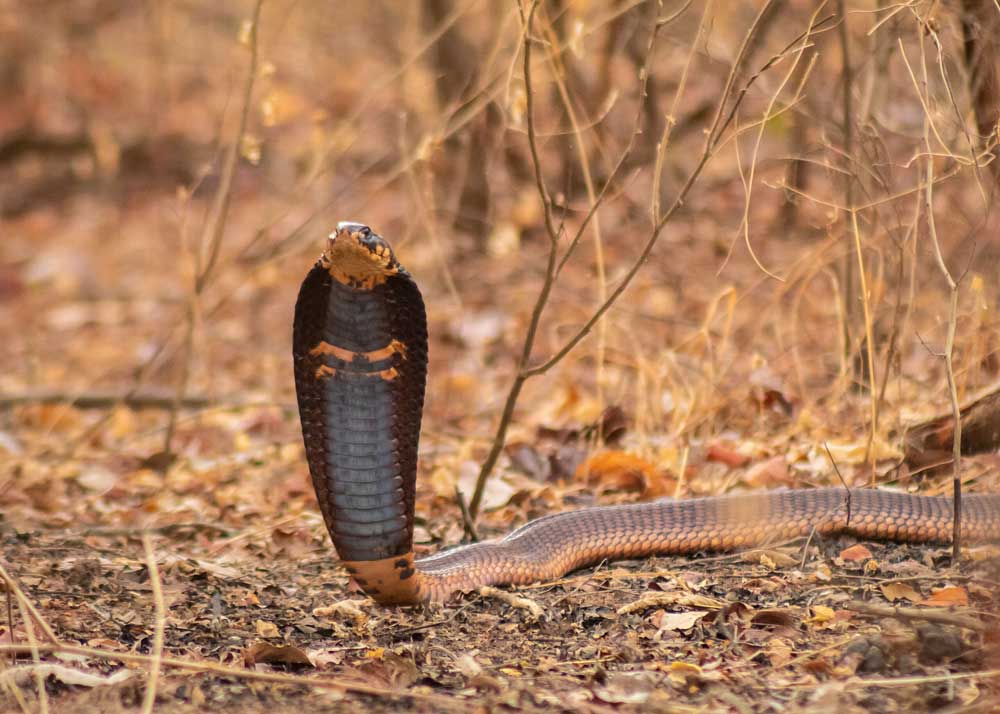
Egyptian cobra. Photo by Dotun55/Shutterstock
A large snake that can be as long as 8.5 feet, most average about 4.5 feet. They are relatively stout. Venom potency and coloration vary widely across its range. The brown to rust colored cobras occupying the northern coastal regions above the Sahara have the most potent venom while the nearly black specimens are found in the western areas.
The Egyptian cobra generally prefers toads, but will hunt rats and poultry, common in villages. They’ve been known to enter houses in pursuit of chickens and rodents. Its proximity to humans means that bites are fairly common. Quick treatment with antivenin is critical.
Boomslang
(Dispholidus typus)
Boomslang means tree snake. As that name implies, they are excellent climbers and mostly hunt from branches and shrubs in forested areas. Hatchlings, eggs, and small adult birds along with lizards and other snakes, even other boomslangs are prime prey.
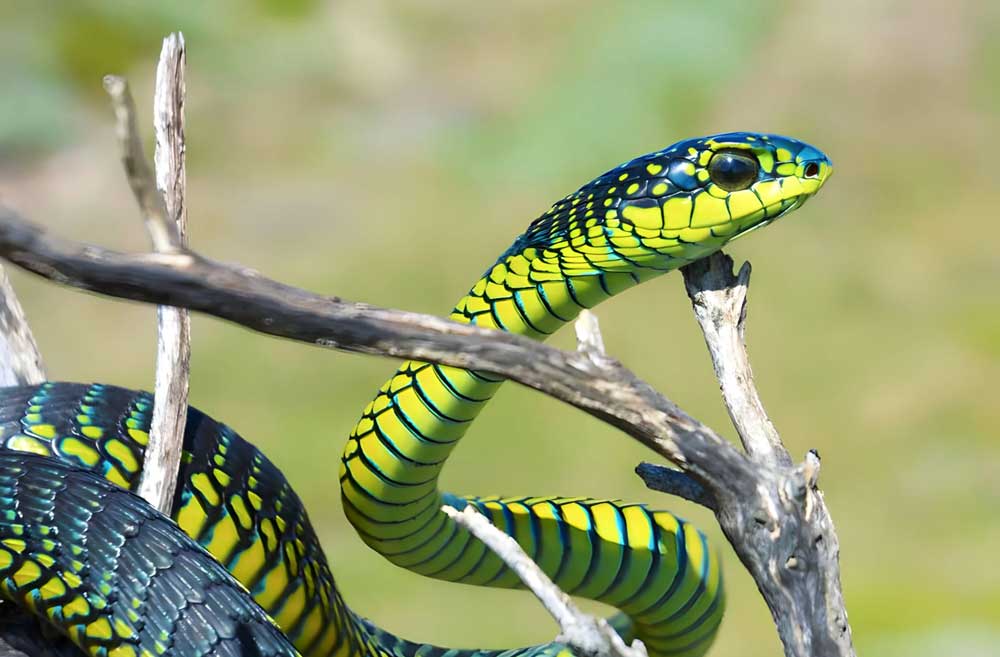
Boomslang. Photo by Tahmid Hasan-Sobuj/Shutterstock
A rear-fanged species with very modest venom capacity (1.5 to 8 mg), the boomslang makes up for lack of quantity with extreme toxicity, with some estimates of a lethal human dose being from 2 to 3 mg. Fortunately, there is a monovalent antivenin available and as deadly as the venom can be, it is pretty slow acting. Bite victims often believe they were not envenomated (dry bite) or that a non lethal dose has been delivered, but untreated, death is likely in 24 to 48 hours.
Bites are very rare as the species is extremely timid and quick to escape through the branches or brush where it is found. Although the males are typically a vivid green, females are generally brownish tan, as are juveniles of both sexes. Hatched from eggs, the young (approximately 5 inches in length) develop venom sufficient to threaten humans by the time they are approximately 18-inches in length.
Adults can reach a length of about 6 feet, but typically average between 3 and 5 feet in length and about 1 pound. Aside from the coloration and/or likely presence in a tree, the boomslang can be easily identified by its very large eyes. Identification is critical, because if you’re bitten, you’ll need the specific antivenin, even if you think you’re feeling fine.
Saw-scaled or carpet vipers (Echis coloratus, Echis hughesi) (Somalia only), (Echis leucogaster, Echis ocellatus), and the closely related Echis pyramidum
This is a nasty-tempered aggressive family of very dangerous snakes. Depending on highly debatable statistics, the family could be the biggest killer of humans in Africa, less debate is over its place worldwide—it is arguably the cause of the most snake-bite deaths in the world (some members of this family range throughout the Middle East and into India.
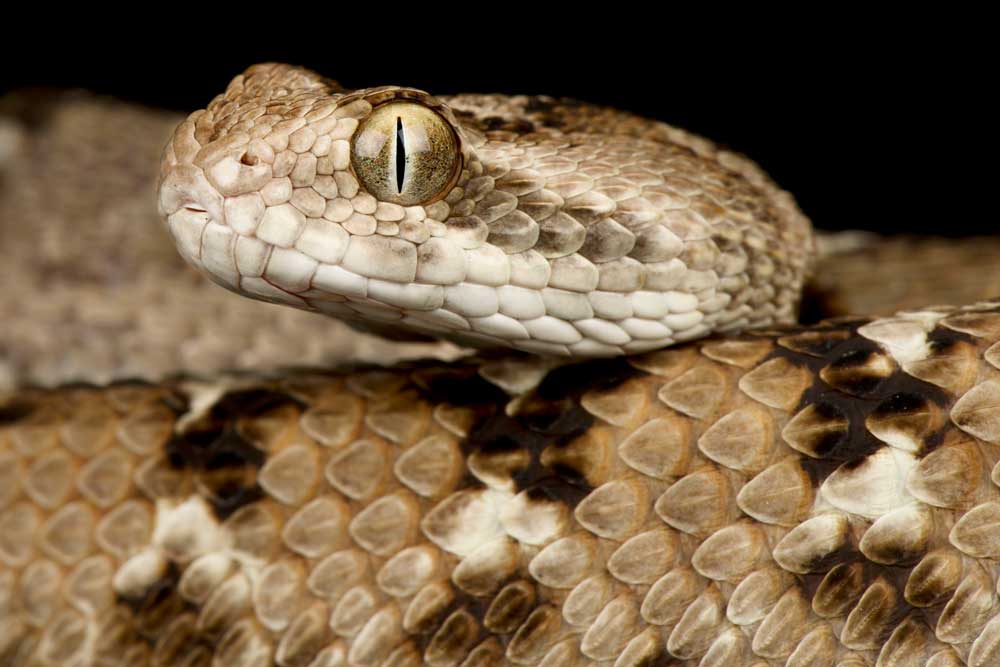
Indian saw-scaled viper. Photo by Reptiles4all/Shutterstock
It is a small viper type, generally no longer than 2 feet, but some varieties can reach 30 inches or more. They are a relatively stout snake and reported to be surprisingly fast when sidewinding (common for the varieties in sandy sub-Saharan locales. The hughesi variant is even smaller, adults average little more than 12 inches, but it inhabits only a small range in northern Somalia.
An egg-laying species with relatively small clutches of 8–20, there is a sexual variance in both toxicity and amount of venom produced. Female venom is approximately twice as potent as male venom, but males produce more. Both are deadly, with mortality rates as high as 20 percent for envenomations which occur at a very high (80 percent) rate. Toxicity and overall volume of venom also varies in most of these snakes with summer being the peak for both.
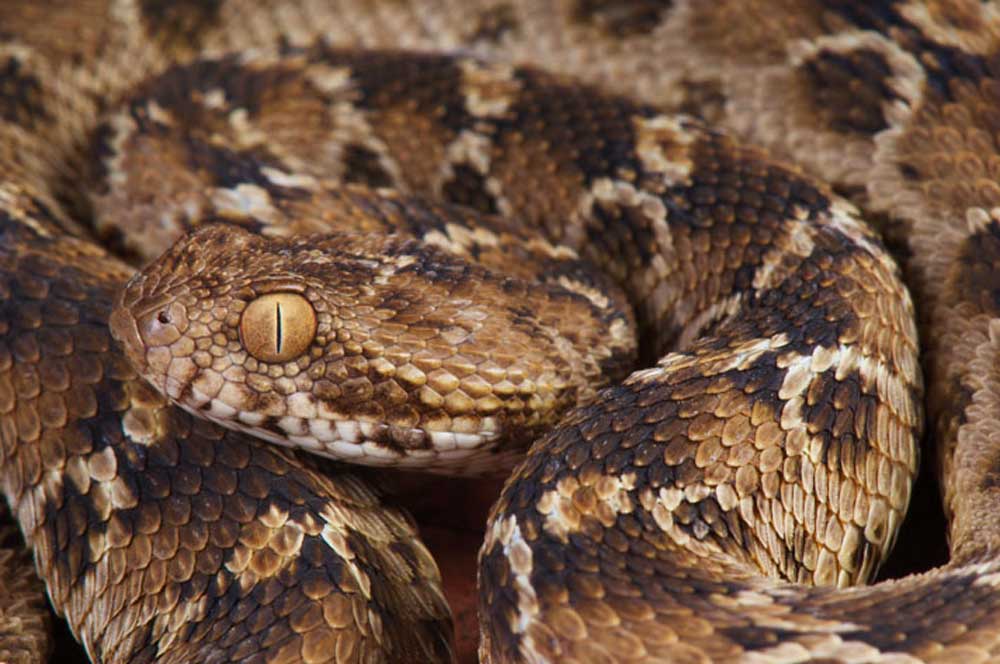
Saw-scaled viper. Photo by Reptiles4all
Saw-scaled vipers get their name from the distinctive warning posture where they rapidly rub the extended scales of their tails, creating a sound that has been described as sizzling. Although they provide warning, they are an unpredictable snake and quick to strike. Unlike most other venomous snakes, they will often overstrike, essentially launching themselves toward the perceived threat.
Insects and scorpions are their primary prey but depending on the environment, small rodents (mice) and birds, along with snakes and amphibians will be taken.
African bush viper
(Atheris squamigera)
An arboreal snake like the boomslang, the African bush viper differs by preferring the denser rainforests of Western Africa. Generally striking prey from above, hanging by its tail, the bush viper will often drop to the ground to hunt for frogs, small mammals, and even other bush vipers.
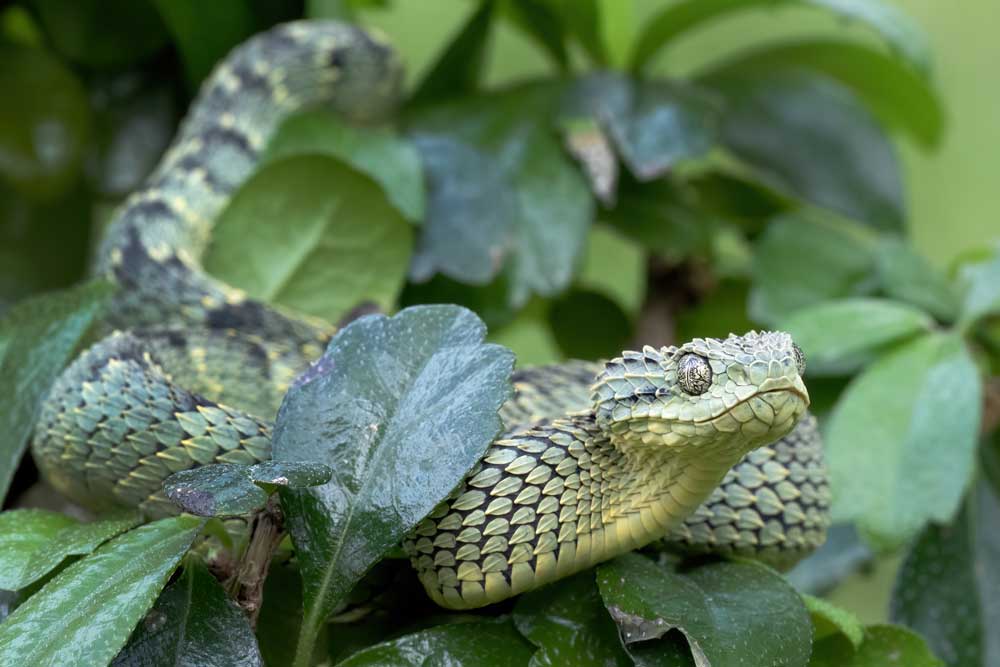
African bush viper. Photo by Mark Kostich/Shutterstock
There is no specific antivenin for this species, but treatment using the antivenin developed for Echis is partially effective. Because of its habitat and preferred hunting style, along with a timid disposition, make for few instances of human deaths from bites.
Across most of its range (the rainforests of Western Africa) the bush viper is consistently observed as a bright green (grass or tree-leaf green) relatively small snake (less than 2 feet).
On the edges of its range, coloration becomes much more varied from yellow to brown. These snakes mate during the rainy season, as high humidity is required. They give live birth to small broods (less than 10 typical) of immediately venomous young. Females tend to be slightly larger than males and much slower to mature.
Western green mamba
(Dendroaspis viridis; native to West Africa), Eastern green mamba (Dendroaspis angusticeps) East Africa
Unlike their close cousins the black mamba, the two species of green mambas are actually the color in their names. Although once classified as variants of the black mamba, there are distinct differences. All three mambas have chemically similar venom, with the black mamba lacking the alpha neurotoxin typical in the three-finger toxin common to mambas. The inclusion of the alpha neurotoxin is likely due to both primarily arboreal green mambas’ reliance on birds for prey whereas the black mamba hunts often for mammals at ground level.
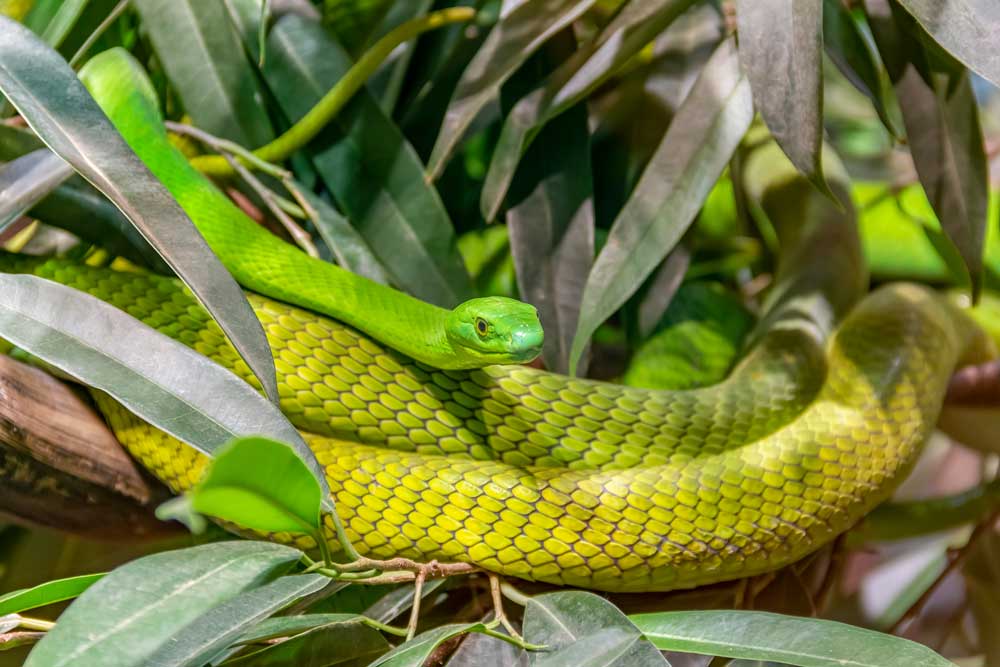
Western green mamba. Photo by Prill/Shutterstock
Again, much like the black mamba, green mambas are long snakes, capable of reaching more than 8 feet, though 6–7 feet is more common. The western variant has the more potent venom of the two, but both are considerably less powerful. However, that certainly doesn’t mean they aren’t potentially fatal. The extremely fast acting venom from a full envenomation can cause respiratory failure and death to an adult human in as little as 30 minutes. Polyvalent antivenin, administered promptly is critical.
Aside from potency differences between the green mambas, there are some visible identifiers. The Eastern mamba is almost entirely green, from head to tail. The Western variety typically fades to yellow toward its tail and features black scale edges.
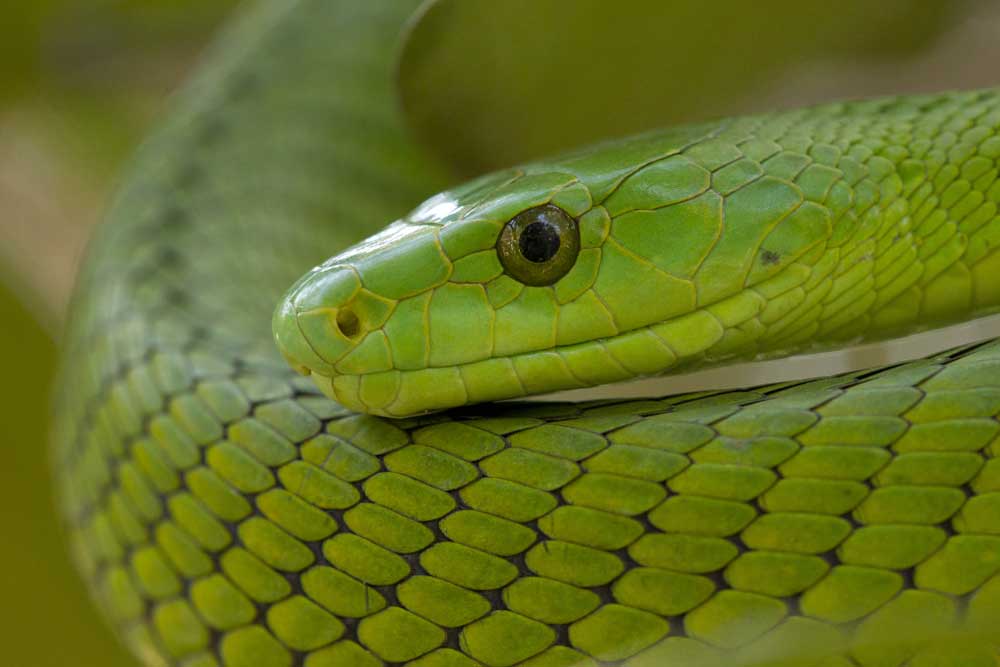
Eastern green mamba. Photo by Stu Porter/Shuttertstock
Despite being tree-loving snakes, deforestation in areas doesn’t appear to disrupt populations terribly as long as sufficient brush and cover exists. Both the western and eastern populations are judged stable.
South African YouTube Star Dingo Dinkelman Passes From Venomous Green Mamba Bite
The highly prized (expensive) Western green mamba is collected and traded internationally. Both green mambas are much less active and aggressive than the black mamba and adapt to captivity more readily.
Cape cobra (Naja nivea)
The cape cobra is the most dangerous cobra in Africa. Exclusive to the southern regions of Africa (thus the name, Cape) the cobra is very much a generalist in both its diet and the terrain it inhabits. It is moderate size for a cobra, averaging about 5 feet with examples exceeding 6 feet. Males are somewhat larger than the egg-laying females.
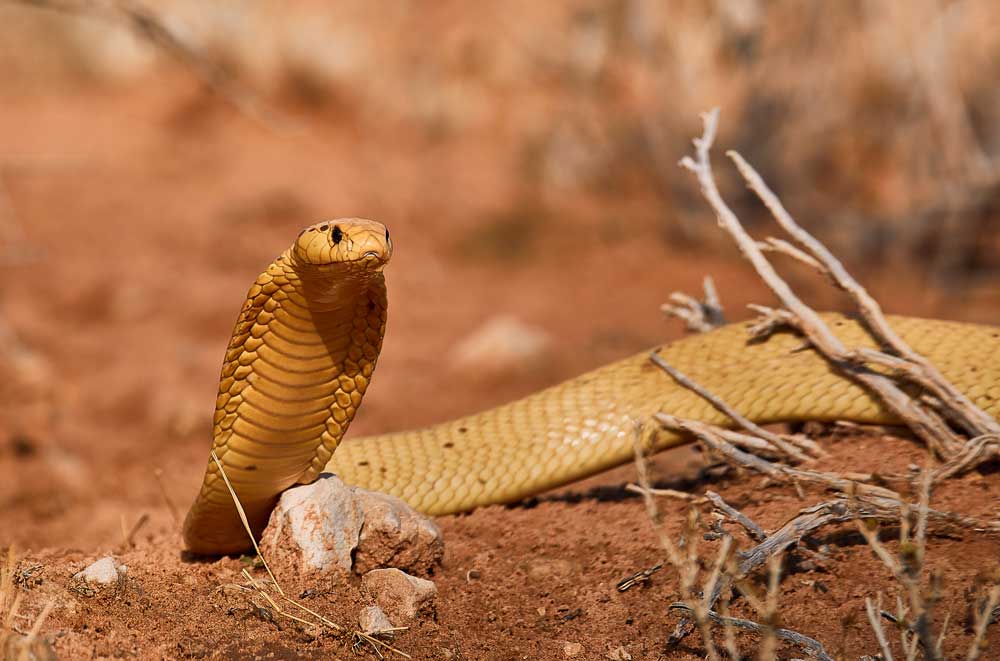
Cape Cobra. Photo by Rudi Zisterer/Shutterstock
One of the reasons the cape cobra is so dangerous to humans is its daylight hunting behavior and its habit of entering homes during hot, sunny days to pursue rodents and presumably for shade.
A ground hunter, the cape cobra will climb trees to rob bird nests, but feeds primarily on rodents, lizards, other snakes, birds, and even carrion. It occupies virtually all the habitats of the region, from arid near-desert to grasslands, and into mountainous areas.
As with all cobras, the cape cobra has a distinctive threat posture with a flattened neck that it holds high. Although it is likely to retreat when given the opportunity, it strikes (sometimes repeatedly) quite quickly and unpredictably, especially during mating season.
A bite from a cape cobra, untreated, is estimated to be fatal to humans in approximately half the cases. That assumes a full envenomation from both fangs. Death (when it occurs) may take 10 hours or more as paralysis leads to respiratory failure. Antivenin is very effective, but even without it, mechanical ventilation and symptom treatment can sometimes be effective.
Notes
Introduction https://pmc.ncbi.nlm.nih.gov/articles/PMC2577696/ “We estimate that, globally, at least 421,000 envenomings and 20,000 deaths occur each year due to snakebite. These figures may be as high as 1,841,000 envenomings and 94,000 deaths. Based on the fact that envenoming occurs in about one in every four snakebites, between 1.2 million and 5.5 million snakebites could occur annually.”
http://www.plosmedicine.org/article/slideshow.action?uri=info%3Adoi%2F10.1371%2Fjournal.pmed.00 50218&imageURI=info%3Adoi%2F10.1371%2Fjournal.pmed.0050218.t002 This study includes charts for estimated envenomings and deaths by region. I combined the numbers from sub Saharan and northern Africa regions. I also noted in the text that those were high estimations. I took the figures for Australian snakebite deaths from those charts as well.
Black Mamba https://www.newsweek.com/snake-catcher-paralyzed-struggled-breathe-black-mamba-bite-1682629 “The black mamba is one of the deadliest snakes in the world. If untreated, a bite from the venomous snake has a fatality rate of 100 percent and can kill a person within 30 minutes.” Chasing the above claim in Newsweek I couldn’t find other sources claiming the flat 100% fatality rate, but did find corroborating claims for the speed of fatality, which is admittedly much quicker than typical, but with multiple bites (common), upper body bites (again common) and venom injection directly into the bloodstream via a vein (less common) death actually can occur in as little as 20 minutes.
The size of the black mamba is disputed, but an authenticated specimen report of a 13 foot specimen is widely cited and many sources say larger specimens exist. To be fair, most found today are in the 10 feet range. https://zslpublications.onlinelibrary.wiley.com/doi/10.1111/j.1748-1090.1993.tb03534.x
Information for population status for the black mamba and the other listed snakes where mentioned is drawn from the IUCN Red List.
The Mozambique spitting cobra Branch, Bill (1998). Field Guide to the Snakes and Other Reptiles of Southern Africa. Ralph Curtis Publishing. p. 109. ISBN 9780883590423. That’s the citation for the size of this snake as well as the info about vision impairment or blindness. Venomous Snakes of the World by Mark O’Shea, Page number 72 is where fatality and disfigurement comes from. Defense Behaviors (spitting, biting, then retreating) from Carruthers, Vincent (2005). The Wildlife of Southern Africa: A Field Guide to the Animals and Plants of the Region. Struik. p. 100. ISBN 978-1- 86872-451-2.