
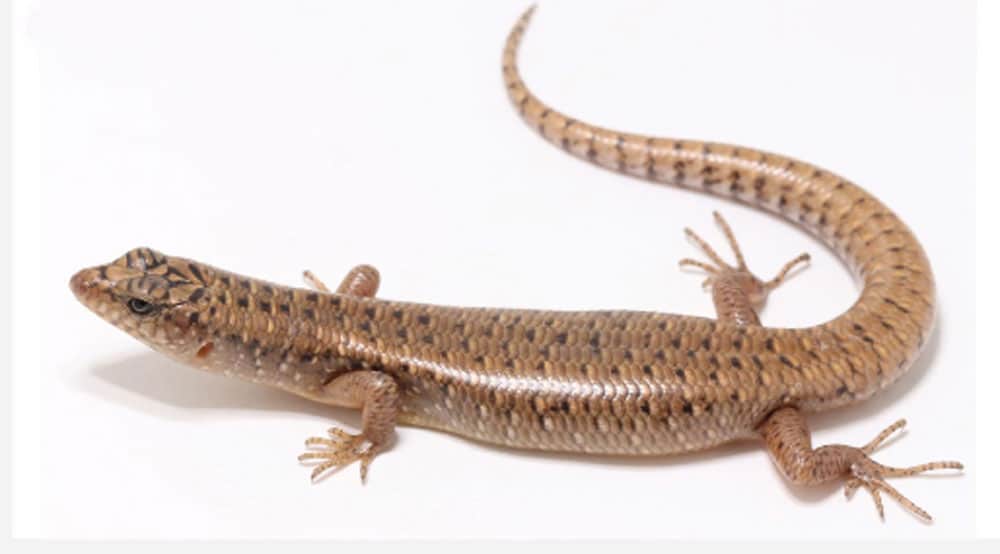
The suggested common name for the species is Khorat Plateau forest skink. It is currently only known to occur in Thailand's Phu Wiang Mountain, Tham Gwang, Khon Kaen Province.
Researchers have discovered a new forest skink species from the Sphenomorphus stellatus complex. The skink, discovered in the forested sandstone ecosystem in northeastern Thailand’s Khorat Plateau, is the sister species to a pair of Indochinese skinks, S. phuquocensis and S. annamiticus. According to the researchers, Sphenomorphus tophus is the fourth endemic lizard species to be found in the Khorat Plateau.
The forest skink is light brown in coloration on its dorsal, head, flanks, and tail. It features darker scales that have a yellowish posterior and light-color countershading in black. It has dark-colored markings on the top surfaces of its limbs and thin and wavy brown, broken and dark colored bands on the top of the tail.
The suggested common name for the species is Khorat Plateau forest skink. It is currently only known to occur in Thailand’s Phu Wiang Mountain, Tham Gwang, Khon Kaen Province.
They were observed from 200 to 670 meters above sea level. Their habitat includes deciduous to dry evergreen forests along sandstone rock outcroppings. The researchers captured the holotype at night, deep inside a narrow sandstone crevice. A stream flowed nearby. The researchers noted the skink regurgitated a Huntsman spider after it was collected. Diurnal, Sphenomorphus tophus was observed on the ground, on tree trunks, and sandstone rocks.
The complete paper describing the species, “A new endemic Forest Skink (Squamata; Scincidae; Sphenomorphus) from the sandstone ecosystem of the Khorat Plateau, Thailand” can be read on the Researchgate website.