
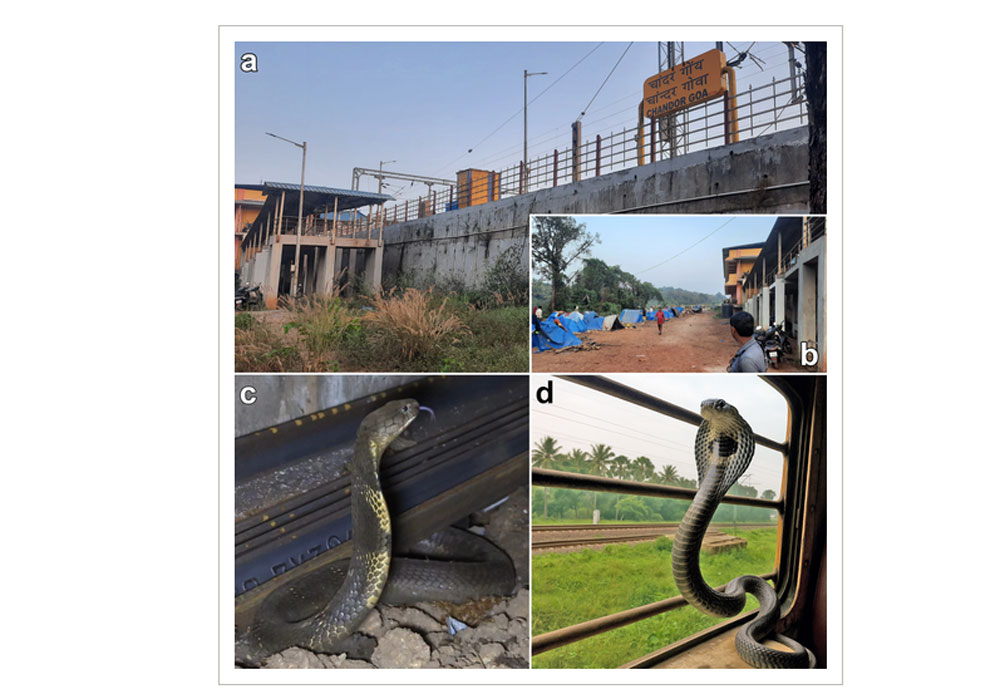
The dispersal of these venomous snakes into towns and villages in which the snake may be not known to inhabit could pose a threat to both snakes and humans.
A study published on the Western Ghats king cobra (Ophiophagus kaalinga) in India has found that the venomous snake may be distributing itself in India’s Western Ghats using the country’s railway system.
The researchers looked at the distribution of Ophiophagus kaalinga in Goa, the smallest state in India. They analyzed snake rescue data, verified sightings, and species distribution modeling and looked at ecological drivers including habitat and climate that affect the distribution of the venomous snake and determined that the snake may unknowingly be using the railway system to get to areas in which it is not known to exist.
The researchers examined one case of a king cobra rescued at the Chandor railway station and found that the habitat in which the railway station is located is not suitable, and even considered hostile, to the king cobra. It is at a junction point in which other areas that meet up in Chandor have significantly better habitat. A second case involved a king cobra that was rescued from Vasco da Gama just 200 meters from the railway station in a habitat not ideal for the king cobra.
Three other king cobra rescues occurred at 270, 220 and 330 meters from the nearest railway station and two others were 900 and 330 meters in Cancona Station. In all, 47 localities in Goa had 120 O. kaalinga documented rescues from 2002 to 2024 by Animal Rescue Squad, Goa, a non-governmental organization. The locals encountered king cobras in villages and forested areas and no reports in agricultural plots or paddy fields.
During the rescue events, the researchers also interviewed locals about the general presence of king cobras in villages and surrounding forests and agricultural plots. This anecdotal information offers insights into the potential for human-snake conflict and interaction. This also helps raise awareness.
The scientists believe that the cobras may be hitching rides on trains because of the potential for abundant food sources such as snakes and rodents on the train. It could be that these railways could act as high speed conduits for the snakes, with shelter and prey items in the rail yards and on the trains.
The dispersal of these venomous snakes into towns and villages in which the snake may be not known to inhabit could pose a threat to both snakes and humans. There is no antivenin for king cobras in India and the bite from a king cobra can be fatal within 15 minutes, the scientists noted. Because of this, Animal Rescue Squad, Goa (ARSG), is raising awareness about these reptiles in the areas in which they are not traditionally found.
The complete paper, “Snakes on Trains: Railways May Sway Goa’s King Cobra Distribution” can be read on the Biotropica website.