
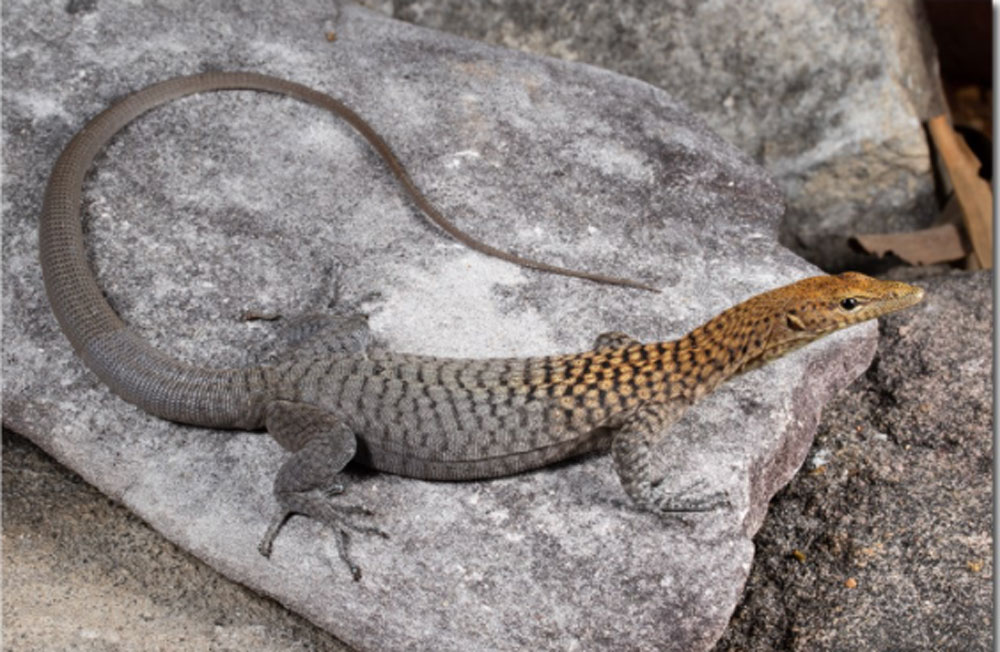
The three monitors, Varanus phosphoros sp. nov., Varanus iridis sp. nov., and Varanus umbra sp. nov. were discovered in northeastern Australia.
Researchers have discovered and described three new Australian dwarf rock monitor species of the subgenus Odatria. The three monitors, Varanus phosphoros sp. nov., Varanus iridis sp. nov., and Varanus umbra sp. nov. were discovered in northeastern Australia. To ascertain whether the monitors were distinct from each other, the researchers collected voucher specimens and generated genomic and morphological data that helped to clarify the evolutionary relationships between the species.
They found that the monitor lizards were each their own species based on genetic divergence, that they occurred in the same geographic area as the other species within the genus, and differ morphologically. According to the researchers, these monitors are the first rock climbing adapted Varanus lizards east of the Carpentarian Gap, a biodiverse tropical savanna ecoregion that is found along the southern Gulf of Carpentaria.
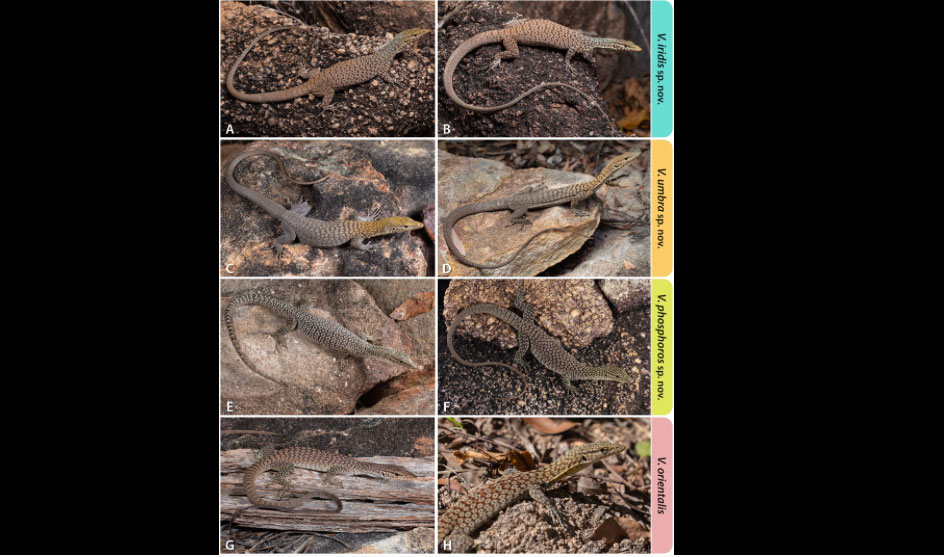
Photographs in life of Varanus iridis (A, B), Varanus umbra (C, D), Varanus phosphoros (E, F), and Varanus orientalis (G, H). Photographs show: A, paratype QM J99219 from Talaroo Station; B, unvouchered individual from Talaroo Station (tissue sample JNW4); C, paratype QM J99224 from Gilberton Station; D, unvouchered individual from Gilberton Station; E, paratype QM J99227 from Isabella Falls; F, unvouchered individual from Mount Molloy; G, unvouchered individual from Gilberton Station (tissue sample JNW6); and H, unvouchered individual from Magnetic Island. Photographs: A–B, D, W. Read; C, E, S. Zozaya; F, J. Meney; G, J. Wright; and H, B. Schembri.
All three species have small bodies with snout to vent lengths of less than 168mm, and slender builds. They are yellow, orange, or orange-brown in coloration, and have similarly colored but distinct dorsal scales.
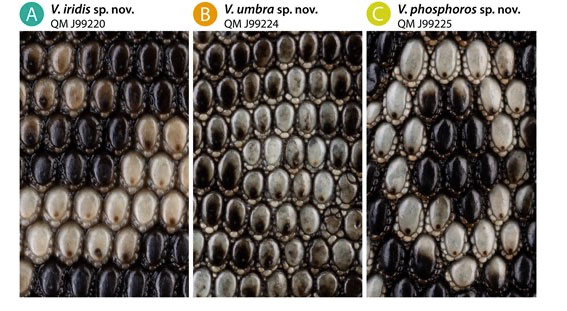
Comparison of dorsal scales among the three new species. Note the granules typically reaching <50% of the way to the anterior margin of primary dorsal scales in Varanus iridis (A) and Varanus umbra (B), but >50% in Varanus phosphoros (C). Photographs: S. Zozaya.
Varanus iridis, the Rainbow rock monitor, features yellow ground coloration on the head and a blue-green color on the nape while V. umbra is orange to yellow-brown ground coloration on the head and nape, and V. phosphoros has a yellow ground coloration on the head and nape.
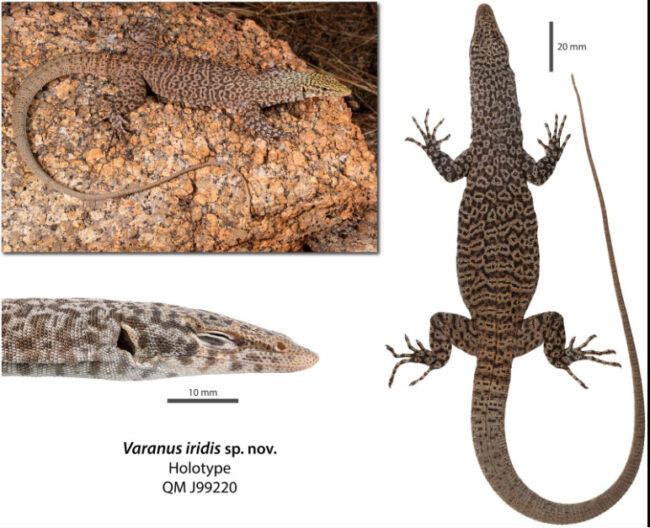
In life and preserved holotype of Varanus iridis (QM J99220), male, collected from Springfield Station, Queensland. Photographs: S. Zozaya.
Varanus iridis currently is known to inhabit an area north and west of the town of Mount Surprise in an ecosystem with “granite boulders and outcrops and Eucalyptus/Corymbia-dominated savanna woodlands,” the researcher noted. All individuals located in the area were sheltering under cap rock on within narrow rock crevices.
Varanus umbra, or Orange-headed rock monitor, features a small body size with an SVL less than 137mm and a total length of 409mm. It has a slender build and a moderately long tail. It is orange to yellow-brown on the head and nape down to a smoky gray to the midbody. It is smaller than V. phosphoros. it is known to inhabit sandstone outcrops and plateaus in open savanna woodland, the researchers said.
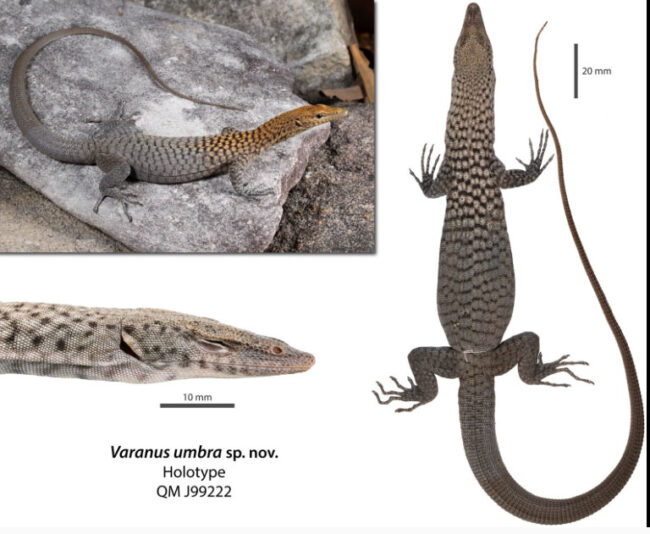
In life and preserved holotype of Varanus umbra (QM J99222), female, collected from North Head Station, Queensland. Photographs: S. Zozaya.
Varanus phosphoros, the yellow-headed rock monitor, also features a small body with a SVL of less than 168mm with a total length of 478mm. The head features bright yellow to yellow-green or whitish spots that extend to the nape, forebody and forearms. The those spots are encircled in black. It lives in rocky habitats in the Einasleigh Uplands, Cape York Peninsula, and Wet Tropics bioregions, the researchers noted. Most observations occurred near where the Einasleigh Uplands and Wet Tropics intersect, in an area around Mount Molloy and Mount Carbine.
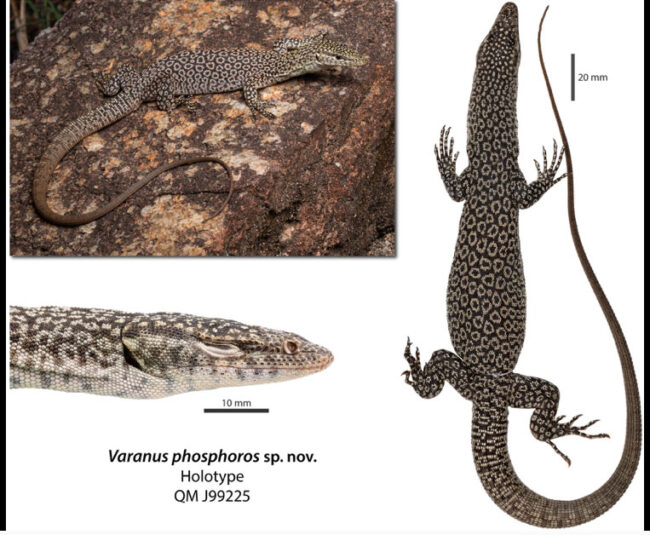
In life and preserved holotype of Varanus phosphoros (QM J99225), male, collected from Mount Carbine, Queensland. Photographs: W. Read (in life); and S. Zozaya (in preservative).
The lizard occurs in granite platforms and boulders that are in Eucalyptus woodlands with grassy under layers of vegetation. Other populations have been observed in sandstone escarpments near the towns of Hopevale and Laura that have abundant grasstrees and vine thicket; and in the Black Mountains in granite boulder fields.
The complete paper describing the three new monitor lizards, “Three new species reveal an unrecognized clade of rock monitors (Varanidae: Varanus) from the eastern Australian savannas” can be read on the Zoological Journal website.