
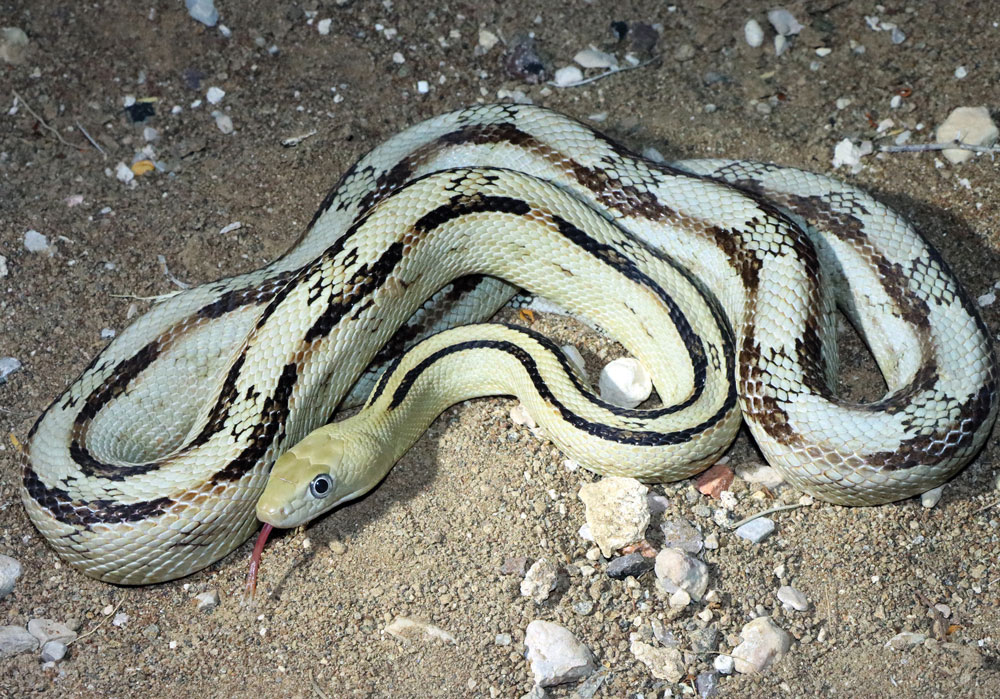
The Trans-Pecos rat snake was famously described by noted herpetologist Carl Kauffeld in one of his books, “Snakes: The Keeper and the Kept.”
In the United States and in other regions around the world, many common and successful species fall into the rat snake family. They are also very popular with reptile keepers due to their attractive colors and capability to thrive in captivity. Because they are fairly common in many parts of the world, Rat snakes may not garner much attention. However, there is one rat snake species in my collection that always attracts attention and captures the interest of my guests.
The Trans-Pecos rat snake (Bogertophis subocularis) is a unique and attractive species indeed, with their distinctive and attractive coloration, docile nature, pink tongues and large, inquisitive eyes. When I ask friends and guests which of the snake species in my collection is their favorite, the Trans-Pecos rat snakes often get lots of votes. I guess you could say, “The ‘eyes’ have it.”
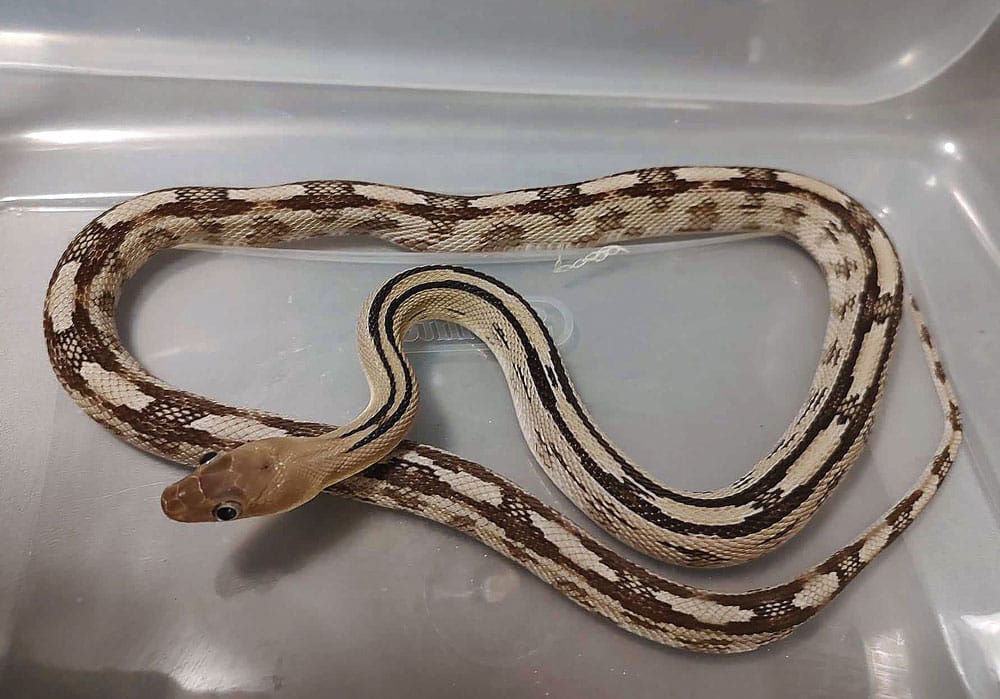
Trans-Pecos rat snake. Photo by David Powell
The non-venomous Trans-Pecos rat snake lives in a desert environment considered too harsh for many other animals. This colubrid species is native to west Texas and parts of New Mexico in the U.S, and their range extends far into Mexico and the states of Chihuahua, Coahuila, Durango, and Nuevo Leon. The area west of the Pecos River in Texas is known as the Trans-Pecos region from which this species gets its common name, and this species has also been called the Davis Mountain rat snake.
The Trans-Pecos region happens to be part of the largest desert in North America known as the Chihuahuan desert. This area is one of the most biologically diverse on the planet due to the number of plants and animals that can be found there and nowhere else. I have made numerous trips to this region, and many people inquire why I would want to vacation in west Texas. In addition to the numerous snake species that can be found out there, the desert absolutely comes alive at night with many forms of life. The night skies are luminous with stars and planets, and one can even see galaxies out there with the naked eye. The scenery, abundant reptilian life and spectacular sunsets are ideal for this born and raised Texas boy who is also a photographer. I feel at peace and one with nature out there. It is a ‘Win, win and win’ for me.
Trans Pecos Rat Snake Natural History
The Trans-Pecos rat snake was first documented in 1901 by herpetologist Arthur Brown. Brown was the superintendant of the Philadelphia Zoological Gardens, which was the first zoo in America (Brown, 1901). He was also the first to document the Grey-banded king snake (Lampropeltis alterna), then known as the Davis Mountain king snake. The Trans-Pecos rat snake is a species whose scientific name comes from a unique row of subocular scales around their very large eyes that have evolved to allow them to hunt at night by starlight or moonlight in the desert. This unique head structure and extra large eyes give this snake a very tame look that many people describe as “cute” or “googly.”
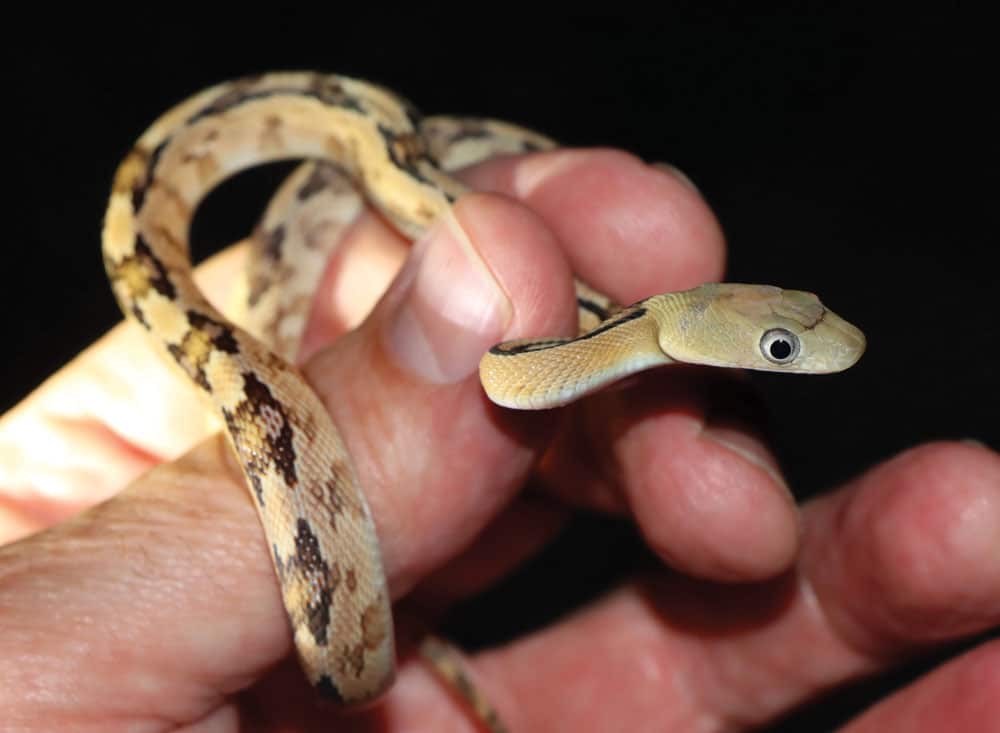
A neonate. Photo by Russell Rozell
While it is true that other snakes have evolved to survive in harsh, desert environments, the Trans-Pecos rat snake’s large, extremely sensitive eyes give them a special hunting advantage at night in the desert. This unique adaptation makes them a bit different for other desert snake species. For example, there are many rattlesnake species that use heat-sensing pits and venom delivery systems to assist them in hunting warm-blooded prey in the desert darkness, but the Trans-Pecos rat snake hunts quite effectively without the benefit of either of those evolutionary tools.
Subocularis, or suboc for short, is one of only two species in the Bogertophis genus. The other species is the Baja California Rat snake (Bogertophis rosaliae), which is another desert species that lives on the Baja peninsula in far southern California and Baja California, Mexico. Subocularis was previously a member of the Coluber and Elaphe genera before being assigned to the Bogertophis genus in 1988.
It is interesting that the Trans-Pecos rat snake has resided in three different genera in less than 100 years, but most people would agree that this snake is decidedly different from most other rat snakes, racers, whipsnakes and coachwhips. Subocs clearly deserve their own genus. Their current genus of Bogertophis is named in honor of American herpetologist Charles M. Bogert, who was the chairman and curator for the department of herpetology for the American Museum of Natural History from 1943 to 1968.
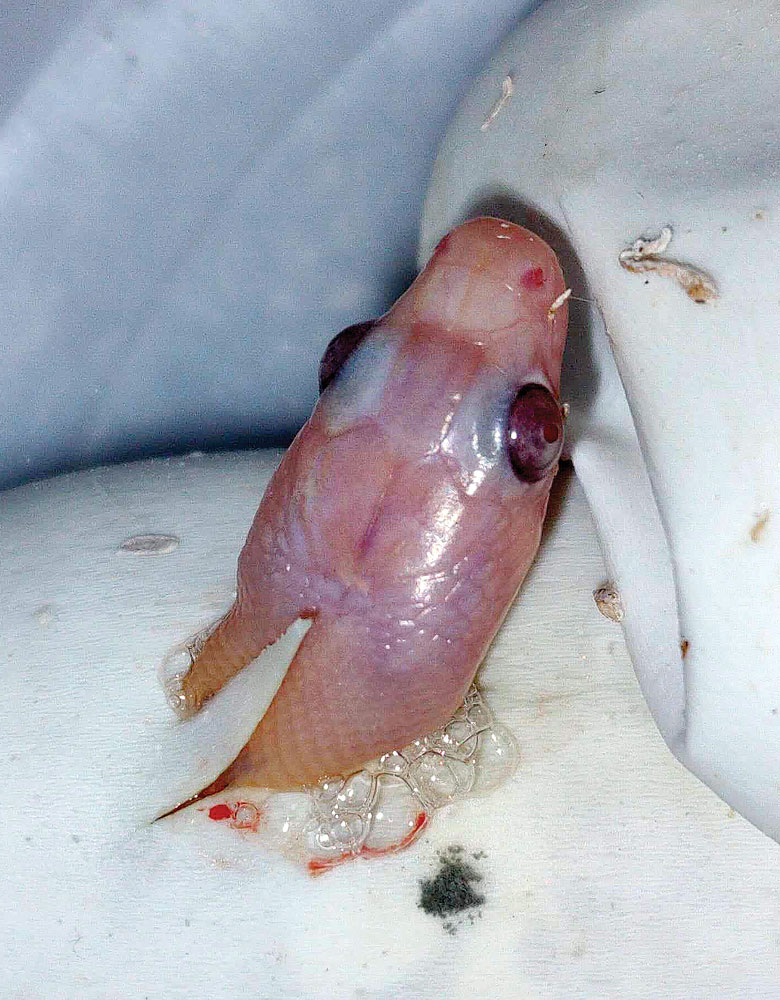
A Trans-Pecos rat snake emerges from its shell. Photo by David Powell
In addition to the distinctive head and eye structure of this species, they have amazing dark brown or even black “H”-shaped dorsal markings that contrast well with their sandy or beige background coloration. The vertical bars of the “H” markings are intermingled with light orange, yellow or brown markings that serve to create two multi-colored stripes down the entire length of the snake’s dorsal area. This coloration helps them blend in nicely with the surface of the Chihuahuan desert where they live.
There are several additional color morphs, which include a “blond” phase from the lower Pecos River watershed in Brewster County, Texas that has lighter coloration and fewer dorsal markings. There is also a variant from the Franklin Mountains in far west Texas that displays steel-grey background coloration. The Trans-Pecos rat snake’s head is unmarked, and its abdomens are a pristine, pearly, cream color. Many Subocularis specimens have light gray or even light blue luminescent eyes, which greatly enhances their look and appeal. To me, the suboc’s coloration and markings look very much like they belong in the American southwest and Mexico. They are iconic!
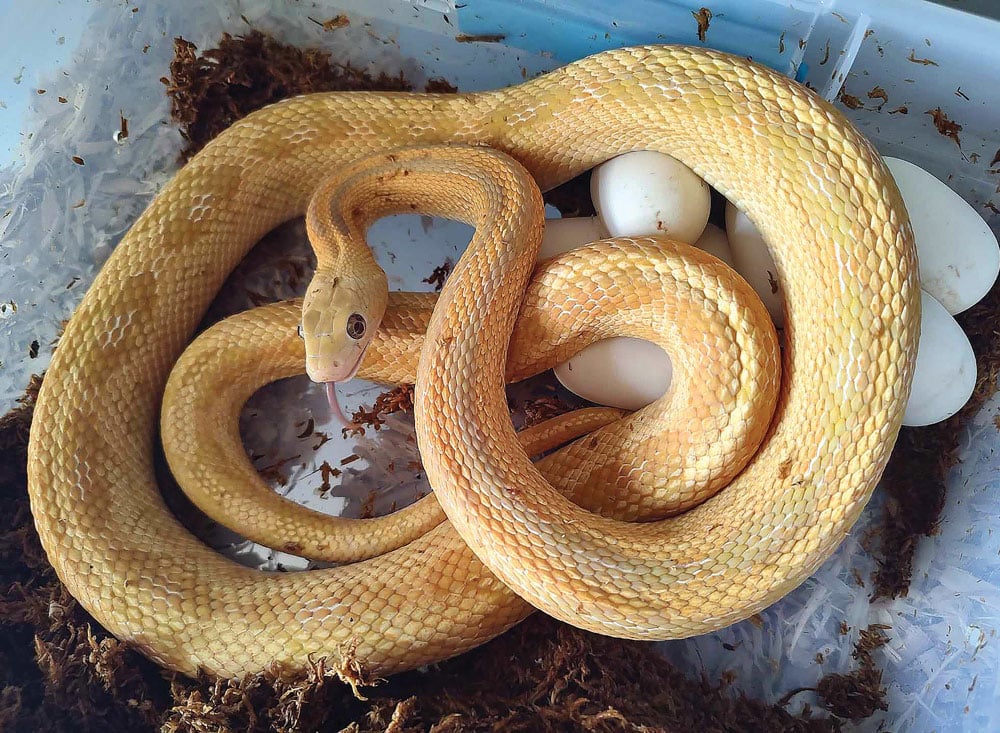
A female with a clutch of eggs. Photo by David Powell
This species was famously described by noted herpetologist Carl Kauffeld in one of his books, “Snakes: The Keeper and the Kept.” He dedicated an entire chapter to them called “The Search for Subocularis” because he was so fascinated with this snake (Kauffeld, 1969). If you have an interest in snakes, then I highly recommend reading Mr. Kauffeld’s work, but the books are currently out of print and only used copies are available. Curator Kauffeld also quite notably amassed a complete collection of all 32 U. S. rattlesnake species for display at the Staten Island Zoo where he worked from 1936 to 1963. That is an impressive accomplishment indeed! Here’s what he wrote about the Trans-Pecos rat snake:
“No doubt aesthetic appreciation of snakes is the result of long conditioning, yet many of my non-herpetological friends agree with me and seem to understand my enthusiasm for this creature. Perhaps they are only being kind, humoring my eccentricity, but to me, insignificant as this individual snake is among myriad animal forms, infinitesimal as we all are in the universe as a whole, it represents beauty and perfection-‘fashioned by loving hands,’ as one would say a work of art.” (Reprinted with permission) These are inspiring words from an inspiring herpetologist.
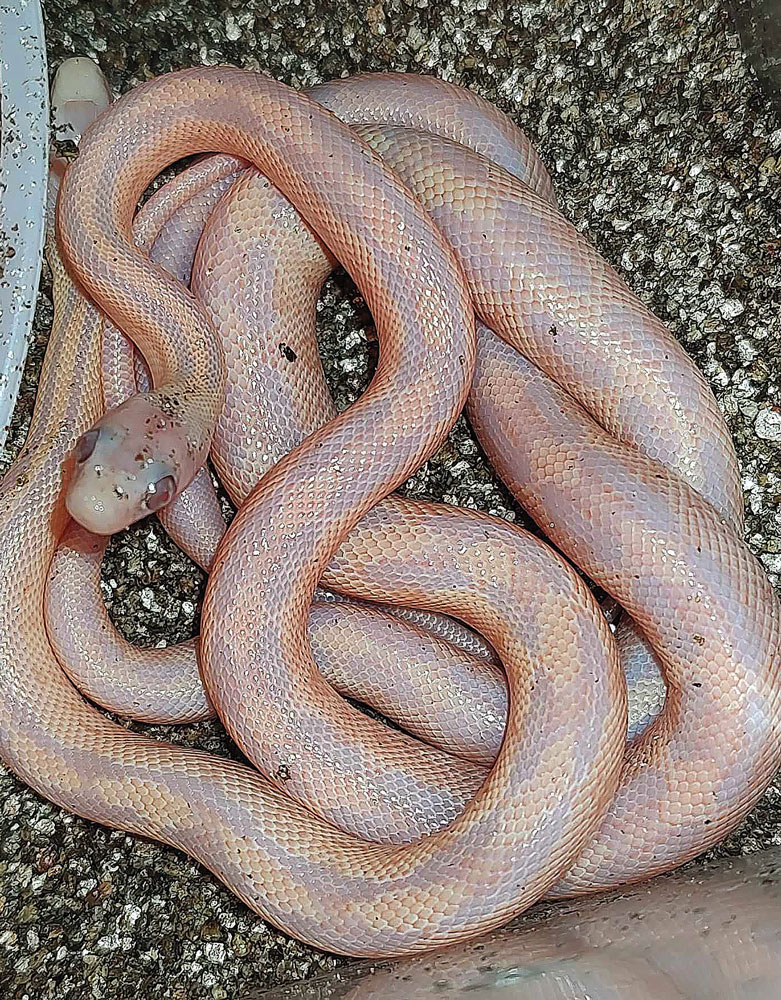
An albino neonate. Photo by David Powell
Trans-Pecos rat snakes are medium to large snakes, averaging between 36 and 54 inches (90-137 cm), with the record being 66 inches (167.6 cm) (Powell, Conant, Collins, 2016). They are strictly nocturnal and can only be found at night under proper conditions at certain times of the year within their range. However, based on my experience in west Texas, these snakes are still fairly common in the wild. Like other rat snakes, Subocularis are constrictors and prey primarily on rodents as adults, including pocket mice (Perognathus), cactus mice (Peromyscus), and kangaroo rats (Dipodomys), but they will also eat birds and lizards. Neonates and juvenile subocs are known to eat lizards. Known predators of Trans-Pecos Rat snakes include raptors, roadrunners, other snakes, skunks, coyotes, foxes, bobcats, badgers, and bears (Ernst and Ernst, 2003). Many of these snakes are also killed on the roads by vehicles.
Subocs are apparently the only known host for a species of ticks known as Robertsicus elaphensis (formerly Aponomma elaphensis). These ticks attach themselves to the snakes’ tail while they are in hibernacula and are responsible for some of these snakes losing their tails in the wild. Apparently these parasites do not cause the snakes much more harm than tail loss and/or scarring. It is now believed that the ticks choose this host because sunlight harms the ticks and disrupts their life cycle, and unlike many other potential hosts, subocs almost never venture out into the daylight.
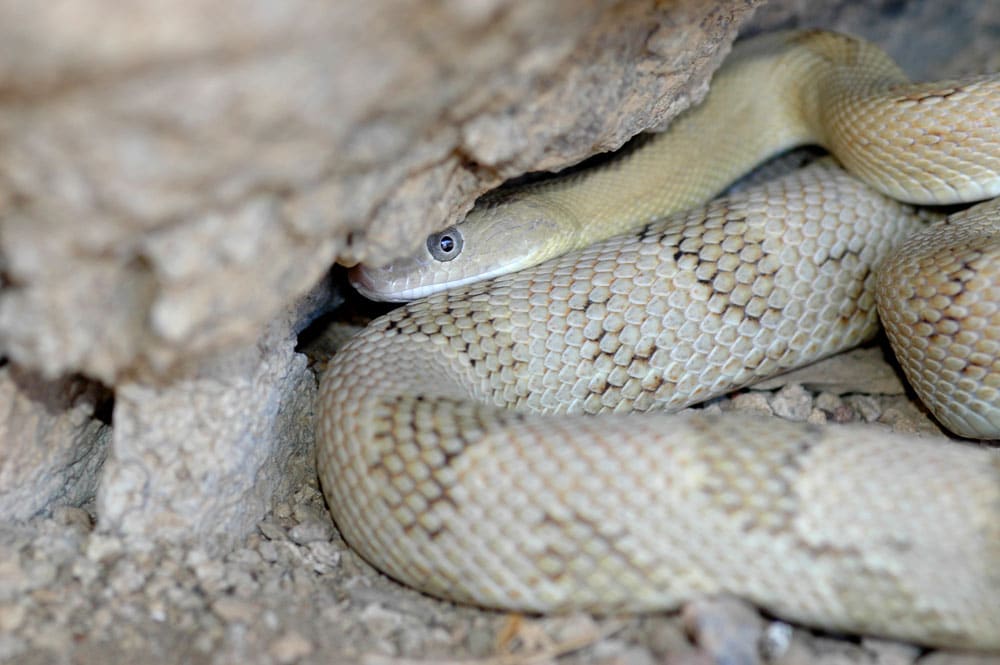
Hidden away for the day, a Trans-Pecos rat snake under a rock ledge. Photo by Rusty Dodson
Most of what we know about Subocularis’ reproduction is derived from captive snakes. They mature at around 3 to 4 years of age, but some authorities cite the size of the snake as a more important variable than age. More specifically, they specify that the adult snakes should be at least 40 inches (101.6 cm) in length before they can reproduce. Because they are a desert species, the brumation period is shorter and less extreme temperature-wise than other species in more temperate climates.
They breed in mid-to late June through mid-July, which is later in the season than many other species. Subocs also lay their eggs later in the season than other species, during the late August to early September time frame. This means that after a 6 to 8 week incubation period, the eggs may not hatch until November (Rhoads, 2008). Like many other aspects of this species, these breeding parameters are very unique.
Subocs are quite docile and do well in captivity, which has contributed greatly to their popularity with reptile keepers. They are extremely tame and calm when handled and many have great personalities, if one can call it that. Even the wild subocs I have handled have not tried to bite me and seem to regard humans as merely an annoyance. My female is always available to be handled when I approach her cage. Keeping Trans-Pecos at snakes is one of my boyhood dreams that has come true because this species was well known to me and special while I was growing up in Texas. Because they can be finicky eaters when captive, I would not recommend this snake species for beginners, even though they are docile and not otherwise difficult to keep. These snakes are an outstanding choice for a moderate to serious reptile hobbyist.
Despite their potentially picky eating habits, I have, through trial and error, found a strategy to encourage my subocs to eat regularly. Both my male and female prefer hairless frozen/thawed rats. My female will routinely refuse similar rodent offerings with hair on them, and she even refuses hairless mice! My male will take both hairless rats and mice and sometimes eat a fuzzy rat as well.
I do need to say that there are plenty of other suboc owners who don’t have these kinds of feeding issues, but some of us do. While some reptile keepers may find these nuances of feeding to be a little dubious, others will completely relate to the problems of getting certain species or individual snakes to eat regularly. I’m including these details here to encourage people to try different things to keep their animals thriving and healthy, and there are a number of ways to do that.
The very first question I will ask anyone who asks me about a snake that is not eating is, “What temperature are you keeping it?” I keep this desert species at a little higher daytime temp than I keep my other colubrids. I accomplish this by using a slightly larger under tank heater than those for my other snakes. I’m keeping my subocs at 80 to 85 degrees Fahrenheit (26.7 to 29.4 degrees Celsius.) during the day, and try to maintain about 40 to 50% relative humidity. Other than keeping them a little warmer and dryer, there is very little difference in the way I keep my subocs versus my other rat and king snakes.
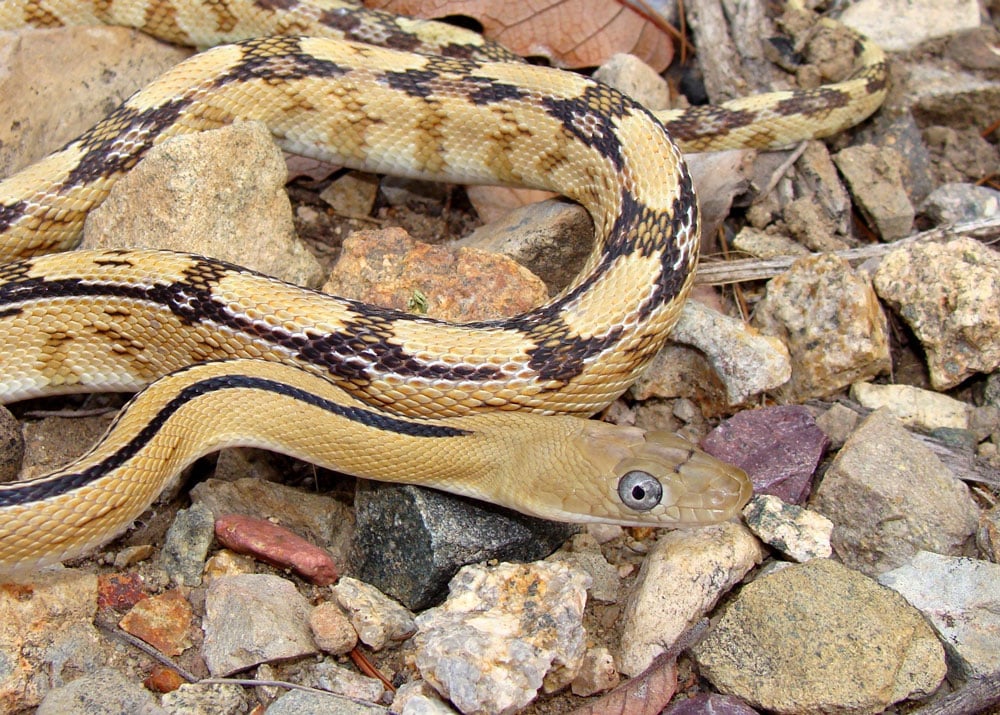
Photo by Matt Jeppson
Setting up an enclosure for one of these snakes is not difficult as long as one considers their natural habitat. I use 50 to 80 gallon glass, reptile enclosures with a fitted top and an under tank heat pad on a thermostat on one side of the enclosure. Generally speaking, the under tank heat pad should cover about 1/3 of the base of the enclosure for most colubrids, but I use almost ½ for my subocs. Every enclosure has at least two hides with one being a humidity box containing sphagnum moss or some other absorbent material. I am partial to Pangea black hide boxes and use old cat treat plastic containers for my humidity boxes. I wrap the clear treat containers in black or grey duct tape to give the snake some security and privacy. When using tape in any reptile enclosure, take care that none of the adhesive is exposed for the snake to get stuck on. I use aspen shavings as a substrate, and add tree branches, logs and rocks for stimulation and to assist in creating temperature gradients within the enclosures.
Subocs can be prone to respiratory illnesses, so I make sure they have good ventilation and try to keep humidity a little lower than my other snakes. I light the enclosures with incandescent lights, and the lights and heaters go off at night via timers. The room never gets below about 70 degrees Fahrenheit (21.1 degrees Celsius) even in the winter, so temperatures will trend toward that at night, much as it does in nature.
My goal with my snakes is to create an environment as close to what they would encounter in the wild as possible. Anyone who is serious about keeping and/or breeding these snakes should read “The Complete Suboc –A Comprehensive Guide to the Natural History, Care and Breeding of the Trans-Pecos Ratsnake” by Dusty Rhoads. It is one of the most comprehensive and complete books on keeping a particular snake species that I have ever read.
With their gentle nature, striking appearance, and relative ease of care, it is not surprising that subocs are so popular. Keeping a Trans-Pecos rat snake as a pet can open your eyes to a whole new variety of rat snake. The captivating dorsal patterns and fascinating survival adaptations of these reptiles will certainly spark the interest of reptile enthusiasts and hobbyists alike. I consider my yearly trips to west Texas almost a spiritual journey of sorts, and the Trans-Pecos rat snakes I find and photograph are an important part of that journey. Whenever I find a suboc out in the desert at night in Texas, it is an exciting moment and becomes yet another great memory in my life.
References
Brown, A.E. (1901). A new species of Coluber from west Texas. Proceedings of the Academy of Natural Sciences of Philadelphia 53(2): 492-495 + Plate XXIX.
Ernst, C., & Ernst E. (2003). Snakes of the United States and Canada. Smithsonian Books.
Kauffeld, C. (1969). Snakes: The keeper and the kept. N.Y: Doubleday and Co. (Now Penguin-Random House).
Powell, R., Conant, R., & Collins, J. T. (2016). Peterson field guide to reptiles and amphibians of eastern and central North America, fourth edition. Houghton Mifflin Harcourt.
Rhoads, D. (2008), The complete suboc: A comprehensive guide to the natural history, care, and breeding of the Trans-Pecos Rat snake. ECO Herpetological Publishing & Distribution.