New Asexual Species Of Lizard Discovered
Click image to enlarge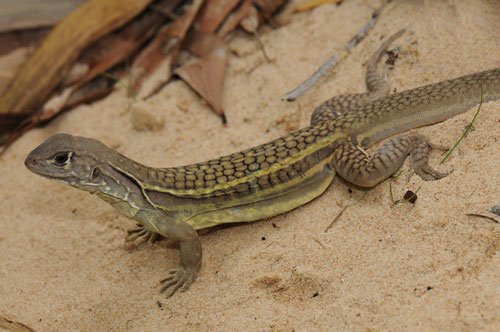 The newly discovered Leiolepis ngovantrii is an all-female species of lizard. Photo courtesy L. Lee Grismer. |
A new species of lizard has been discovered in Vietnam. Leiolepis ngovantrii is an all-female, asexual species. In a process called parthenogenesis, L. ngovantrii ovulates and produces offspring without the need of a male.
According to news sources, the species was discovered in Ho Chi Minh City, Vietnam. Though it has long been served as a dish in Vietnamese restaurants, L. ngovantrii is new to science. It was discovered by herpetologists Ngo Van Tri (after whom the species has been named) of the Vietnam Academy of Science and Technology, L. Lee Grismer of La Sierra University, and Jesse Grismer of Villanova University. L. Lee Grismer and his son, Jesse Grismer, published a study about the discovery in Zootaxa.
Parthenogenesis is rare in vertebrates. According to the study, L. ngovantrii is likely a result of hybridization between two species. Hybridization can occur between two related species in the area between two habitats. The new species discovered in Vietnam appears to be native to the Binh Chau-Phuoc Buu Nature Reserve, which sits between scrub coastal woodland and coastal sand dunes, according to news sources.
According to news sources, in general, hybrid species are at a disadvantage and are prone to extinction due to a lack of genetic diversity. L. Lee Grismer agreed, to a point. "In general yes, hybrids are at a disadvantage. But in many cases such as this, they thrive better in the ecotonal and disturbed habitats than do either of the parental species," he said. "We believe this species is thriving and will continue to do so because of the habitat it lives in."
The Grismers used mitochondrial DNA to identify L. ngovantrii's maternal species as L. guttata. In most multicellular organisms, mitochondrial DNA is maternally inherited, as is the case with L. ngovantrii. Since publishing the study, Jesse Grismer has examined L. ngovantrii's nuclear DNA and determined the lizard's paternal species. He plans to publish this information and other new discoveries about L. ngovantrii in a peer-reviewed journal in the near future.