Asteroid Strike 66 Million Years Ago Led To Diversification Of Snakes
The asteroid crash led snakes to diversify into niches once filled by their competitors.
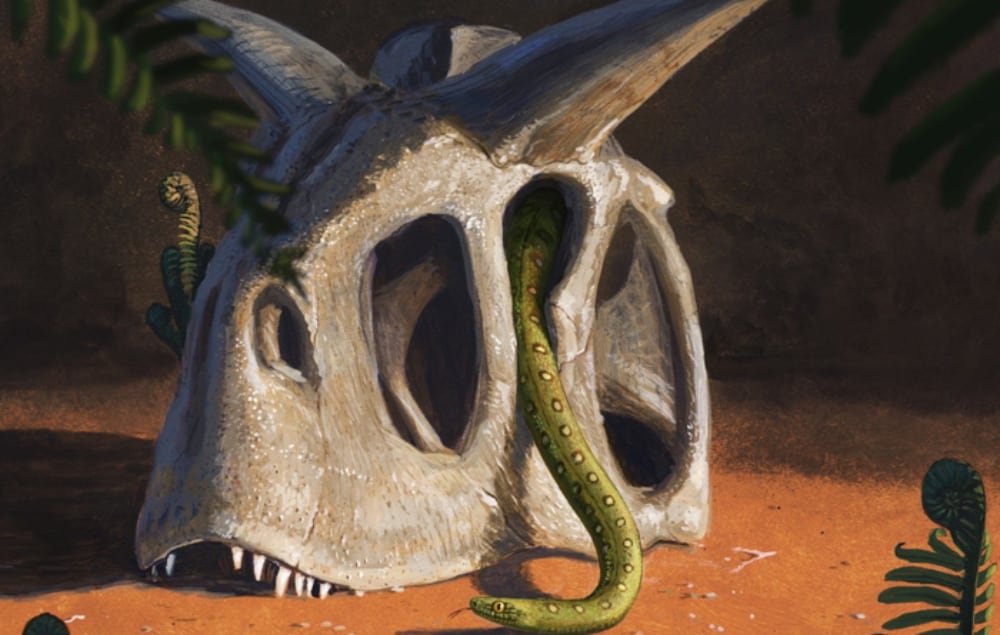
A huge asteroid that hit the earth in what is now Mexico led to the extinction of 75 percent of the flora and fauna on Earth, but also led to the diversification of snakes around the same time much of the living things on earth died off, according to a study published in the journal Nature Communications.
The researchers, led by Catherine G. Klein of the University of Bath, Bath, UK, Davide Pisani, Daniel J. Field, Rebecca Lakin, Matthew A. Wills and Nicholas R. Longrich of Cambridge University and the University of Bristol, say that the asteroid that crashed near what is now the town of Chicxulub, Mexico, saw the diversification of the surviving mammals, birds, frogs and teleost fishes. The evolutionary effects of the large-scale extinction event on snakes, are not well understood, if at all.
“It’s remarkable, because not only are they surviving an extinction that wipes out so many other animals, but within a few million years they are innovating, using their habitats in new ways,” lead author Dr. Catherine Klein, who now works at Friedrich-Alexander-Universität Erlangen-Nürnberg (FAU) in Germany said in a statement announcing the findings.
The Earth Is Headed To A 6th Mass Extinction, Study Says
Archosaurs: Crocodilians, Birds, Extinct Dinosaurs
Asteroid Extinction Effects
The researchers say that the asteroid crash led snakes to diversify into new niches that were once filled by their now deceased competitors. They used fossils and analyzed the genetic differences in modern snakes in an effort to reconstruct the evolution of these reptiles. The analyses aided the researchers in determining when exactly modern snakes evolved. They found that all currently living snakes can be traced back to just a few species that survived the asteroid’s destruction 66 million years ago, which is the same extinction event that killed off all the dinosaurs, the researchers said.
“Our research suggests that extinction acted as a form of ‘creative destruction’- by wiping out old species, it allowed survivors to exploit the gaps in the ecosystem, experimenting with new lifestyles and habitats, Dr. Nick Longrich, the Milner Centre for Evolution at the University of Bath said.
“This seems to be a general feature of evolution - it’s the periods immediately after major extinctions where we see evolution at its most wildly experimental and innovative. The destruction of biodiversity makes room for new things to emerge and colonize new landmasses. Ultimately life becomes even more diverse than before.”
Diversification of Snakes
The researchers say that the diversification brought upon modern day vipers, cobras, garter snakes, pythons, and boa constrictors. Snakes such as tree snakes, sea snakes, vipers and cobras, and the large constricting boas and pythons, only emerged after the extinction of the dinosaurs.
The complete paper, ‘Evolution and dispersal of snakes across the Cretaceous-Paleogene mass extinction” can be read on the Nature Communications website.


